

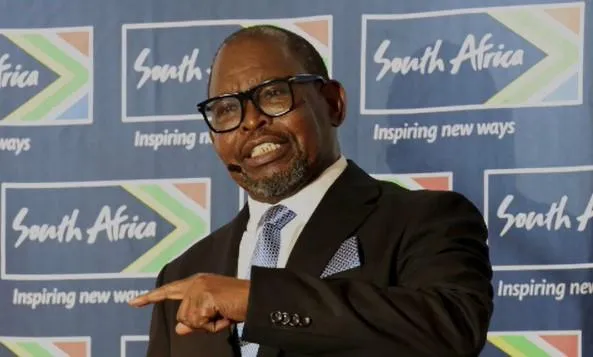
Minister of Finance Enoch Godongwana speaking during the Post-Budget Breakfast following the tabling of Budget 2026 hosted by the National Treasury, in partnership with Brand South Africa, in Cape Town on Thursday.
Image: GCIS
Finance Minister Enoch Godongwana has mounted a robust defence of government’s fiscal strategy, arguing that macroeconomic stability, structural reform, infrastructure investment and improved living standards form the backbone of South Africa’s economic turnaround.
Speaking on Thursday during a media engagement following the tabling of the 2026 National Budget Review, Godongwana said the Budget is not a panacea for solving all social and economic challenges in one stroke.
He said the Budget was not designed to fix every problem at once, but to stabilise the foundation of the economy. At the centre of that strategy is macroeconomic stability, the first of what he called government’s four pillars.
“Our critics normally say, ‘Where’s growth?’ They're talking macroeconomic stability,” Godongwana noted. “Macroeconomic stability is a necessary condition. It may not be a sufficient condition for growth, but it is a necessary condition.”
The National Treasury is projecting that growth will gradually accelerate by 0.2 percentage points each year over the medium term, growing to 1.4% in 2025, 1.6% in 2026, and 1.8% in 2027 until it reaches 2% by 2028.
Godongwana also stressed that stabilising public finances was essential after years of fiscal deterioration when debt levels were rising sharply and confidence was fragile. He said the focus has been on restoring fiscal credibility and preventing further deterioration.
According to the Budget, the government debt-to-GDP ratio is expected to rise further in the current fiscal year, reflecting weak nominal GDP growth as well as higher market issuance to take advantage of strong investor demand.
Evan Wohlmann, vice president - senior credit officer at Moody’s Ratings, said they expect strengthening economic activity, continued spending discipline, and lower debt service costs to support a gradual narrowing of the general government deficit.
“That said, South Africa’s fiscal space to absorb shocks will remain limited. We expect general government debt will remain above 80% of GDP in the coming years and meaningful debt reduction likely hinges on growth exceeding our baseline,” Wohlmann said.
Meanwhile, Godongwana said the second pillar is structural reform, an area where he acknowledged ideological criticism.
Some detractors have labelled government’s reform agenda as “neoliberal”, particularly measures aimed at improving efficiency in network industries and encouraging private sector participation.
But Godongwana rejected the label, saying that countries such as China and Vietnam have implemented market-oriented reforms without being dismissed in the same way. For him, he said, structural reform is about pragmatism rather than ideology: fixing what is broken and enabling growth.
“When you sit in my position, when you look at the numbers you say 'Oh, should I allow myself to sit in an environment where we lose sovereignty by going cap in hand to the IMF?' So we've got to make these structural reforms [work]. Structural reforms are also an instrument of growth,” Godongwana said.
Energy reform featured prominently in this context. Godongwana said the government allocated R254 billion in debt relief to Eskom to stabilise the power utility and address load shedding, adding that these interventions were part of broader reforms unfolding alongside fiscal consolidation.
“We've had an environment where over a decade and a half, trying to fix an institution, Eskom, not fix power to the grid. Those are two distinct things,” he said.
“Structural reforms are trying to fix power to the grid, but also fix Eskom. We put R254bn down on Eskom precisely because we wanted to fix the lights but still deal with structural reforms at the same time.”
The third pillar, and one he described as a personal passion since taking office in August 2021, is infrastructure investment. Godongwana said he had once displayed a drawing in his office symbolising the centrality of infrastructure to economic renewal.
Godongwana expressed satisfaction that infrastructure delivery is now more firmly embedded within government’s planning and budgeting processes.
“In that sense infrastructure is a key stimulus. I'm glad that infrastructure has become embedded in Treasury,” he said.
The fourth pillar focuses on State capacity, particularly within municipalities as they are at the coalface of service delivery. Godongwana turned to the dysfunctionality of local government finances, particularly in water services.
“In essence if you start at just one level at municipality level, we've got huge challenges,” he said.
He cited analysis showing that while billions of rand are allocated for water services, only a fraction is ultimately spent on maintaining and upgrading water infrastructure.
In one example, he noted that although R9 billion was earmarked for water services in the City of Johannesburg, only about R1bn effectively reached maintenance and operational needs.
“Between 2016 and now, personnel expansion has grown by 82%. That’s dysfunctionality,” he said bluntly. “That's our story. We’re trying to sort it in those four pillars.”
BUSINESS REPORT