
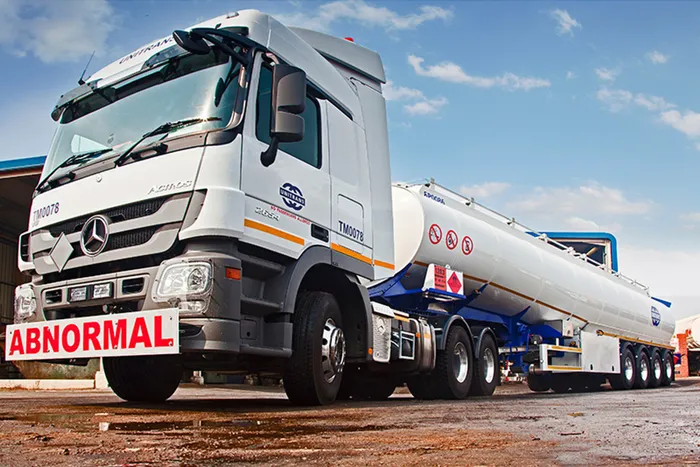
A truck from KAP's transport business Unitrans. The business did well on its turnaround in the six months to December 31, 2025, but its financial results were impacted by the not unexpected loss of a passenger contract, the impact of which could not be ameliorated in time for the interim results.
Image: Supplied
KAP, the diversified industrial group, increased headline earnings per share by a strong 32% to 22,7 cents for the six months to December 31, with good growth momentum for the future, CEO Frans Olivier said Thursday.
Revenue was down 3% to R14,9 billion. Earnings before interest, tax, depreciation, and amortisation was up by 5% to R2 billion. Cash generated from operations increased by 39% to R899 million. Net debt was down 8% to R8,5bn.
“Our results improved largely because of the easing of factors experienced in the prior period, the most significant being increased costs related to the ramp-up of PG Bison’s new MDF line. That said, disciplined execution was instrumental in making this improvement possible, especially as trading conditions are still challenging,” said CEO Frans Olivier.
“PG Bison’s upgrading presses and plants, including the MDF line, are now operating at full capacity,” he said in an interview.
Feltex reported a strong performance. Sleep Group and Unitrans also delivered better results, with the turnaround of underperforming operations the key drivers, he said.
New products and markets had been developed, costs were managed tightly, and good progress was made against strategic objectives.
“Unfortunately, Safripol was a drag on performance, mostly due to the global polymers downcycle; however, their operational efficiencies were good,” he said.
KAP’s prior period results were affected by the increased operating costs related to the ramp-up of major capital projects, of which PG Bison’s MDF line was the largest; and lower new vehicle assembly volumes by mainly two major vehicle manufacturers, due to temporary production constraints, which negatively impacted Feltex.
As management expected, the financial effects of these factors had since eased. PG Bison’s production facilities, including the new MDF line, were fully utilised, resulting in increased sales volumes and profitability, while domestic new vehicle assembly volumes recovered, and hence Feltex’s performance.
New vehicle build forecasts for the second half, however, were slightly lower due to lower volumes by two vehicle manufacturers, as well as the introduction of the new Toyota Hilux model, which typically resulted in lower production volumes for a period, said Olivier.
Net finance costs were lower due to reduced debt and interest rates. The group reported a free cash outflow of R219m, R576m better than the prior period, as major capital projects contributed to cash flow and capital expenditure wound down following the completion of major capital projects.
This supported a R752m reduction in net debt, although net debt is R409m higher than the 2025 financial year due to seasonality in working capital. He said that with the latest investment cycle completed, they would focus on maximising the contribution of the new investments, fixing underperforming businesses such as in Unitrans, and reducing net debt.
PG Bison delivered a 32% increase in operating profit. The division opened new export markets. Sales volumes to primary markets increased by 14% and to deep-sea export markets by 43%.
Unitrans delivered a 3% increase in operating profit. An improvement in its agriculture operations and turnaround of its petrochemical operations was offset by a contract disposal, as well as a material contract loss in its passenger operations.
“While we anticipated these changes in the passenger operations, new growth opportunities did not materialise in time. This is unfortunate, as it masked the improvement in Unitrans’ other operations, which collectively grew operating profit by 19%, which is a good turnaround in performance,” he said.
Safripol’s disappointing result was largely due to the cyclical low in the global polymers sector, which the industry expected would last until the mid-2030s. Operating profit fell by 40%.
“The cyclical low in the global polymers sector was further compounded by a significant increase in PET imports, mainly from China, at heavily discounted prices.”
Feltex saw increased sales volumes due to higher domestic new vehicle assembly volumes and the non-recurrence of costs associated with a major model changeover in the prior period, which lifted operating profit by more than 100%.
Sleep Group delivered improved results, with good progress in extending its range to include entry-level and premium products and turning around its underperforming foam operations. Operating profit improved by 4%.
Optix’s operating loss widened, mainly because of sales conversion being below expectations, while costs to build capacity to grow international sales increased.
KAP’s share price closed at R2.38 yesterday and is up 24% year to date.
BUSINESS REPORT