

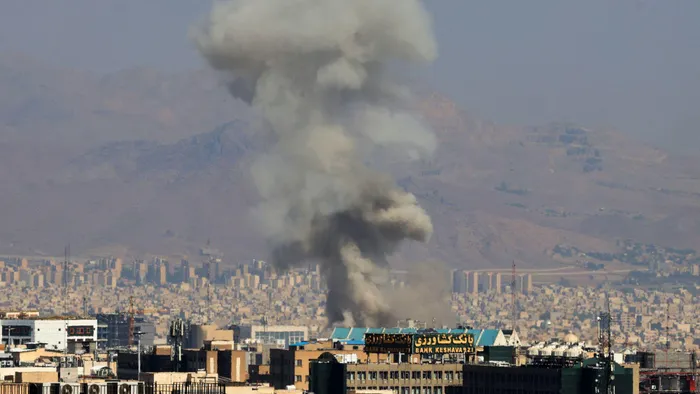
Smoke billows following an explosion in central Tehran. Roughly 20% of globally traded crude oil and a similar share of liquefied natural gas passes through the Strait of Hormuz each day, about 13 million barrels of oil moving through a narrow 33-kilometre-wide channel between Iran and Oman.
Image: Atta Kenare / AFP
Oil markets are bracing for a potentially historic price shock after the United States and Israel launched military strikes against Iran over the weekend, dramatically escalating tensions around the Strait of Hormuz, the world’s most critical energy chokepoint.
Brent crude closed the week near seven-month highs at around $73 per barrel, up roughly 16% since the start of the year.
The surprise attack on Iran came after the US and Iran agreed to continue nuclear negotiations next week. Discussions were set to resume after consultations in each capital, alongside technical-level meetings scheduled next week in Vienna.
The immediate collateral damage of the strikes has been the closure of crucial Middle Eastern airspace, a vital corridor for flights connecting Europe and Asia.
Analysts have warned that if tensions spiral into a broader regional war and shipping through Hormuz is severely disrupted, prices could spike far beyond current levels, potentially reaching $140 per barrel in an extreme scenario.
Roughly 20% of globally traded crude oil and a similar share of liquefied natural gas passes through the Strait of Hormuz each day, about 13 million barrels of oil moving through a narrow 33-kilometre-wide channel between Iran and Oman. Any serious interruption to that flow would reverberate immediately across global markets.
Bianca Botes, a director at Citadel Global, said markets are now pricing in a much wider range of outcomes. Under a limited-strike scenario, where hostilities remain contained and symbolic, oil could rally 8% to 10% before stabilising. That would likely push Brent toward $80 per barrel in the short term.
However, Botes said if military operations expand into sustained strikes on Iranian military infrastructure and Tehran retaliates by targeting Gulf energy assets or interfering with shipping traffic, Brent could rapidly climb through $90 per barrel within days.
"Any serious military escalation that closes or disrupts the Strait, even temporarily, sends oil to levels that would rewrite inflation expectations across every major economy," Botes said.
More severe outcomes are no longer being dismissed.
In a scenario where Iran significantly disrupts traffic through the Strait, reducing shipping volumes by roughly 50% for several weeks through harassment, navigation interference or targeted attacks, analysts estimate oil could trade around $84 per barrel on average, with a persistent geopolitical risk premium embedded into prices through the second quarter.
The most disruptive scenario involves a temporary but effective closure of the Strait. Analysts estimate that such a move could remove up to 11 million barrels per day from global supply, even after accounting for rerouted exports and increased US production.
Under those conditions, Bridget Payne, head of energy forecasting at Oxford Economics Africa, said oil prices could surge to around $140 per barrel, while LNG prices could quadruple above $40/MMBtu as buyers scramble for alternative cargoes.
"With stockpiles able to offset supply loss of this scale for only a number of weeks, we would expect the risk of severe energy inflation and shortages to prompt a rapid global response. We assume this results in an international military intervention which succeeds in re-opening the Strait," Payne said.
Although a sustained blockade would be difficult for Iran to maintain in the face of rapid international military response, even a short-lived closure lasting a week could trigger violent price swings and severe volatility across financial markets.
Payne said the baseline assumption remains that the Strait stays open. However, recent developments, including partial closures during Iranian military drills and growing domestic unrest within Iran, have raised the probability that the regime could take more extreme measures if it perceives its survival to be at stake.
Nigel Green, the founder and chief executive of deVere Group, said energy markets are entering a repricing phase driven by operational risk rather than speculation.
“When close to one fifth of global crude flows transit a single maritime corridor, even a marginal probability of disruption demands a higher structural risk premium,” he said.
Oil does not need to be physically halted for prices to jump. Shipping reroutes, higher insurance costs and precautionary stockpiling can tighten effective supply expectations and lift prices sharply, complicating monetary policy decisions for central banks already navigating fragile growth conditions.
Analysts said the duration of the conflict will determine whether this becomes a short-term spike or a prolonged energy crisis. A tightly contained military campaign could produce a sharp but temporary oil rally followed by stabilisation once shipping routes are secured. However, a multi-week war that credibly threatens Hormuz flows would sustain elevated prices well into the second quarter and beyond.
BUSINESS REPORT