
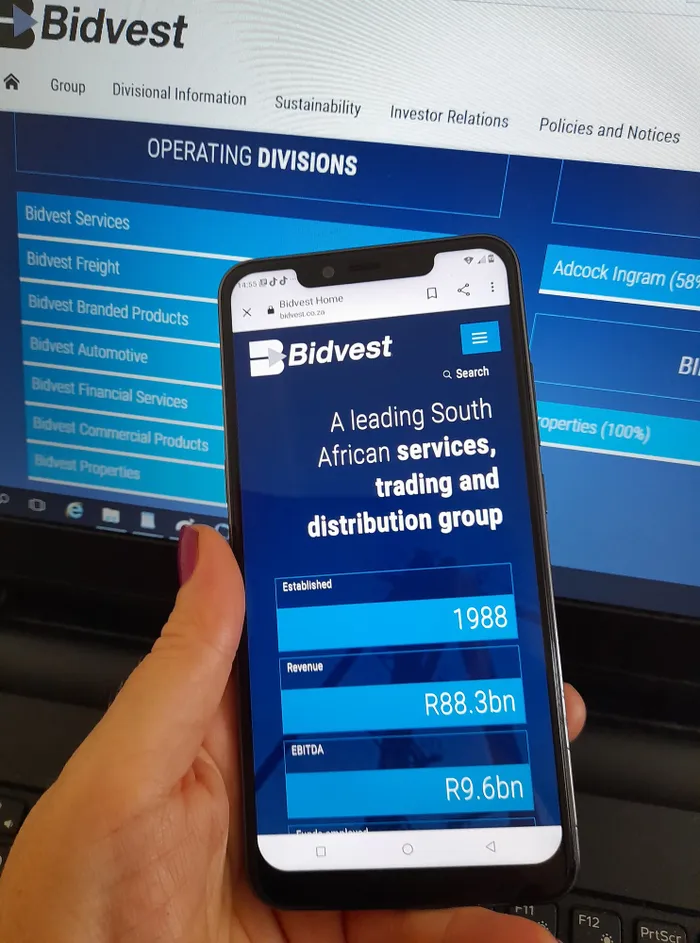
The Bidvest Group plans to pause its merger and acquisition activity following five years of strong growth, to build sustainable returns and finalize its exit from the financial services sector.
Image: Supplied
There has been a “flurry of interest” to buy Bidvest Bank after its acquisition by Access Bank collapsed, Bidvest CE Mpumi Madisa said Monday.
The deal with Access Bank was thwarted last month because the required approvals were not obtained prior to the transaction deadlines; the transaction lapsed at the end of January 2026. Madisa said in an interview Monday the main problem with the Access Bank deal had been having to deal with the regulators in two different banking jurisdictions.
“The sale process has been relaunched, and we remain confident in our ability to successfully execute this disposal and will accelerate transaction timeframes,” she said.
Speaking at the release of group results for the six months to December 31, she said such was the level of interest, she expected they would be able to finalise the sale and obtain the cash for the deal by the end of the calendar year.
The group is also disposing of Bidvest Life to a private equity company, and a transaction is currently subject to customary regulatory approvals and is expected to conclude soon, she said.
Bidvest had announced the planned sale of Bidvest Bank to Access Bank on December 12, 2024. The deal had been valued at around R2,8 billion and was intended to allow Bidvest to streamline its portfolio and reduce debt.
Access Bank is a pan-African commercial banking group headquartered in Lagos, Nigeria, and is one of the continent’s largest financial institutions. Bidvest Bank provides niche banking services rather than competing with the big retail banks in South Africa, including solutions for SMEs and corporates, asset finance and a strong presence in foreign exchange and travel money.
“Our strategy of building the largest international hygiene business is gaining traction, with the hygiene services operations now contributing 55% of Services International trading profit,” said Madisa.
She said they would take a “pause” on merger and acquisition activity after many deals over the past five years, so as to build the sustainability of the returns on the expanded group and to finalise the exit of the financial services businesses.
Meanwhile, the group delivered a resilient half-year result. Trading profit increased 6.9% to R6.7 billion. January was tough due to what seemed a slow start to the year by business, and activity was better in February, she said.
Trading profit for the six-month period was driven by revenue growth, strong gross margin expansion and cost control.
“All divisions contributed positively to profit growth. Cash flow generation was excellent with free cash almost R2bn more than the same period last year, delivering on our commitment to increase free cash generation,” said Madisa.
The interim dividend was raised 5,3% to 495 cents per share.
Continuing operations’ headline earnings per share (HEPS) and normalised HEPS, a measurement used by management to assess the underlying business performance, increased by 5,1% and 5,3%, respectively.
Group revenue grew 3,7% to R66,7bn. Four divisions and Adcock Ingram improved their gross profit margin through operating leverage and/or positive business mix.
Overall expenses, which increased by 3,4%, appeared well controlled across the divisions. On a like-for-like basis, operating expenses were only marginally up. A new $500 million seven-year bond was raised in September.
Madisa said the pressure on returns was expected to ease in the second half due to limited merger and acquisition activity and even stronger free cash generation.
In Services South Africa and Services International, good results in hygiene, hospitality and testing, inspection and compliance services, with strong cost control, more than offset contract margin and rescoping pressures for trading profit growth of 10% and 8,3%, respectively.
Commercial Products and Branded Products saw muted and price-sensitive demand, but a focus on revenue mix, product portfolio management, factory efficiencies and cost control saw trading profit increases of 9,7% and 5,4%, respectively.
Positive operating leverage in the bulk commodity terminal operations supported the 6,9% increase in Freight trading profit. Automotive held its own with a 1,8% increase in trading profit despite record low vehicle gross margins across the industry.
Adcock’s trading profit (+20,1%) recovered off the depressed base given a better sales mix, volume growth and a rebound in factory recoveries.
Visit:www.businessreport.co.za