

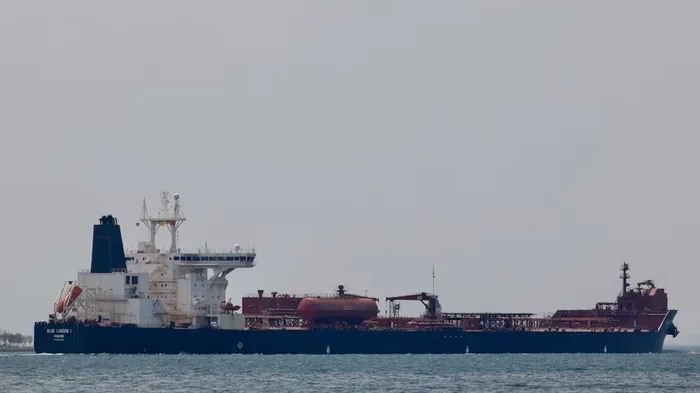
With shipping companies steering tankers away from the Gulf, flows through the Strait of Hormuz, which normally carries about 15% of global oil supply and roughly 20% of global liquefied natural gas (LNG), have effectively stalled.
Image: File
Oil markets are bracing for a potential surge to $100 per barrel as the effective closure of the Strait of Hormuz threatens to disrupt a significant share of global energy supply, deepening the economic fallout from escalating conflict in the Middle East.
This comes as Brent crude jumped nearly 10% to above $80/bbl early on Monday after joint US and Israeli strikes on Iranian government, military and nuclear facilities triggered retaliation from Tehran and prompted insurers to withdraw cover for vessels transiting the narrow waterway.
With shipping companies steering tankers away from the Gulf, flows through the Strait of Hormuz, which normally carries about 15% of global oil supply and roughly 20% of global liquefied natural gas (LNG), have effectively stalled.
According to Wood Mackenzie, a global research and consultancy group for energy resources, oil prices could exceed $100/bbl if tanker traffic is not restored quickly.
The disruption represents a dual supply shock: not only are current exports halted, but additional volumes from OPEC+ and much of the group’s spare capacity are inaccessible while the strait remains closed.
“The key question is when vessels re-establish export flows,” said Alan Gelder, senior vice president of refining, chemicals and oil markets at Wood Mackenzie.
While tanker rates and insurance premiums are expected to surge, Gelder noted that these costs are marginal compared with the price impact of sustained supply curtailments.
“During that time, oil prices are heavily risked to the upside. The most recent comparison is during the early days of the Russia/Ukraine conflict, when the fear of loss of Russian supplies drove the oil price to over $125/bbl,” Gelder said.
According to Gelder, oil prices over $100/bbl are possible if transit flows are not re-established quickly in the current scenario.
Neil Wilson, Saxo UK investor strategist, concurred that the longer this goes on with the Iranian regime remaining in place the higher the markets go up the risk ramp, and things could get a lot worse from here.
“But if we get scenarios [where a protracted war that draws in regional players], with the potential for strikes against oil facilities as part of this, whether in Iran or elsewhere, we are looking at $100 oil and that really would hit the growth outlook,” Wilson said.
Saudi Aramco says one of its facilities, the largest refinery in the world, was hit. The facility, Ras Tanura, processes 550,000 barrels per day.
Efforts by OPEC+ to stabilise markets may prove insufficient. Eight members, Saudi Arabia, Russia, Iraq, United Arab Emirates, Kuwait, Kazakhstan, Algeria and Oman, agreed to increase production by 206,000 barrels per day in April, resuming the unwinding of earlier voluntary cuts.
But analysts caution that extra supply on paper cannot compensate for physical constraints if oil cannot move safely through shipping lanes. Alternative export routes exist, including Saudi Arabia’s East-West pipeline to the Red Sea and limited Iraqi volumes via the Mediterranean.
However, none can fully offset the loss of flows through Hormuz. Strategic stock releases from International Energy Agency member countries could provide temporary relief, though these nations account for less than half of global oil demand.
Energy markets have already reflected mounting anxiety. Gold surged above $5,400 per ounce as investors sought safe-haven assets, while equity markets sold off sharply.
Oil majors gained, but airlines, banks and travel stocks were hit hard as rising fuel costs and widespread flight cancellations rippled through the aviation sector.
The rand weakened to R16.17 to the US dollar on Monday as the greenback strengthened on the rise in global financial market risk aversion.
"The risk is for further rand weakness as the US dollar is proving to be a safe haven now, running stronger with the severe escalation in geopolitical tensions in the Middle East, while the oil price is at risk of further elevation to $100/bbl plus," said Annabel Bishop, chief economist at Investec.
For import-dependent economies such as South Africa, the consequences could be acute. South Africa remains exposed to energy markets and capital flow spillovers rather than to the conflict itself.
Momentum Investments chief economist, Sanisha Packirisamy, said a more adverse scenario could involve interference with commercial shipping in the Strait of Hormuz, including the deployment of sea mines, fast-boat interceptions of tankers, drone attacks or the temporary seizure of vessels.
“In this scenario the Strait of Hormuz would face sustained disruption, resulting in a bigger reaction in oil prices, with levels around $100 a barrel not implausible. This could conceivably go higher if oil supply was materially curtailed for more than a few weeks,” she said.
BUSINESS REPORT