

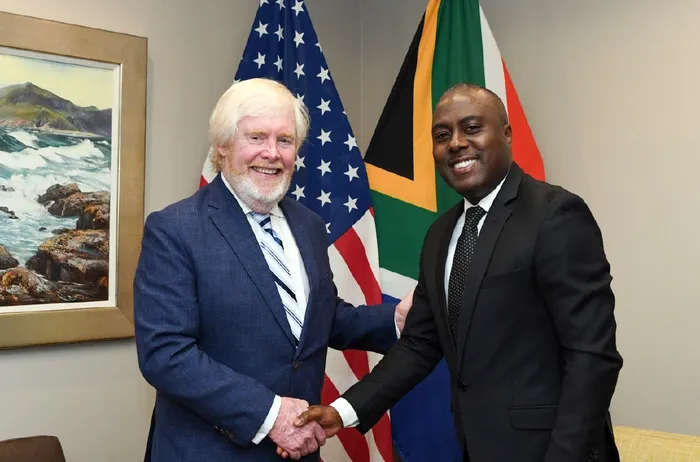
Deputy Director-General (DDG), Clayson Monyela, Acting Chief of State Protocol, receiving copies of Letters of Credence from His Excellency L Brent Bozell III, United States Ambassador to South Africa. South Africa’s engagement with the US remains a critical pillar of its broader trade strategy.
Image: DIRCO
South Africa has vowed to continue to push for stable and predictable trade relations with the United States despite mounting pressure from renewed tariff measures and shifting global trade dynamics.
Appearing before Parliament's portfolio commitee on Tuesday, the Department of Trade, Industry and Competition (the dtic) acknowledged that efforts to strengthen trade ties with the US have been complicated by “tariff wars” and policy uncertainty emanating from Washington.
The dtic director-general, Simphiwe Hamilton, said the department's target of improving trade relations with the US has been challenged by developments beyond South Africa’s control, including the reintroduction of certain trade measures by the current US administration.
While a US Supreme Court ruling struck down US President Donald Trump's sweeping “Liberation Day” tariffs, Hamilton noted that new instruments have since been introduced in a different form.
“No matter how much we try and which we did and more, that target would be challenged and is unlikely to be met with the current administration in the US,” Hamilton told MPs.
“But we will continue to work towards it. And where the committee desires proofs of evidence of those efforts, they will be truly provided because not only do they exist, but they occupy us day and night in trying to achieve what we have sought to achieve in this regard.”
South Africa’s engagement with the US remains a critical pillar of its broader trade strategy. The US is one of the country’s largest export destinations, particularly for manufactured goods and value-added products in the automotive, agriculture and mining sectors. Preferential access under frameworks such as the African Growth and Opportunity Act (Agoa) has historically supported thousands of local jobs.
However, rising protectionist sentiment and unilateral tariff actions have complicated the environment. Hamilton indicated that diplomatic and technical engagements are ongoing, with the department prepared to provide detailed evidence of its efforts to Parliament.
The negotiations come at a time of broader global trade fragmentation. South Africa recently used its leadership role within the G20 to rally support for multilateral trade rules under the World Trade Organization (WTO).
While global trade conducted under WTO rules has declined in relative terms over recent years, Hamilton argued that the system has shown resilience despite direct challenges from major economies.
Trade with the US is further complicated by shifting geopolitical currents, including tensions in the Middle East and renewed global supply chain volatility. The department stressed that its strategy involves diversifying markets while simultaneously defending existing trade relationships.
“My personal view is that while we admit that trade under the WTO may have been reduced from being about 83% of global trade to being about 75% or so of global trade, it is quite telling that the biggest economy in the world has actually failed to destroy global trade under the multilateral rules,” he said.
“If it was 40% less, we would be trembling and saying that the assault has been severe. I think the resilience of the WTO, the commitment of countries like South Africa to it and its rules, and the role that we play using our chairpersonship of the G20 should never be underestimated.”
Hamilton added that South Africa would continue advocating for rules-based trade, whether through the WTO, regional blocs or bilateral discussions.
Beyond tariffs, negotiations with the US also intersect with industrial policy priorities. South Africa is seeking to deepen its role in global value chains, including electric vehicle battery manufacturing and green industrialisation. These ambitions require stable export markets and predictable trade conditions.
In the automotive sector, for example, South Africa hopes to replicate its past success in catalytic converter production — built on its platinum reserves — by integrating into global electric vehicle supply chains. Hamilton said this strategy depends partly on maintaining strong trade ties with major economies such as the US and the European Union.
BUSINESS REPORT