

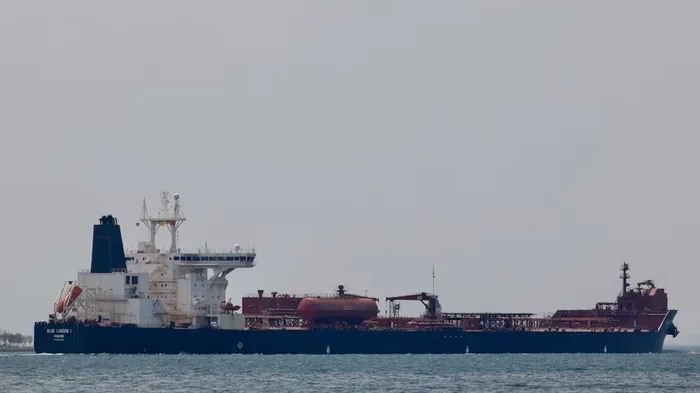
Shipping through the Strait has slowed dramatically amid security risks and soaring insurance costs, with around 17 million barrels per day typically transiting the narrow waterway.
Image: File
Oil markets have been rattled by the escalating war in the Middle East, but economists say prices are unlikely to rise above $100 a barrel for a sustained period, even as supply disruptions push crude sharply higher in the short term.
Global benchmark Brent crude settled just above $82 per barrel on Wednesday after briefly climbing past $85 per barrel on Tuesday, its highest level since July 2024.
The surge was driven by fears of supply disruptions as the conflict entered its fifth day, with attacks on energy infrastructure and shipping routes fuelling concerns over exports from the Gulf.
The crisis has already forced major producers to halt output and severely limited traffic through the Strait of Hormuz, a critical chokepoint for global oil flows.
Iraq reportedly cut output by around 1.5 million barrels per day due to storage constraints and blocked exports, while Saudi Arabia confirmed attempted attacks on its Ras Tanura refinery, and moved to divert some supplies to the Red Sea to maintain operations.
Shipping through the Strait has slowed dramatically amid security risks and soaring insurance costs, with around 17 million barrels per day typically transiting the narrow waterway. Qatar’s LNG exports have also been disrupted, raising concerns in global gas markets.
Yet despite the flare-up, economists on Wednesday argued that the market reaction reflects disruption rather than outright shortage.
Bridget Payne, head of energy forecasting at Oxford Economics Africa, said current pricing suggests investors expect the shock to be temporary. She said the broader global economic impact is limited as the Gulf Cooperation Council region accounts for less than 2% of world GDP.
“Our base case is now for a notable but manageable supply disruption. We are downgrading global oil supply by 4 million barrels per day over the next quarter to account for disrupted flows through the Strait of Hormuz,” Payne said.
She also argued that geopolitical incentives favour de-escalation. A prolonged closure of Hormuz would inflict severe economic costs not only on Iran but also on Gulf neighbours, China and the United States. As the economic fallout intensifies, Payne said pressure is expected to mount on all sides to restore flows.
“Iran can create a sharp shock by disrupting the Strait, but sustaining a severe disruption for a prolonged period would be much harder,” Payne said.
“A complete and lasting stoppage would require Iran to maintain effective control over a heavily trafficked waterway under intense international pressure, while also absorbing the economic damage from choking off its own exports and those of its neighbours.”
Alternative pipeline routes offer partial relief. Saudi Arabia’s East-West pipeline and the UAE’s Abu Dhabi Crude Oil Pipeline can reroute roughly 6 million barrels per day combined, offsetting part of the disruption. While insufficient to fully replace Hormuz, these routes help prevent an outright supply crunch.
Crucially, the oil market entered the crisis with buffers in place. Years of strong supply growth and relatively weak demand have left global inventories healthier than in previous geopolitical shocks. OECD members are required to hold 90 days of oil stocks, while China, the largest importer of Gulf crude, has accumulated record-high reserves.
Spare production capacity is also significant. Saudi Arabia and the UAE together have around 3.5 million barrels per day of spare capacity, and OPEC+ recently agreed to increase output quotas, signalling readiness to stabilise markets if needed.
Investec chief economist Annabel Bishop said uncertainty remains elevated but does not expect oil above $100 per barrel to persist.
“With currently still a low risk of the Brent crude oil price exceeding $100/bbl for a substantial period of time, a temporary breach remains possible and would be in a marked risk-off environment,” Bishop said.
She noted that major exporters are already increasing supply to calm markets.
“A large jump in oil supply, particularly exports, in what was already expected to be an already over supplied market this year, substantially reduces the chance of the oil price breaching $100/bbl for a sustained period,” Bishop said.
“An oil price of over $100/bbl is not expected to be sustained, and instead have only a temporary price shock, which SA’s Monetary Policy Committee would be expected to look through and not react with higher interest rates.”
BUSINESS REPORT