

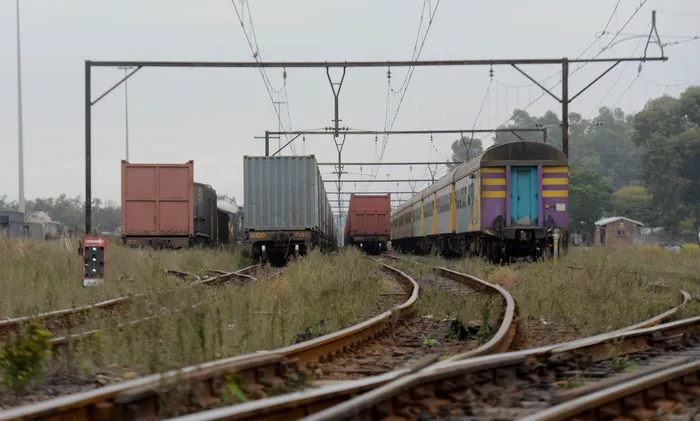
An audit report tabled before the Standing Committee on Public Accounts (Scopa) in Parliament on Wednesday revealed that hundreds of locomotives purchased under a controversial procurement programme are either idle, partially functional or being stripped for parts, raising serious questions about the sustainability of the rail operator’s recovery strategy.
Image: Armand Hough/Independent Newspapers
State-owned freight and logistics company, Transnet, is facing a growing operational crisis as a mounting maintenance backlog of rolling stock, idle locomotives and unresolved supplier disputes continue to undermine rail performance and revenue generation.
An audit report tabled before the Standing Committee on Public Accounts (Scopa) in Parliament on Wednesday revealed that hundreds of locomotives purchased under a controversial procurement programme are either idle, partially functional or being stripped for parts, raising serious questions about the sustainability of the rail operator’s recovery strategy.
Transnet originally contracted for 1,064 locomotives from four different suppliers as part of a major fleet modernisation programme intended to improve freight rail capacity and support economic growth.
However, only 674 locomotives have been delivered to date, leaving 390 still outstanding.
The procurement process later became embroiled in legal and contractual disputes. One of the contracts was eventually set aside by the courts due to irregularities and concerns about the specifications of the locomotives supplied.
Lindiwe Ndala, senior manager at the office of the Auditor-General, said that despite the contract being nullified, some locomotives continued to be delivered afterward as part of renegotiated settlement agreements with suppliers.
Ndala said that in several cases, companies that had already been paid but had not fulfilled their delivery obligations agreed to supply the remaining locomotives over time as part of court-mediated settlements.
"Another thing that has developed then is that Transnet then went out and sourced a new company where, in essence, what they did is they tried to find parts within those suppliers to then be able to finalize and restore the locomotives," Ndala said.
"So in essence, what they tried to do was to say, I'm trying to look for a Range Rover. I'm looking for an engine that will be able to take that vehicle and set it in its place in order for those locomotives to then operate and hence the number has increased in the current year."
But even the locomotives already delivered are not all operational.
Bongumusa Thabethe, deputy business unit leader at the Office of the Auditor-General, said more than 200 locomotives are currently not functioning, largely due to component failures, missing spare parts or technical defects.
In addition, Thabethe said they identified approximately 271 locomotives sitting idle at various depots across the rail network. In many cases, he said Transnet has been forced to “cannibalise” locomotives, removing parts from one train to repair another in order to keep a portion of the fleet running.
This practice has effectively turned parts of the fleet into a rotating pool of spare components, allowing a limited number of locomotives to remain operational while others remain grounded.
"What we can give you the insight on is that some of these locomotives had parts that were failing, which is one reason you will see that they had to go and try and get some of these parts to come through so that they can be able to work on them," Thabethe said.
"There are probably more than 200 locomotives that are sitting and not working yet, mainly because of either when they came in, they broke during the process or they don't have spare parts to be able to repair them or they have harvested some of them to be able to use the others."
The situation has been compounded by the breakdown of maintenance agreements with original equipment manufacturers (OEMs). Under the original contracts, suppliers were expected not only to deliver the locomotives but also to provide maintenance services and spare parts through dedicated service facilities.
However, when the contracts were set aside, some suppliers withdrew these support services. This left Transnet responsible for maintaining locomotives for which it does not always have access to proprietary parts or technical support.
In some cases, suppliers have refused to provide spare parts altogether, forcing Transnet to search for alternative components or salvage parts from other locomotives.
"That is why you will see now, because they were locked out due to the contract with the Chinese companies, they could not be able to deliver the spare parts now to be able to use these locomotives. They end up saying, what can we do? Can we not find the Mercedes to be able to fix BMW as an alternative?" Thabethe said.
The consequences of the lack of spare parts extend beyond operational inefficiencies. Transnet financed the locomotive acquisitions through borrowing, meaning the company continues to service debt for assets that are not generating revenue.
This problem feeds directly into the company’s broader financial pressures. Transnet already faces high debt servicing costs and declining freight volumes, both of which have contributed to financial losses in recent years.
The maintenance backlog itself has also grown significantly. Over the past decade, maintenance expenditure has consistently fallen short of requirements, leaving an accumulated backlog estimated at more than R30 billion.
Although the company increased maintenance spending by roughly 47% in the past year, auditors indicated that the increase remains insufficient to address the scale of the problem.
The committee warned that unless the backlog is addressed and locomotives are returned to service, Transnet will struggle to meet freight volume targets and restore rail capacity.
Scopa chairperson Songezo Zibi suggested that government may eventually have to consider a direct capital injection to stabilise the company rather than relying solely on debt guarantees that allow Transnet to continue borrowing.
BUSINESS REPORT