

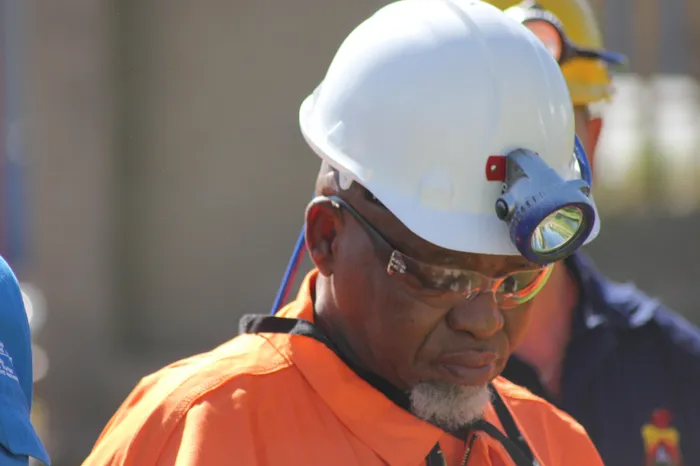
Mining analyst Peter Major argues that President Cyril Ramaphosa and Mineral and Petroleum Resources Minister Gwede Mantashe oversaw the loss of up to 500,000 mining jobs.
Image: Sandi Kwon Hoo / DFA
Allegations by mining analyst Peter Major that President Cyril Ramaphosa and Mineral and Petroleum Resources Minister Gwede Mantashe oversaw the loss of up to 500,000 mining jobs have sparked renewed debate, with research and industry body arguing that the reality is far more complex.
Major, director at Modern Corporate Solutions, has repeatedly claimed that policy uncertainty, nationalisation rhetoric and deteriorating infrastructure under the ANC government have severely damaged mining investment and employment.
He previously suggested that as many as 450,000 gold mining jobs and another 100,000 jobs in other commodities were lost unnecessarily due to rigid legislation and poor governance.
Mantashe was appointed as minerals minister in February 2018 when Ramaphosa assumed The Presidency.
In an interview this week, Major doubled down, questioning the reliability of official employment statistics and arguing that flawed data has obscured the true scale of the sector’s decline.
“In the past, we used to work very closely with government and cross-check figures,” Major said. “Now you are often simply forwarding numbers from government, and that creates a problem if the underlying statistics are not accurate.”
However, research released last month by the Bureau for Economic Research (BER), in collaboration with Economic Research Southern Africa (ERSA), presents a different assessment.
According to the BER, mining employment has declined from a peak of more than 760,000 jobs in 1987 to around 465,000 today, a reduction of approximately 300,000 jobs, not 500,000.
The researchers emphasised that while the decline is significant, attributing it simplistically to recent political leadership overlooks deeper structural shifts in the sector.
“Our research identifies multiple binding constraints to sector growth. Without addressing these binding constraints, the sun will surely set on South African mining,” the BER said.
These include infrastructure bottlenecks, regulatory inefficiencies, energy instability and logistics challenges. But the report stresses that the solutions are well understood and within South Africa’s capacity to implement.
The BER also stresses that the structure of mining has changed considerably since the late 1980s. Globally, the industry has become less labour intensive as mechanisation and automation have advanced.
Although South Africa remains relatively labour intensive compared to many other mining jurisdictions, productivity gains mean fewer workers are required per unit of output.
The researchers note that future growth, particularly if automation accelerates, may generate fewer jobs than in previous decades.
Major, however, maintains that long-term policy instability has been a decisive factor discouraging investment. He traces uncertainty back to the late 1980s, when labour unrest intensified and gold prices were under sustained pressure.
The August 1987 strike, which began in coal and spread to gold, marked a critical turning point, he said, with retrenchments following in subsequent years.
He argues that uncertainty deepened in the early 2000s during debates over the Mineral and Petroleum Resources Development Act (MPRDA) and public discussions about possible nationalisation of mines.
Although proposals for 51% State ownership were ultimately reduced to 26%, Major contends that investor confidence was already shaken.
“Mining is not like flipping a switch,” he said. “You are talking about 50- to 100-year projects. It takes five to 10 years just to sink a shaft. If the policy environment is unclear, companies will simply not commit that capital.”
Without sustained exploration and development of new mines, Major said South Africa has effectively lost a generation of mining assets.
While acknowledging that commodity cycles and geological depletion have also played a role, Major argued that legislative uncertainty and inconsistent political messaging compounded the risks.
He did not necessarily placed sole blame on current leaders but insisted that accountability is collective and long-term.
“It’s not as simplistic as a headline,” he said. “Policy decisions over 30 years have consequences. If you keep out investment, you lose jobs.”
Meanwhile, the Minerals Council South Africa, which represents the bulk of the country’s mining companies, also disputes the broader narrative of sector-wide collapse.
Spokesperson Allan Seccombe pointed out that the overall employment decline since 1994 is largely attributable to the shrinking gold industry rather than across-the-board contraction.
Gold mining, once the backbone of South Africa’s economy, has faced geological depletion, rising costs and declining grades for decades.
The gold industry has shed the a significant number of jobs in the past 31 years. The industry is more than 100 years old, mines have been depleted and shut.
"There has not been any major development of new mines to replace those that have closed. Gold mines are generally deep and expensive to operate. The grade being mined is lower, mines are older and working faces are far from the shafts," Seccombe said.
In contrast, Seccombe said employment in most other major mineral sectors, including platinum group metals, coal, iron ore and manganese, has increased since 1994.
"So, the overall jobs picture for the mining sector is about the reduced contribution of the gold industry while the other mineral industries are expanding and have grown employment."
Though the Department of Mineral and Petroleum Resources had not replied to requests for comment, what emerges is not a simple story of policy failure, but a complex intersection of ageing gold reserves, evolving technology, infrastructure constraints and regulatory friction.
BUSINESS REPORT