

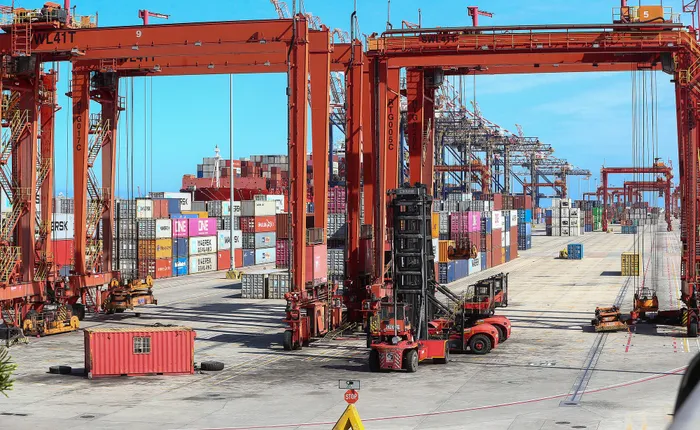
In audit outcomes tabled before Parliament on Wednesday, the Office of the Auditor-General painted a sobering picture of an institution battling to stabilise its finances while trying to restore core rail and port operations.
Image: Leon Lestrade/Independent Newspapers
State-owned freight and logistics company, Transnet, is facing mounting financial and operational pressures, with rising debt, missed volume targets and a growing maintenance backlog casting doubt over the sustainability of its turnaround efforts.
In audit outcomes tabled before Parliament on Wednesday, the Office of the Auditor-General painted a sobering picture of an institution battling to stabilise its finances while trying to restore core rail and port operations.
At the centre of concern is Transnet’s debt burden.
Auditor-General deputy business unit leader, Bongumusa Thabethe, said Transnet now carries debt of roughly R144 billion, up from R137.6bn previously, with interest payments alone amounting to about R15bn per year compared to R14bn the prior year.
Thabethe said that translates to roughly R1.2bn per month in servicing costs, before funding day-to-day operations or infrastructure maintenance. With annual revenue sitting at around R86bn, a significant portion of Transnet's income is absorbed by debt servicing.
Though the government has stepped in with guarantees currently totalling nearly R193bn and allowing the entity to access funding from lenders, Thabethe said Transnet is increasingly borrowing to service existing debt, a pattern that raises red flags about long-term sustainability.
"What it means is that in the future, the debt levels are still likely to increase even more than this because at the moment they have got guarantees that are approximately R192.8bn, which simply means that is the room that has been opened for them to be able to go and borrow more," he said.
Compounding the issue is Transnet’s weak liquidity position. Short-term liabilities exceed short-term assets by approximately R65bn, placing the company in a net current liability position.
"It simply means there are daily pressures that they need to manage that they cannot be able to honor them, mainly because they are sitting in a net current liability situation," Thabethe said.
Although the company reduced its annual loss from R7.3bn in the previous financial year to R1.9bn in 2024/25, the Office of the Auditor-General cautioned that this improvement was partly due to once-off accounting adjustments.
The Standing Committee on Public Accounts (Scopa) also scrutinised Transnet’s cash interest cover ratio, a key metric used by lenders to assess risk.
The company achieved a ratio of 1.8 times, meaning it generated cash equivalent to 1.8 times its interest obligations. However, some loan agreements require cover of between two and 2.5 times. Falling below those thresholds risks breaching debt covenants, which could allow lenders to demand immediate repayment.
Operationally, the picture is equally concerning due to persistent network and capacity constraints. The company’s recovery plan initially targeted moving 193 million tons of freight by the end of the programme. That target was revised down to 170 million tons, but actual volumes reached only 160 million tons.
The inability to meet rail targets reflects deeper infrastructure and equipment challenges. A major obstacle is the deteriorating state of Transnet’s assets.
Thabethe described vandalised locomotives, shortages of spare parts and the practice of “harvesting” components from some locomotives to repair others, effectively reducing the available fleet. Deliveries of new locomotives have also been delayed, further constraining capacity.
Infrastructure maintenance is another major weakness as significant underinvestment over the past decade has weakened network reliability.
Thabethe said over the past decade, Transnet has failed to meet maintenance requirements, resulting in a cumulative underspending of R32.3bn. Transnet was supposed to spend R10bn last year but managed only R6.6bn, a R3.4bn shortfall.
"What it means, therefore, is that the business were not able to get the required funds to be able to save this infrastructure that they wanted to use," Thabethe said. "They have high number of infrastructure or assets that needed to be repaired that have not been repaired."
Transnet has now increased its maintenance spending by 47% compared to the previous year.
Scopa chairperson Songezo Zibi said Parliament's concerns related to capital availability, specifically whether Transnet has sufficient capital for ongoing maintenance of existing infrastructure and expansion of rail infrastructure where feasible.
He said the apparent logic is that if locomotive shortages are resolved, volumes increase, generating higher revenue and operating profit, and those profits could then be reinvested into maintenance to address infrastructure backlogs.
"The third thing for me is how the entity plans to deal with the debt, given that you're always going to start on the back foot. You brought your locomotives, you never got them, you've been servicing this debt all along with no revenue," he said.
"There's a mismatch between the revenue expected and the borrowings made. So we just need to understand how they're going to manage the debt vis-a-vis the fact that all they have from Treasury are guarantees rather than actual cash, which puts you in that cash-to-loss situation."
BUSINESS REPORT