

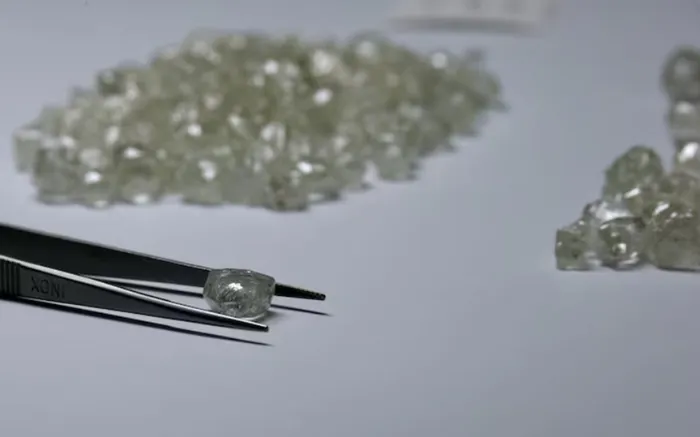
S&P said Botswana's heavy reliance on the sector means any sustained downturn in diamond markets has an outsized impact on the broader economy.
Image: . REUTERS/Siphiwe Sibeko/File Photo.
S&P Global Ratings has downgraded Botswana’s sovereign credit rating, warning that prolonged weakness in the global diamond market is placing mounting pressure on the country’s fiscal outlook, economic growth and external balances.
The ratings agency on Friday lowered Botswana’s long-term foreign and local currency sovereign credit ratings to ‘BBB-’ from ‘BBB’, while the short-term rating was reduced to ‘A-3’ from ‘A-2’. The outlook on the rating remains negative, signalling the risk of further downgrades if fiscal and external conditions deteriorate further.
The decision reflects concerns that structural changes in global diamond demand will continue to weigh on Botswana’s mineral-dependent economy for longer than previously anticipated.
Botswana is the world’s second-largest producer of natural rough diamonds, with the sector historically accounting for around 70% of exports, about one-third of government revenue and roughly a quarter of GDP. The heavy reliance on the sector means any sustained downturn in diamond markets has an outsized impact on the broader economy.
According to S&P, global diamond demand has weakened sharply since late 2023. Prices have fallen significantly from their 2022 peaks amid a combination of changing consumer preferences, rising competition from lab-grown diamonds and weaker luxury spending in key markets such as China.
Lab-grown diamonds have rapidly gained market share in recent years, capturing about 20% of the global market by value and as much as 50% of the engagement ring market in the United States in 2025. At the same time, demand for natural stones has been affected by broader economic uncertainty and shifting consumer spending patterns.
These structural changes have already had a visible impact on Botswana’s economy.
S&P estimates the country’s economy contracted for a second consecutive year in 2025 following a downturn in diamond production and export revenues. A sharp 56% year-on-year decline in diamond production during the final quarter of 2025 offset earlier growth in the year and pushed the economy into contraction.
Looking ahead, the agency expects only a modest recovery. Economic growth is forecast to reach 2.5% in 2026, with average growth of around 3.2% between 2027 and 2029.
S&P said production cuts by the country’s largest mining operator, Debswana Diamond Company, have compounded the downturn. Output from the joint venture between the Botswana government and De Beers fell significantly in recent years, dropping from about 25 million carats in 2023 to roughly 15 million carats expected in 2026.
The weaker diamond market has also taken a toll on public finances.
S&P projects Botswana will continue running large fiscal deficits over the coming years. The general government deficit is expected to reach 8.9% of GDP in the 2026/27 fiscal year, only slightly lower than the estimated 9.3% deficit recorded the previous year.
With mineral revenues under pressure and spending commitments rising, the government is increasingly relying on borrowing to finance its budget shortfall. As a result, net general government debt is projected to climb to 37.4% of GDP by 2029, compared with a net asset position only a few years ago.
Borrowing costs have also risen sharply. Yields on short-term Treasury bills increased from about 3.4% at the start of 2025 to more than 10% by early 2026, reflecting greater reliance on domestic debt markets.
Botswana’s external position has also weakened. Foreign exchange reserves have fallen to about $3.8 billion at the end of 2025, down from roughly $7.5bn in 2017, though the country still maintains a net external asset position.
The country’s central bank, the Bank of Botswana, has introduced several policy measures to stabilise the currency and protect reserves. These include adjusting the crawling peg exchange rate system and widening trading margins for the pula.
Despite the downgrade, S&P said Botswana continues to benefit from strong institutions and a long record of prudent economic management.
The country’s democratic governance and stable policy framework remain important strengths. The peaceful transfer of power following the October 2024 elections, which saw the Umbrella for Democratic Change assume office, highlighted the resilience of Botswana’s political institutions.
The new government has outlined plans to diversify the economy through initiatives such as the Botswana Economic Transformation Programme and the National Development Plan 12, which aims to expand sectors including tourism, agribusiness, renewable energy and technology.
However, S&P said these reforms will take time to deliver results. For now, S&P warned that Botswana’s narrow economic base and heavy reliance on diamonds continue to leave it vulnerable to global commodity cycles.
BUSINESS REPORT