

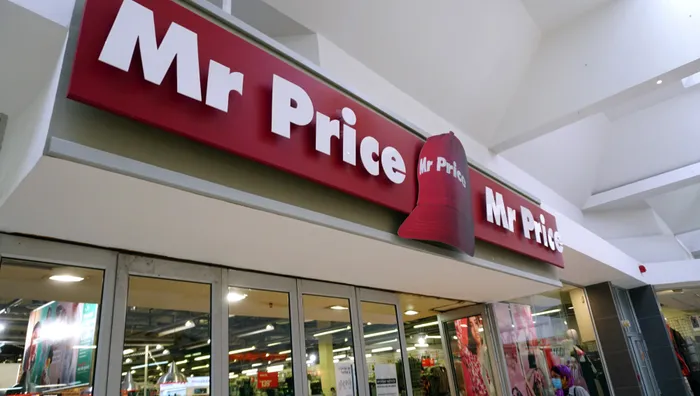
Mr Price's board have moved to allay investor concerns that the retailers' management focus might be diverted from theirSouth African core operations, with the acquisition of NKD in Europe..
Image: Ian Landsberg/Independent Newspapers.
Mr Price Group on Tuesday moved to defend its R9.24 billion acquisition of Europe-based value retailer NKD, saying the acquisition will be earnings accretive in year two, there is no need to raise additional capital, and there are great opportunities for expansion.
In December, when Mr Price first announced the deal, many investors expressed skepticism mainly due to what they perceived to be a high purchase price, NKD’s weak financials, and the risks of a South African group expanding into unfamiliar European markets. They were also concerned the deal might be a diversion from Mr Price’s core South African value retail model. The backlash triggered a sharp sell-off in Mr Price’s shares at the time.
Mr Price’s share price recovered somewhat yesterday; it was 2,35% higher at R172.62 by midday on the JSE, but the price is still well down from R214.63 which it traded at on December 3, 2025, about a week before the acquisition announcement saw the sharp price decline.
Mr Price chairman Nigel Payne said this was the biggest acquisition by Mr Price in 40 years, and Tuesday was the first opportunity management had to address investor concerns, as much of the relevant information could not be disclosed until regulatory approvals for the acquisition were concluded.
Payne said that after years of organic growth and acquisitions in South Africa, Mr Price’s board decided three years ago to begin studying international expansion opportunities. A great number of acquisitions overseas by other companies, both successful and less successful, were studied.
Some of the successful overseas expansions they studied were by Vukile, Bidcorp and Naspers. It was decided that the number one choice market for the group to enter would be Central and Eastern Europe.
Mr Price CEO Mark Blair said in his view, the investor concerns were overplayed, but to be fair, there had not been a great deal of information available at the time to make a proper judgement on the deal. The group had decided to do a great deal more disclosure about the acquisition than normal to address investor concerns, he said.
He said the deal also did not signify that Mr Price was no longer interested in the South African market, and long-term opportunities were still being considered for the local market, as were investments to maintain position in the market and produce a consistent performance.
He said benefits of the NKD acquisition included that it was an apparel and homeware value retailer just as Mr Price is, while the value retail market that NKD operated in is worth about $1.8 trillion a year, which is 17 times the potential value of the local market of R109bn.
Other benefits were that Mr Price’s dividend policy would remain unchanged after the acquisition, and the deal would also still leave Mr Price with considerable headroom on its earnings to debt ratios, debt covenants and high cash generating ability.
Another benefit was that Mr Price would not need to operate NKD from South Africa; it would remain under existing management. Mr Price would also not need to go and undertake a restructuring at NKD; its existing business model was performing well. “If we had to do that in a foreign market, we would have stepped away from the deal very early,” said Blair.
Other benefits included that the number of NKD stores was roughly the same as Mr Price’s and NKD has a strong 60-year brand in Europe. Most importantly, there was significant opportunity to expand the store network in existing markets in Germany, Italy, and Poland, with potentially a net 600 new stores by 2030, said Blair.
Joint buying concessions and opportunities may arise from suppliers, while NKD also brought with it well-established buyer relationships, and NKD also has a significantly advanced data-driven culture which Mr Price could benefit from.
Blair said they were targeting 3% average annual like-for-like sales growth in NKD to 2030, and 3% to 4% annual space growth envisaged. The earnings before interest and tax for NKD was forecasted at a compound annual growth rate of 15% to 20% by 2030.
BUSINESS REPORT