

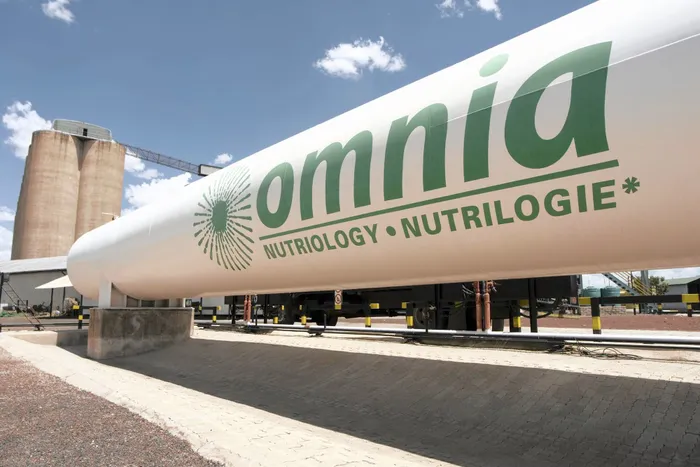
Omnia has warned that fertiliser costs will rise due to the crisis in the Middle East, which has impacted oil, gas and chemicals production and transport from the region.
Image: Supplied
Two key industries in South Africa, agriculture and mining, face significant cost increases in the months ahead, apart from fuel, due to sharply rising world prices of the chemicals used to manufacture explosives and fertiliser.
This was according to Omnia Holding CEO Seelan Gobalsamy, who said Wednesday that the crisis in the Strait of Hormuz and the Middle East had already in some countries resulted in the price of fertiliser increasing by up to 70%.
He said in an interview that while these price increases may take some months to materialise in this country as existing stock is used up, the group, as a leading manufacturer of fertiliser and explosives in the SADC, and an exporter to 23 countries, had already taken steps to further diversify its sources of ammonia, which is a key gas required to make these products.
“The Middle East conflict has had two major impacts. It has constrained the global supply chains of oil for fuel, and gas for fertiliser products. The other impact is that some of the production facilities for these commodities have been bombed and may take some time to restart production once tension eases in the region,” he said.
Gobalsamy said their main priority at JSE-listed Omnia through the period of the Middle East conflict was to ensure customers were supplied, and the group had worked to ensure the Western Cape had the fertiliser to begin its current grain planting season, while the grain planting season for the rest of the country fell later this year.
“While we might be able to save on fuel costs by driving less, unfortunately we can’t tamper with food security. What recent global crises such as Covid, the Ukraine war, and the Middle East crisis have showed us is that supply chains are very fickle, and it is why we have invested in storage capacity, transport capability such as rail and port terminals, and solar power,” said Gobalsamy.
The directors of AECI, another JSE-listed chemical group supplying the mining and agriculture sectors, when questioned about the impact of the Middle East crisis said: “To ensure continuity, we are actively strengthening our strategic stock levels, diversifying supply routes, and closely managing procurement risks. While we are not experiencing immediate shortages, the situation is evolving and we are prepared to respond quickly as needed.”
Meanwhile, JSE-listed fuels and chemical producer Sasol said in a statement several of its businesses had been impacted by developments in the Middle East, but measures were in place to manage these impacts “to the best extent possible.”
It would, however, continue to reliably supply fuel and chemicals to the economy.
Sasol’s ORYX GTL synthetic fuel plant in Qatar was shut down last month when the conflict started, and Qatar Energy started limiting gas supply, which impacted gas availability to the ORYX plant. The upstream gas fields and infrastructure remained intact.
The group also supplies about 30% of South Africa’s fuels market through its coal-to-fuels operations at Secunda and the Natref oil refinery, and there was currently sufficient fuel inventory to meet committed supply obligations across all grades.
Natref, one of only two oil refineries still operating in South Africa, uses a blend of sweet and sour crude oil, and the availability of sour crude oil from the Middle East had been impacted, but this was now being sourced from other regions. Also, the use of sweet crude was being optimised.
Meanwhile, the Sasol Middle East operation had declared force majeure last month, and options were being assessed to redirect product from South Africa to alternative regions.
“Our chemical sales into the South African market continue to be prioritised in response to the constrained supply of chemicals from the Middle East,” the group said in a statement.
“We are assessing the impact of regional shipping constraints and have implemented contingency measures. While we are experiencing increased energy and feedstock costs in certain regions, particularly Europe, we expect a positive impact on our US-based commodity chemicals business due to stable ethane-based feedstock and improved pricing. Any specific limitations to customers arising from the Middle East situation will be communicated to the customers,” Sasol said.
Visit:www.businessreport.co.za