

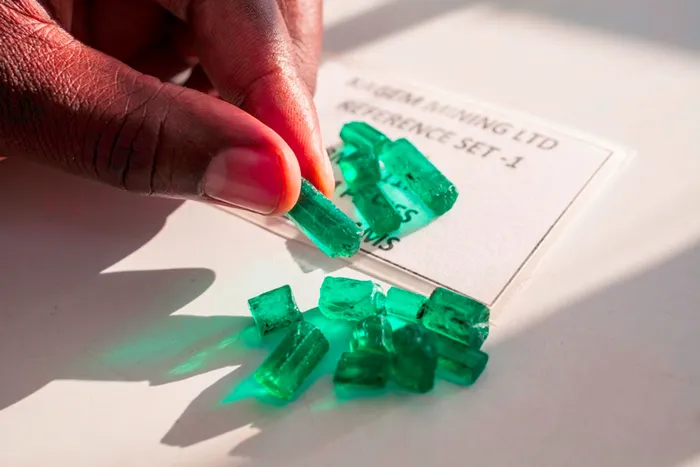
Gemfields' Kagem in Zambia mines emeralds. The company also annuallypublicly declares its contributions to the Zambia government to promote transparency and accountability.
Image: Supplied
Gemfields declared a lower “G-Factor for Natural Resources” for its 2025 year due to weak markets, illegal mining and other disruptions at its coloured stone mining operations.
For many decades, mining groups have come under fire in Africa from politicians and civil society organisations alike for failing to make a proper contribution to the countries where they operate.
JSE-listed Gemfields declares its so-called “G-Factor for Natural Resources” in an effort to highlight, in a transparent and accountable manner, its contributions to its host governments for the Kagem emerald mine in Zambia and Montepuez Ruby Mining in Mozambique.
CEO Sean Gilbertson said they continue to encourage broader industry adoption of the “G-Factor” data on natural resources, so that host governments and their citizens could better assess the stewardship of their resources.
The 'G-Factor for Natural Resources' reveals the percentage of natural resource revenue paid to the government in the form of mineral royalties, corporation tax, and, where the relevant government is a shareholder, dividends.
The company said in a statement that the G-Factor for the Kagem mine currently stood at 17%, and 26% for Montepuez Ruby Mining, for the 10-year period from 2016 through 2025.
In Mozambique, Montepuez Ruby Mining paid 23% of its revenue to the Government of Mozambique in 2025. Cash payments were lower than in prior years – reflecting reduced premium-ruby output, the postponed December ruby auction, and illegal mining intrusions – but the proportional fiscal contribution remained strong, he said.
At Kagem in Zambia, the one-year G-Factor for Natural Resources stood at just 6% for 2025, far below its long-term average. This reflected the halt in operations at Kagem from January through April 2025 due to competitor actions in the market and the temporary 15% export tax on precious gemstones, which was lifted by March 2025.
“With operations restarted and market conditions improving, we expect Kagem's G-Factor to trend back toward its long-term average of around 18%,” said Gilbertson.
Montepuez Ruby Mining paid $11.3 million to the Mozambique government in the form of mining royalties and corporate taxes in 2025, compared with total company revenue of $40.9m.
At Kagem emerald mine, $4.9m was paid to the Zambia government in the form of mineral royalties and corporation tax, compared with $84.1m in total revenue from the mine.
Kagem reported losses in 2024 and 2025 as a result of poor market conditions and a suspension of all mining in the first half of 2025.
Gilbertson said that the data was also an indicator of the efficiency of natural resources companies in converting those natural resources into funds for the host government.
"Gemfields' 2025 G-Factor for Natural Resources underscores how contributions to host nations vary with market and operating conditions,” said Gilbertson.
He said in the annual report released late last month that 2025 had been "a difficult year”, with operational disruptions at both mines constraining premium gemstone production, auction cadence, and cash generation.
Seven auctions had generated just $129m, “reflecting both the shortfalls in gemstone availability and bumpy market conditions, despite continued pricing resilience at the top end of the ruby and emerald quality spectrum.”
He said their focus for 2026 was on stabilising operations, completing the final commissioning of the much-delayed second processing plant at Montepuez, so its benefits could emerge progressively throughout the year, and maintaining strict cost and capital discipline to protect liquidity and deliver deleveraging. The first half was expected to remain challenging as we iron out the new processing plant's teething issues, he added.
BUSINESS REPORT