

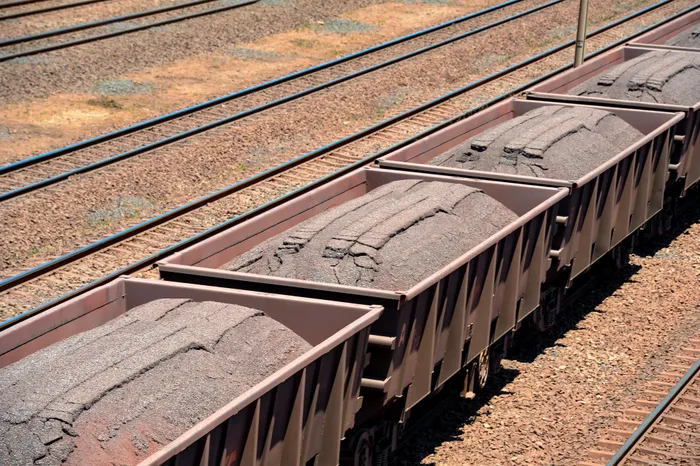
Kumba Iron Ore CEO Mpumi Zikalala said there were improvements in the logistics performance of the rail line between Sishen and Saldanha Bay in 2025, despite four derailments, and she was optimistic about further improvements in 2026.
Image: Henk Kruger | Independent Newspapers
Kumba Iron Ore has made progress on its R11,2 billion ultra-high dense media separation processing plant at Sishen, which aims to secure the life of mine to 2041 and significantly increase the volume of premium grade product, said the CEO Mpumi Zikalala.
Writing in the annual report released Friday, she said 37% of the overall project was complete and 90% of all engineering work was done. Critical milestones for the main tie-in of the bulk materials handling systemwere scheduled to be reached for the second half of 2026.
On the development of low-carbon steelmaking technologies, the group is working with an Anglo American team – and with industry bodies, suppliers and academia – to research and pilot feed strategies for lower-carbon steel technologies, and to develop a portfolio of innovative solutions to reduce emissions.
She said this, together with work being done to decarbonise its own activities, minimise its environmental footprint and invest in host communities, would strengthen the group’s resilience and position it well for a sustainable future.
The group is also assessing growth opportunities, or “close to the core” adjacencies, including downstream beneficiation opportunities to secure Kumba’s position in the green steel market.
However, the most immediate priority was to unlock the group’s full potential and enhance competitiveness through operational excellence, drive cost competitiveness and embed a culture of accountability, safety and performance, she said.
“In addition to maintaining fatality-free production, a priority is to drive margin improvement and reduce our break-even price. Given the volatile market and supply chain environment, and our relative position on the global cost curve, there is a critical need to drive and sustain cost efficiencies and ensure disciplined capital allocation,” she said.
In the 2025 financial year, the group secured R673m in cost savings and combined with the R4,4bn in 2024, had delivered R5,1bn of cumulative savings.
“Our focus is to drive efficiency by improving asset reliability through our heavy mobile equipment recapitalisation programme, and enhancing our procurement and sourcing model. Our aim is to maintain cost discipline without heavy capital spend, focusing on efficiencies that rely mostly on management efforts, balancing cost control while sustaining output and quality,” she said.
Restoring the Ore Export Channel’s performance to design capacity was also crucial, she said.
“There have been recent improvements in the performance of the logistics network, as well as progress in the government’s reform process aimed at allowing private sector participation on the network,” she said.
The group is a significant employer in the Northern Cape, where it operates, and it employed 15,486 people by the end of 2025, with 5,869 permanent employees, and 8,515 service partners, and 1,102 trainees, the annual report showed.
At the Sishen open pit mine, which generates 70% of group production, R135,8m was invested in social and community projects in 2025, while at the second mine Kolomela, which makes up 30% of group production, R126,8m was invested in social and community projects.
Of the R10,3bn of dividends to shareholders in 2025 (2024: R12,5bn), R3,5bn went to empowerment partners (R4bn), bringing to R67,3bn the total dividends paid to BEE shareholders since inception in 2006.
Total payments to the government in 2025, through corporate tax, mining royalties, payroll tax, skills levy and the Unemployment Insurance Fund, came to R9,2bn in 2025, in line with 2024.
Some R7,1bn was paid to employees in the year, including salaries, benefits, bonuses and share-based payment expenses (R6,7bn).
The number of women employed at the group increased to 32% of the total workforce from 30% in 2024, and to 36% of management from 33% in 2024.
Visit:www.businessreport.co.za