

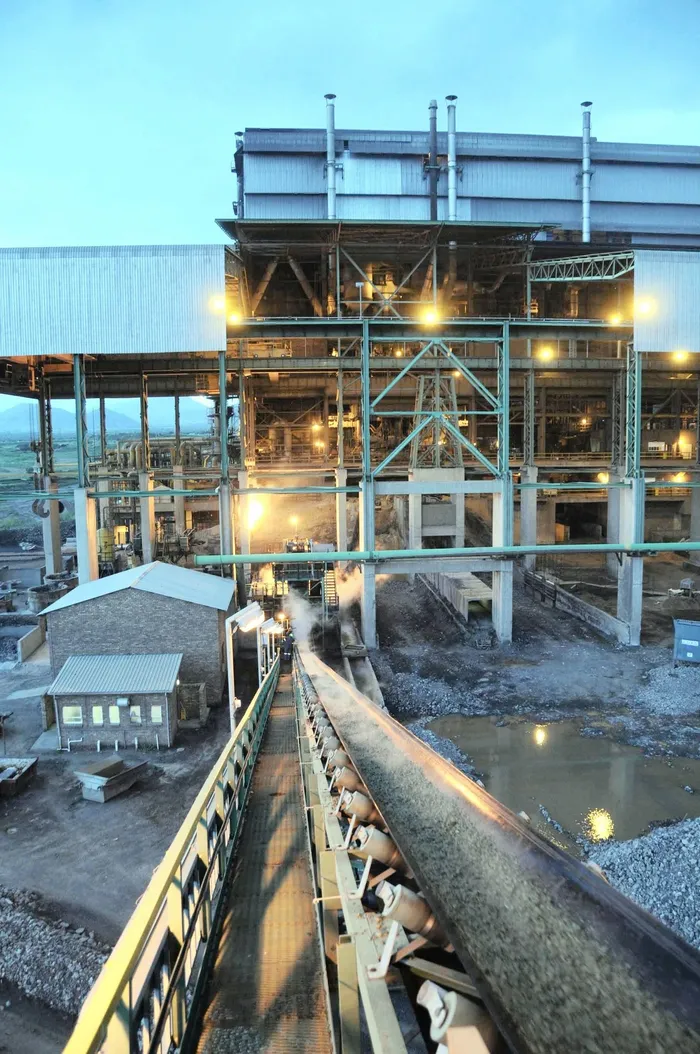
A section of the Glencore Merafe Chrome Venture. Challenges such as high energy costs and increased competition from China have led to the suspension of two of group's ferro chrome smelting operations. The government has agreed to a lower electricity tariff to prevent further smelter closes.
Image: Supplied
Merafe Resources on Friday extended the termination date of its planned retrenchment of up to 3,000 employees and urged a speedy resolution to regulatory processes for a lower electricity tariff of 62c per kWh, which is designed to prevent further ferrochrome smelters from closing.
The termination date was extended to May 11, 2026, from April 9, 2026. The extension came after Eskom and the government indicated they would support this lower tariff. In the past three years, at least four ferrochrome smelters have been closed or temporarily closed, which has been attributed mainly to high electricity prices.
Eskom stated on Friday that the Eskom Smelter Task Team had concluded the tariff adjustment for Samancor Chrome and the Glencore-Merafe Chrome Venture ferrochrome smelters.
The lower tariff follows the Venture's indication earlier this year, that an initial, revised, 12-month interim electricity tariff of 87,74c per kWh, was insufficient for the ferrochrome industry to become financially viable.
The Glencore-Merafe Chrome Venture ranks among the world’s largest ferrochrome producers. Two of the joint venture’s five smelters, Boshoek and Wonderkop, in the North-West Province, were closed late last year due to high power costs.
Consumers have a base electricity tariff rate of R2,18 per kWh.
“The tariff intervention improves Eskom’s liquidity without requiring higher tariffs, additional Eskom borrowing, or further government support. It also provides Eskom with predictable sales volumes for up to the next five years and protects public investments made in the utility, as well as its ability to support re-industrialisation and economic growth,” the utility said in a statement.
“The Glencore-Merafe Venture has received formal communication from the Eskom board confirming the revised terms and conditions linked to the proposed tariff, which the Venture has provisionally accepted, subject to clarification points and conditions,” Merafe’s directors said.
The Venture said its final acceptance of the tariff terms remained conditional upon the wider ferrochrome industry agreeing to the terms and conditions, as well as subsequent approval by the National Energy Regulator of South Africa (NERSA).
“Eskom's submissions of the proposed tariff and revised terms and conditions to NERSA brings the ferrochrome industry closer to achieving a more sustainable operating environment,” they added.
Eskom CEO Dan Marokane said that without the success of Eskom’s turnaround over the past three years, "we would not have been in a position to support the ferrochrome industry or play a meaningful role in preventing job losses."
The amended tariff is a medium-term solution of up to five years, and enables a proactive, case-by-case approach, allowing Eskom to tailor pricing and contractual structures to the specific commercial circumstances of each smelter, while aiming to ensure transparency, fairness, and regulatory alignment for all customers.
The ferroalloy and iron and steel segments are experiencing sustained pressure from global commodity markets, rising input costs, and structural competitive challenges, and would be prioritised ahead of other smelter industry sectors, Eskom said.
For these segments, pricing would be determined through a structured, bottom-up assessment that takes into account the cost of production, electricity intensity, and exposure to commodity prices. This is not a uniform approach; rather, it allows for tailored pricing solutions specific to each smelter.
"This differentiated approach ensures that Eskom applies a consistent economic framework across the smelting sector while avoiding the risk of unintended pricing benchmarks or cross-sector distortions, in support of a sustainable, long-term industry solution."
Visit:www.businessreport.co.za