

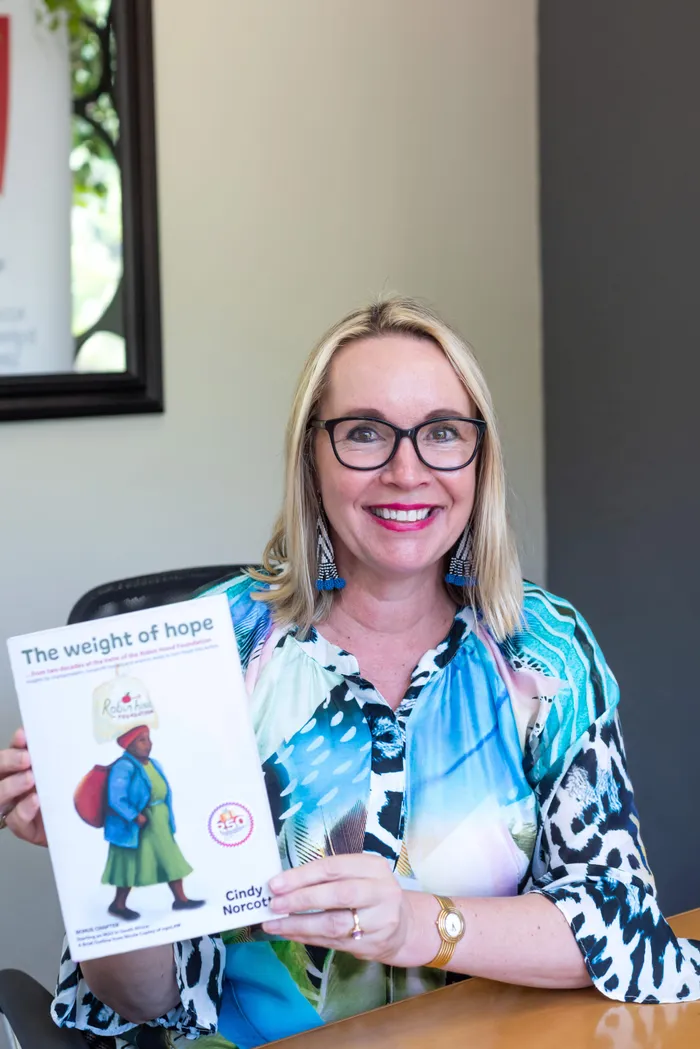
Cindy Norcott, founder of the Robin Hood Foundation and author of the book Weight of Hope, says many women struggle to reach an appropriate balance between work and home life..
Image: Supplied
Many women executives often struggle with issues of over-performance, over-giving, and assertiveness in their roles.
Entrepreneur and motivational speaker Cindy Norcott - she also owns ProTalent, a Durban-based recruitment company, and is the founder of the Robin Hood Foundation - said this while being interviewed on her role in the launch on May 1 of “The Aligned Woman Blueprint” program.
She said the workplace is becoming increasingly pressurised and stressful in South Africa, with employers generally struggling to just break even in the weak economy and aiming for their employees to be as productive as possible.
From what she has encountered, and apart from workplace-specific trends such as the difficulty in dealing with staff under the age of 29, women in leadership roles tended to have issues that were specific to themselves.
Much had also changed in the workplace environment in the last few years, with the loss of engagement and productivity associated with the trend towards less work being done at the office or place of work in the years post the Covid-pandemic, she said.
Another common refrain among women business-people was an inability to reach an appropriate balance between work and home life, said Norcott.
Other executives often just don’t see or understand the “invisible load” that their women counterparts carry that extends to outside the boardroom, such as bringing up children.
The multidisciplinary program is being launched by fellow entrepreneur Laura Thomas, and it is designed to move female leaders beyond the traditional, often sustainable “masculine” management blueprint.
In this program, Norcott leads the module on Aligned Leadership and Identity.
She said she meets a great number of “really amazing” businesswomen in every area of leadership and of “enormous calibre” through her work and speaking engagements.
She said that arguably, one of the most common things she encounters is that women sometimes struggle to deal with the prevailing male-centred management style at their businesses.
“It seems hard to believe I still have to say this in 2026, but yes, it is still a thing.”
Typically male examples of management styles include being able to give directions, being direct, being assertive, and showing confidence.
She says that for many women, these characteristics are opposite to the more dominant traits normally associated with many women, such as being more empathically attuned and more able to tap into their intuitive compass.
“Many women are taught from a young age to be the unassertive, nice girls,” she said.
Adopting management styles that were contrary to one’s nature could lead to, for example, women becoming too assertive, or result in them attempting to over-perform in the workplace, she said.
Norcott said that instead of sublimating their natural identities, such as by copying the dominant male management style, women would benefit more by using these “superpowers” in their management approach. Collaborative leadership outperforms rigid hierarchies.
“You have to present the best version of yourself, and with what is aligned to your character,” she said.
BUSINESS REPORT