

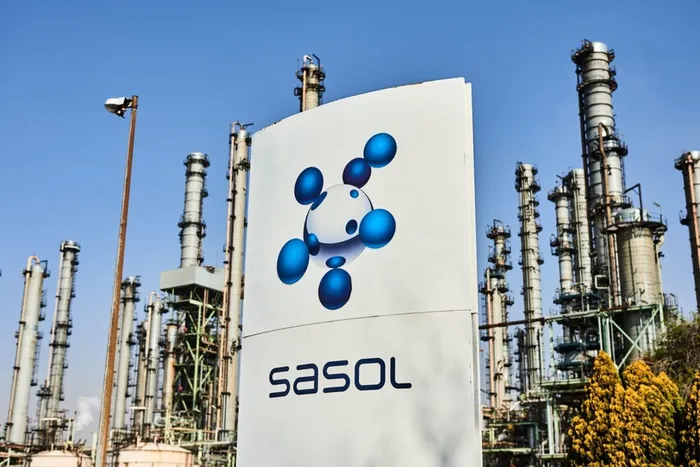
Sasol said demand for its fuels and chemicals has risen amidst escalating global tensions affecting oil supply.
Image: Supplied
Investors have sent Sasol's share price soaring since the start of the Middle East crisis, as the fuels-and-chemicals-from-coal and oil refiner typically benefits strongly from tighter global oil supply and higher oil prices.
The group on Thursday confirmed its oil refinery product sales are seeing strong demand linked to energy security concerns, while it has focused on maintaining uninterrupted production of its energy and chemical products through the Middle East conflict.
Sasol’s share price was 0,13% higher at R217.60 following a business performance update for the 9 months to February 28, but the price is 73.4% higher than it was on February 26, a day or so before the Middle East crisis started, and the price is a staggering 233.8% higher than what it traded at a year ago.
An online search showed that for every R1 per litre increase in South African fuel prices, driven by higher Brent crude oil prices and rand depreciation, there is a material uplift in Sasol’s earnings before interest, tax, depreciation, and amortisation, and cash flow, as it benefits from its integrated operations, offset to an extent by higher input costs from Middle East supply disruptions. The group strategy has also been reset.
In the business update, the group’s forecasted fuel sales volume growth for the 2026 financial year was revised upward from 5% - 10%, to 10% - 15% higher than the 2025 financial year, due to stable SO (Secunda-based synthetic fuel operations) production, higher Natref volumes, and increased demand.
The group’s response to the crisis had been to leverage their integrated value chain to ensure a consistent supply of products while maintaining discipline on cost and capital spend, Sasol’s directors said in the update.
“Despite the Middle East conflict constraining sour crude supply, Sasol mitigated this through sourcing sour crude from other regions, resulting in continued strong sales volumes for the quarter,” the directors said.
Production at Sasol’s ORYX GTL (gas-to-liquid) facility in Qatar, however, was significantly lower, following the shutdown of the plant due to gas supply disruption in early March, “with the timing of a restart remaining uncertain,” they said.
In the International Chemicals’ Eurasia operations, sales were higher on tightened global supply, but higher input costs and feedstock constraints impacted production, “resulting in the force majeure on certain products.”
The US chemicals business performance reflected a mixed macro environment, but the business benefited from more favourable pricing and improved production. Revenue for Chemicals Africa increased compared to the previous quarter, driven by higher volumes and prices.
In the Southern Africa business, the recently commissioned destoning plant delivered improved coal quality, with average sinks in line with expectations and higher coal production reducing external coal purchases.
In Mozambique, country-wide flooding impacted condensate logistics and transportation, necessitating a reduction in gas production.
Gas production volume forecasts for the full year were revised down from 0% - 5% below the 2025 financial year, to 5% - 10% below that year.
“Overall, SO production benefitted from improved coal quality and gasifier availability, and despite plant outages in the third quarter, however, was 8% higher than the prior year.”
“While tight supply is supporting current demand, we remain cautious on the medium-term outlook, focusing on managing input cost pressures to support margins and optimising production across our value chains,” the group said.
The group’s exposure to oil price and currency volatility was being managed through a hedging program. The 2027 financial year oil hedging program had been completed, securing downside protection while retaining upside participation. The new rand dollar hedging program for the 2027 financial year was still underway.
The Integrated Processing Facility (IPF) for the PSA (Production Sharing Agreement with the Mozambique government) became operational in March 2026, which enabled the first in-country production of LPG (liquid petroleum gas).
“This displaces a significant quantity of imported LPG, while also contributing additional natural gas, light oil, and condensate production,” the group said.
In March, Sasol successfully issued a $750 million seven-year bond at a coupon rate of 8.75%, with the proceeds used to partially repurchase the 2028 and 2029 bonds, resulting in the debt maturity profile being extended and a strong liquidity position.
In the third quarter, Natref became the first iol refinery in Africa to attain International Sustainability & Carbon Certification PLUS (ISCC PLUS) product sustainability certification.
The certification covers sustainable aviation fuel (SAF) and renewable diesel produced through the co-processing of used cooking and vegetable oil feedstocks, as well as the production of certified sustainable chemicals at Sasol's Secunda Operations.
Group capital expenditure had been revised downwards from R22 billion - R24bn to R20bn - R22bn, supported by capital optimisation and deferral of non-critical shutdowns. Working capital had increased following the Middle East conflict.
“The operating environment is expected to remain volatile," Sasol's directors said.
BUSINESS REPORT