

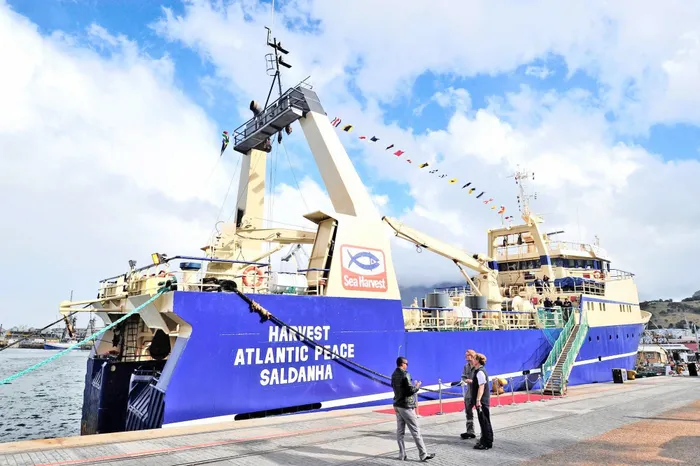
Sea Harvest Group's "Harvest Atlantic Peace" fishing vessel. The group saw record hake catches last year, but has warned that rising diesel prices may impact earnings in the year to December 31, 2026.
Image: Henk Kruger
Sea Harvest, one of South Africa's biggest fishing groups with 61 vessels, says the sharp increase in diesel prices so far this year might impact its earnings as fuel is one of the company's biggest cost components, CEO Felix Ratheb said in the annual report released on Friday.
The group saw one of its most successful hake catches in its history last year and its prawn operations turned around in Australia, and as a result, its headline earnings per share soared to 219 cents from 55 cents the year before. Operating profit was up 125% to R1.3 billion and revenue increased 21% to R8.7bn.
Since early March 2026 however, the Middle East conflict had driven up the price of a barrel of oil by about 70%, and diesel prices could be expected to double should the conflict persist, he said.
Sea Harvest employs some 5,330 people; its operations include eight aquaculture plants, its products are exported to 30 countries and following the sale of the Ladismith Cheese factory last year, some 64% of its sales are derived from exports.
Ratheb warned that depressed market demand for abalone and climate variability affecting certain of the group's fisheries might also constrain their financial performance this year.
More positively, however, Ratheb said the global supply gap in whitefish, driven by declining cod quotas, is expected to persist for several years and this will continue to support strong demand for Cape hake.
Operationally, the group was well positioned to maximise the value of its fishing quotas and continue improving efficiency across the business.
"Our view is that a sharper, more focused seafood business is better positioned to deliver higher margins and improved free cash flow, which should support improved dividends and enhanced long-term shareholder returns," said Ratheb.
Chairman Fred Robertson said Sea Harvest had entered 2025 following one of the most challenging periods in recent history, and the group has reset its strategy for the next three years to focus on its core identity as a leading diversified seafood business, grounded by its traditional wild-caught fisheries and complemented by aquaculture and value-added operations.
BM Foods Group was sold, and Ladismith Cheese's sales is subject to Competition Commission approval. West Point Fishing continued to be integrated into the group, said Robertson. West Point Fishing, which does pelagic fishing off the South Africa West Coast, was acquired in January 2024.
Robertson said South Africa's socio-political landscape continued to present risks and opportunities - the formation of the Government of National Unity had introduced a new phase of political collaboration, albeit one that remained both stable and fragile.
"The group's primary goals are clear: halve debt, enhance operating margins, and deliver a healthy return on invested capital."
"Sea Harvest is investing in what it does best: increasing efficiencies across the fleet, improving processing throughout, modernising vessels, and expanding capacity in facilities with proven demand," the annual report said.
At the same time, market diversification and premium pricing strategies would help maximise the value of every catch. Major capital expenditure programs were completed, shifting focus to maintenance-level capital expenditure, dcost management, and working capital optimisation.
The group said its sector fundamentals remain attractive. Global demand for premium, wild-caught, sustainable seafood continued to exceed supply, while aquaculture was one of the fastest-growing global food sectors.
“Notably, aquaculture output now exceeds wild-caught fisheries, and fishmeal and fish oil (core products in our pelagic operations) are essential components of aquaculture feed.
Aquaculture operations globally depend on high-quality feed, with the group’s fishmeal and fish oil primarily supplied to salmon farms. As the premium species in global aquaculture, salmon represents about 2% of total aquaculture production yet contributes close to 20% of the industry’s value. This allows the group to participate in a high-value segment of the aquaculture ecosystem."
BUSINESS REPORT