

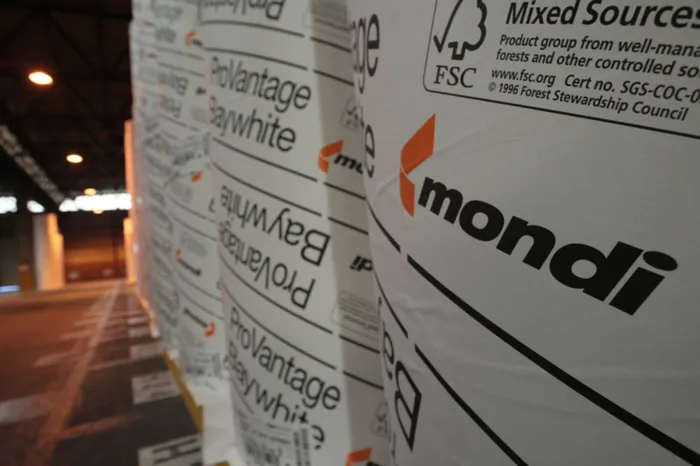
Branded rolls of paper are seen at a Mondi production facility. The group has warned that higher energy, logistics and supply chain costs have arisen from the crisis in the Middle East through the three months to March 31, 2026.
Image: supplied
Mondi’s share price fell a significant 9.45% on Friday due to higher energy, raw material, and logistics costs stemming from the Middle East crisis, which it expects will impact its markets in the third quarter of this year.
The closure of another three plants this month, resulting in a headcount reduction of 450 was also announced in a trading statement from the group on Friday. The share price ended at R168.54, having fallen 40.23% compared to a year ago.
The London and JSE-listed group said market conditions had remained challenging.
This had resulted in a slightly lower, underlying earnings before tax, depreciation, and amortisation (EBITDA) of £212 million, including £8m of forestry fair value, compared with £214m in the fourth quarter, which included £1m of forestry fair value gain.
"Against a backdrop of challenging market conditions, sales volumes increased; however, lower selling prices and, more recently, cost pressures linked to escalating geopolitical tensions weighed on underlying EBITDA,” said CEO Andrew King.
These pressures persisted into the second quarter, and "we are taking pricing actions to mitigate their impact," he said.
The three converting plants that were closed comprised a Consumer Flexibles plant in Hungary and Corrugated Solutions plants in Poland and Germany.
“This brings the total number of recently announced plant closures to six, with customers transferring to alternative plants in our network.”
On a sequential basis, the group’s Corrugated Packaging and Flexible Packaging business units increased sales volumes throughout the three-month period across the range of paper grades.
This was supported by recent capacity expansions, as well as exposure to diversified geographies, end markets, and products.
There were also no planned maintenance shutdowns in the quarter.
The increase in volumes was offset by lower average selling prices and, towards the end of the quarter, higher energy-related input costs.
In the converting operations, the performance of the Corrugated Solutions and Paper Bags businesses was impacted by margin pressure, while Consumer Flexibles delivered a broadly stable performance, supported by resilient end markets.
The group’s directors stated that significantly heightened geopolitical tensions in the Middle East had increased volatility in an already complex operating environment.
“We have a limited direct exposure to the region, and all operations continue to run safely. However, across the business, we have experienced increased energy, raw material, and logistics costs. We are actively responding with pricing actions,” the group directors said.
Following a recent reduction in wood prices in South Africa, and assuming the market did not change significantly for the rest of the year, the full-year forestry fair value gain for 2026 was expected to be nil.
“We continue to take targeted actions to strengthen our competitive advantage. Operational excellence programmes, rigorous cost control, and margin management remain central to our approach,” said King.
Cash flow optimisation remained a priority, supported by disciplined control of capital expenditure and rigorous working capital management.
"Despite the uncertain outlook, we continue to focus on what we can control: driving operational excellence, rigorous cost and margin discipline, optimising our production footprint, and focused cash flow management. These actions underpin our confidence in our ability to navigate the current headwinds,” said King.
BUSINESS REPORT