

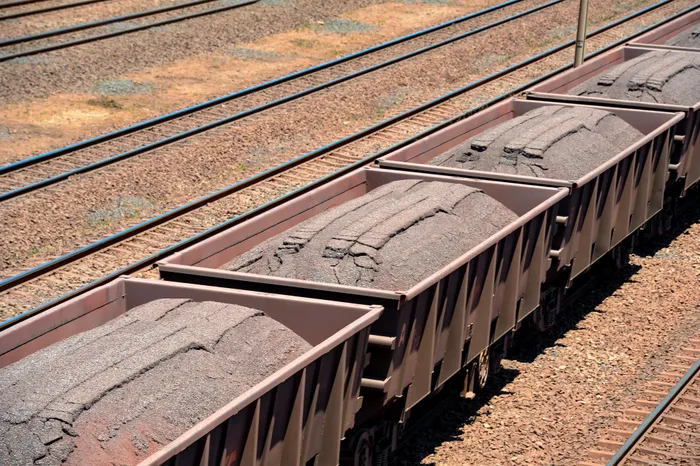
Kumba Iron Ore CEO Mpumi Zikalala said a planned Transnet rail maintenance shutdown in May resulted in Kumba’s iron production falling marginally in the three months to March 31, as stockpiles were managed in preparation.
Image: Henk Kruger | Independent Newspapers
Kumba’s iron production was marginally lower in the first quarter of its financial year to end-March 2026 as stockpiles were managed ahead of Transnet’s planned logistic maintenance shutdown in May, but the full-year production guidance remains intact.
Kumba’s chief executive, Mpumi Zikalala, said increased sales volumes were supported by improved finished stock levels and equipment availability at Saldanha Bay Port.
“As we move towards a sustainable future, construction of Sishen's Ultra High Dense Media Separation (UHDMS) project continues, with preparations underway for the main plant tie-in scheduled for the second half of 2026. Notably, Kolomela received its first wheeled renewable electricity from Envusa Energy, a joint venture between Anglo American and EDF Renewables, achieving a 72% reduction in scope 2 carbon emissions in March,” she said.
She said in a first quarter production report that Kumba’s export sales routes to its markets in Asia and Europe remain open and had not been impacted by shipping disruptions caused by the conflict in the Middle East.
“Our supply chains have been secured for the rest of this year, and we continue to closely monitor developments and manage potential associated risks, including cost inflation. Against this backdrop, we have maintained our full-year 2026 guidance," said Zikalala.
Iron ore fundamentals were being supported by demand from China, other Asian countries, and Europe, and supply was constrained by seasonal weather disruptions in the southern hemisphere towards the end of the first quarter.
Iron ore prices and lump premium, which were initially under pressure due to weak steel mill margins in China, recovered in March on restocking and increased blast furnace utilisation rates.
Safety was maintained in the first quarter, with the fatality-free production record at the Sishen and Kolomela mines, of nine years and more than three years respectively, unbroken.
Total first-quarter production of 8,8 Mt (Q1 2025: 9 Mt) was 2% lower, driven by Kolomela and partially offset by increased production at Sishen.
Total waste mining decreased by 3% to 39,2 MT (40,5 MT), reflecting lower waste mining at Sishen. A 12% decrease at Sishen to 30,6 MT was largely due to seasonal weather disruptions, resulting in challenging mining conditions and low shove reliability. Kolomela's waste mining increased 45% to 8,5 MT in line with the planned ramp-up in waste mining and the higher strip ratio guided for 2026.
Total sales increased by 3% to 9,3 Mt (9 Mt) on the back of improved logistics performance.
Finished stock of 7,2 Mt (7,5 Mt) comprised 4,7 Mt (5,7 Mt) at the mines, and 2,5 Mt at Saldanha Bay Port (1,8 Mt).
Kumba achieved an average realised free on board (FOB) export iron ore price of $93 per wet metric ton (wmt) ($98/wmt), 8% above the Fastmarkets 62% Fe FOB equivalent price of $86/wmt ($88/wmt).
Following a drawdown of stockpiles at Kolomela and increased sales, total finished stock fell to 7,2 MT (7,5 MT at the end of December 2025). Stock at the mine ended at 4,7 MT versus 5,7 MT at the end of December, with stock at Saldanha Bay of 2,5 MT (1,8 MT).
In terms of meeting the full-year guidance to investors provided in February, Kumba directors said Sishen’s production would be weighted to the first half of 2026 due to the tie-in of the UHDMS project in the second half of 2026, with sales not expected to be impacted owing to the planned drawdown of finished stock.
Visit:www.businessreport.co.za