

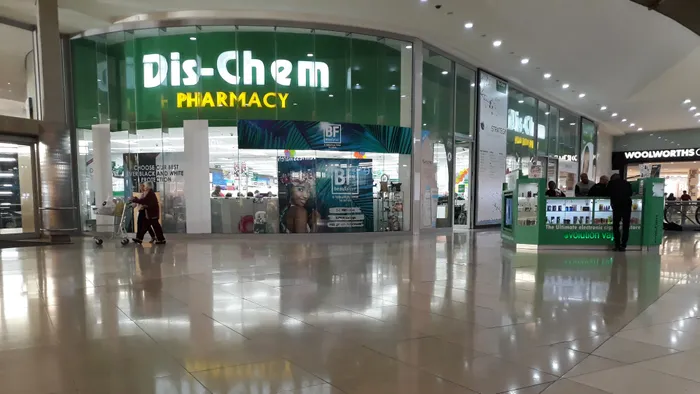
Dis-Chem plans, in its 2027 financial year, to tighten the span of control of its CEO and to shift from the founder-led cross-functional leadership to a structure that creates clearer lines of accountability, with 200 new roles set to be created in underinvested departments.
Image: Karen Sandison / Independent Newspapers
Dis-Chem Pharmacies' share price fell by over 8% on Friday following the announcement of a sharp decline in earnings per share and a substantial cut in dividends.
The share traded 8.9% lower on the JSE on Friday afternoon at R34.55, a price that was still marginally above the R31,33 that it traded at 12 months before.
Group revenue increased 9.3% to R42.8 billion. Basic earnings per share (EPS) dipped 17.1%, while headline earnings per share (HEPS) followed suit, falling by 17.3% to 113,7 cents.
The final dividend per share came to 15,92 cents, marking a drastic 42.8% decrease. The total dividenddeclined by 17.3% to 45,34 cents a share.
When the previous year’s once-off property gains were excluded, EPS and HEPS would have only diminished by 11.3% and 11.7% respectively, indicating how the comparative year-ago results significantly skewed the current figures.
The core retail profit before tax increased by 27.1%. Group profit before tax was 20,1% higher at R1.8bn. Comparable pharmacy store revenue growth was reported at 5,3%, while the wholesale revenue saw a commendable rise of 13.1%.
Directors said the group had generated strong revenue performance considering the consumer was financially constrained, while the total income margin improved and there were market share gains across all core retail categories. The company opened 31 retail pharmacy stores and adjusted its retail footprint accordingly, even as three baby stores closed.
The year marked significant investments in Dis-Chem’s ecosystem, particularly in the 'X, bigly labs', which saw R330m committed to innovation aimed at transitioning the business from a traditional pharmacy retailer to an integrated healthcare provider.
Results of this investment in the latter part of the financial year showed proof of concepts such as the launch of the ‘Better Rewards’ program and the Store of the Future initiative that are designed to enhance customer experience and bolster revenues, the directors said.
Retail expenses grew by 15.7% due to the investments in new stores and innovation. Retail employment costs, when excluding the investment in X, bigly labs, increased by 10.3%. Like-for-like retail employment costs were well maintained at 3.5%.
Wholesale expenses increased by only 2.6%, which related mainly to additional employee and courier costs from the expansion into the Long Meadow warehouse.
Directors said the outlook remains cautiously optimistic—with group revenue growing 9% in the early months of 2026—as the economic backdrop, including inflationary pressures and rising fuel costs, continues to pose challenges.
As the 2027 financial year progresses, initiatives to drive earnings growth includes the relaunch of digital channels, opening of new stores, and enhancements in staffing frameworks.
From March 1 to May 19, 2026, group revenue grew by 9% over the comparable period. Retail revenue grew by 8.8%, supported by the opening of 8 pharmacy stores and market share growth from Better Rewards. Wholesale revenue to external customers grew by 10.4%. The group's total income margin increased to 32%.
Other initiatives in the new financial year include the launch of the "Store of the Future" design, continued acceleration of space identification and new store openings, a restructured operating model focused on realigning the business's operating model to a modern operational structure that allows a more cohesive working relationship with X, bigly labs, a tighter span of control for the CEO, and an important shift from founder-led cross-functional leadership to a structure that creates clearer lines of accountability, with 200 new roles set to be created in underinvested departments.
BUSINESS REPORT