

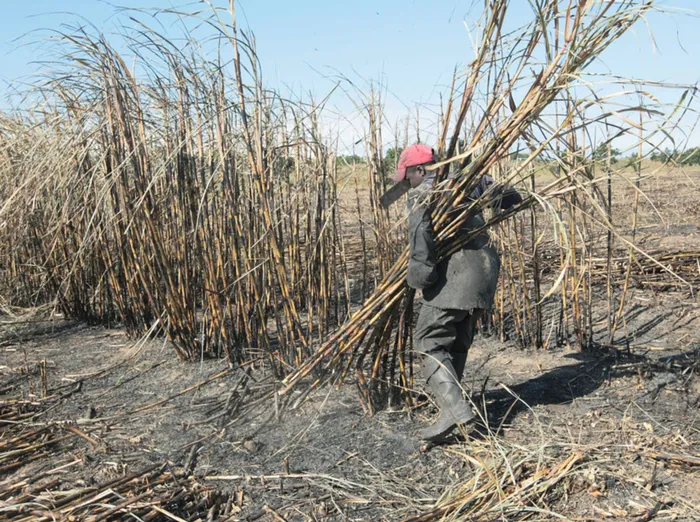
Private investor and whistleblower Dave Woollam warns that the closure of Tongaat Hulett could devastate South Africa's North Coast sugar industry.
Image: Simphiwe Mbokazi/Independent Newspapers
Former banking executive, private investor and whistleblower Dave Woollam has warned of dire consequences facing South Africa’s sugar industry, particularly those operating on KwaZulu-Natal’s North Coast.
His warning follows news that Tongaat Hulett (THL), a major sugar producer, is facing possible provisional liquidation after business rescue efforts collapsed.
The news sent shockwaves through the sector and caused deep concern among small-scale sugarcane farmers who sell their produce to the company. It is estimated that these farms collectively generate R4.5 billion worth of produce annually, and if the sector were to collapse, the ripple effect could impact nearly one million lives, including farmers, related businesses, employees and dependents.
During a podcast interview, Woollam said nearly a million livelihoods hang in the balance, depending on the survival of the sugar industry.
With THL’s future in doubt, uncertainty has intensified among affected farmers ahead of the upcoming sugar milling season, which begins at the end of March and runs through December.
Woollam said that if the sugar market faltered, the impact would result in irreversible economic destruction for KwaZulu-Natal’s North Coast, as the industry is central to the region’s financial well-being.
“If you take that four-and-a-half billion rand away, it will decimate the North Coast in the true meaning of the word, not the over-exaggerated version,” he said.
Woollam suggested the Industrial Development Corporation (IDC) would need to play a critical role in bridging funding gaps for struggling farmers and industries. He urged stakeholders to work together in good faith and prioritise the welfare of farmers who have been suffering under strained market conditions.
He said the operational state of sugar mills posed another challenge, as they were in disarray after missing annual maintenance exercises due to financial constraints.
“The mills are inoperable right now, and it requires very good engineers and dedicated staff to put it all back together,” Woollam said.
Tongaat Hulett entered business rescue in October 2022. Business rescue practitioners said this followed “severe historic accounting irregularities, financial misstatements and governance failures” under previous management, which destroyed approximately R12 billion in shareholder value.
A rescue plan approved by creditors in January 2024 relied on the Vision Consortium acquiring the company’s assets. However, practitioners later reported that the deal depended on three “critical conditions”, including refinancing a R2.3 billion IDC facility and funding a R517 million escrow account for the South African Sugar Association.
In a media statement, the SA Canegrowers' Association warned that liquidation of THL posed a “profound risk to the entire South African sugar sector and the million livelihoods it supports”.
The association said that if an unfunded liquidation proceeded, growers supplying Tongaat’s three mills would face immediate non-payment for cane and levies. Because sugarcane must be milled shortly after harvest to remain viable, any halt in operations would leave large volumes of this season’s crop to rot in the fields.
“If this operational continuity is not secured, the consequences will extend far beyond one company. The entire South African sugar value chain, from growers to workers, transporters and downstream industries, will be severely destabilised,” said Thomas Funke, CEO of the association.
Affected farmer Ndumiso Luthuli, whose family supplies the Amatikulu mill, described the situation as “heartbreaking”, particularly for employees.
Luthuli said farmers were left reeling by the looming liquidation.
“If liquidation happens, farmers face the possibility of non-payment for goods already supplied. On top of that, there are unpaid levies and fees owed to us,” he said.
In a recent media report, Higgins Mdluli, chairperson of SA Canegrowers, said the fallout would be widespread, affecting South Africa’s 27,000 small-scale and 1,100 large-scale growers.
“In such a fragile environment, the loss of three of South Africa’s 12 remaining sugar mills would spell disaster for the industry,” Mdluli said.
Meanwhile, Agriculture Minister John Steenhuisen called for urgent intervention to prevent the shutdown of key sugar mills following THL’s looming liquidation, warning that failure to resolve the funding impasse could devastate rural economies and threaten jobs.
In a statement on Wednesday, Steenhuisen said the escalating crisis had created significant uncertainty ahead of the April crushing season. He said his department was engaging industry stakeholders and had been informed that unless the funding deadlock is urgently resolved, growers may be unable to deliver cane for processing.
“This is not a theoretical risk — it is an immediate economic threat to rural communities,” Steenhuisen said.
DAILY NEWS