

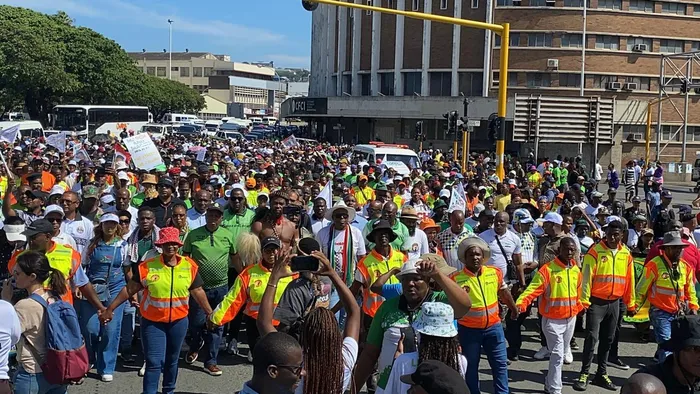
Thousands gathered in King DinuZulu Park to join the 'March and March' protest led by Jacinta Ngobese Zuma, voicing frustrations over illegal immigration's impact on South African society.
Image: Sipho Jack
Dissatisfied with the ever-increasing number of illegal immigrants in South Africa and the resulting implications, thousands of supporters flocked to King DinuZulu Park on Wednesday morning to join the March and March movement's protest against the thorny issue.
Supporters of the movement, which formed a year ago and is led by Jacinta Ngobese-Zuma, marched largely peacefully through the city centre, into Dr. Pixley KaSeme Street and to Hoy Park.
The mass action was also supported by members of various political parties, including the MK Party, IFP, and ActionSA, and some of their prominent leaders.
However, the tone of proceedings turned tense as the procession shaped to move towards Mahatma Gandhi (formerly Point) Road, an area known to be well-populated with foreign nationals. Police officials on duty intervened and prevented the protestors from progressing any further.
They maintained that the organisation did not obtain the required permission to venture into the Point precinct.
Ngobese-Zuma condemned the restriction and claimed that the blockage was a deliberate attempt to undermine the message of her movement and its supporters.
“All the police care about is making sure that they distract March and March so that we don't go to Point Road,” she said.
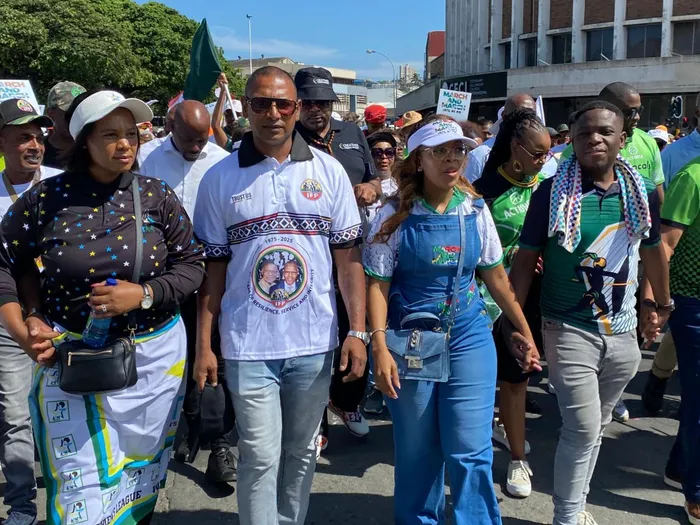
ATM women's league national spokesperson Gugu Xulu, IFP Ward councillor Neil Pather, and March and March leader Jacinta Zuma
Image: Sipho Jack
“We are tired and want the illegal immigrants to know that we are uncomfortable in our own country because they are taking over.”
Ngobese-Zuma and the many supporters complained about being constantly frustrated by the authorities, as their concerns were not given priority.
The SAPS spokesperson in KwaZulu-Natal, Robert Netshiunda, responded to the allegations and said the police were acting within the limits of their operational protocol.
“The road (Mahatma Gandhi) was not agreed upon. If they insist (that they were permitted), they must provide the necessary approved application,” Netshiunda said, explaining that the protestors attempted to venture away from the route that was agreed upon by the authorities.
ActionSA leader Herman Mashaba said their presence at the march was confirmation that he and his party were standing in solidarity with Ngobese-Zuma and her movement, as the South African government’s neglect of its citizens was evident.
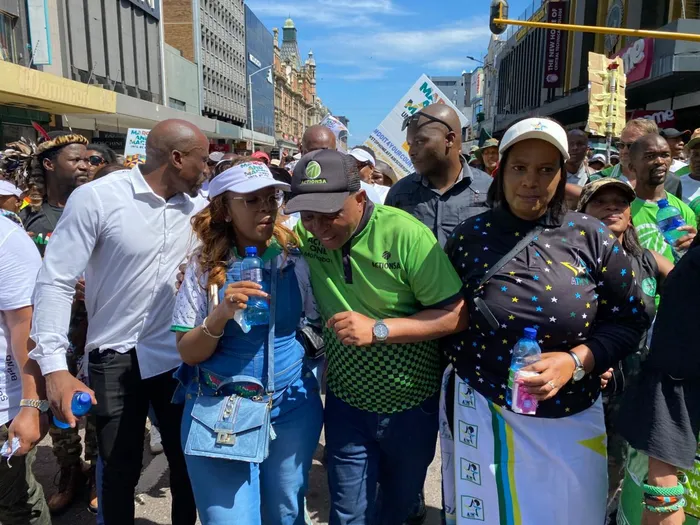
March and March Leader Jacinta Zuma, ActionSA Leader Herman Mashaba and ATM Women's League national spokesperson Gugu Xulu
Image: Sipho Jack
He linked illegal immigration to rising unemployment, particularly among youth and graduates, and claimed that foreign nationals were exploiting the country's resources.
“The ANC-led government is failing to prioritise South Africans,” Mashaba said, highlighting the multitude of struggles faced by locals.
He said the government needed to act urgently in addressing the challenges brought by illegal immigrants.
S’bonelo Giso from the National Freedom Party (NFP) shared similar concerns as Mashaba and stated that it was a travesty that many educated South African youth were struggling to secure employment due to the immigration situation.
“Our people are struggling to obtain business permits compared to foreigners,” Giso said, calling on the government to take prompt and decisive action.
The protest action eventually ended as the movement's leaders waited in vain for senior officials to receive the document. KZN Police Commissioner Lieutenant-General Nhlanhla Mkhwanazi was one of the leaders who was expected to make an appearance.
Ngobese-Zuma expressed her disappointment at the lack of response from government officials despite their persistent calls for assistance.
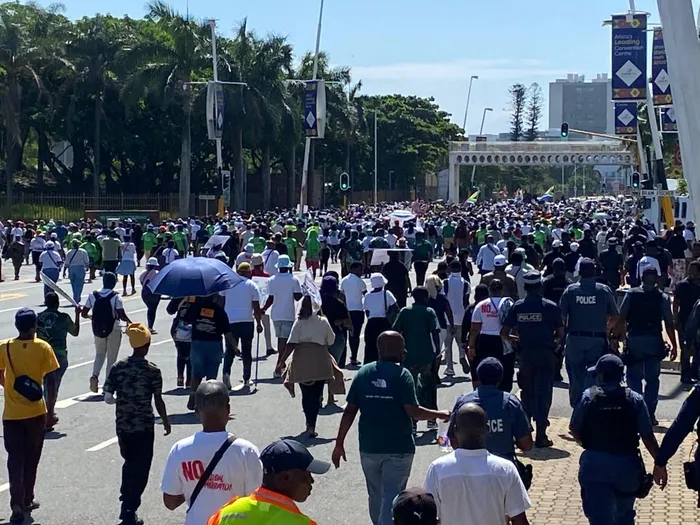
The largely peaceful demonstration faced police restrictions, sparking further debate on government accountability and the challenges faced by citizens.
Image: Sipho Jack
"The March and March movement aims to continue applying pressure on the government to address the concerns of ordinary South Africans. We won't back down in the face of adversity," said Ngobese-Zuma.
“We will not apologise for advocating for our citizens,” said Mashaba.
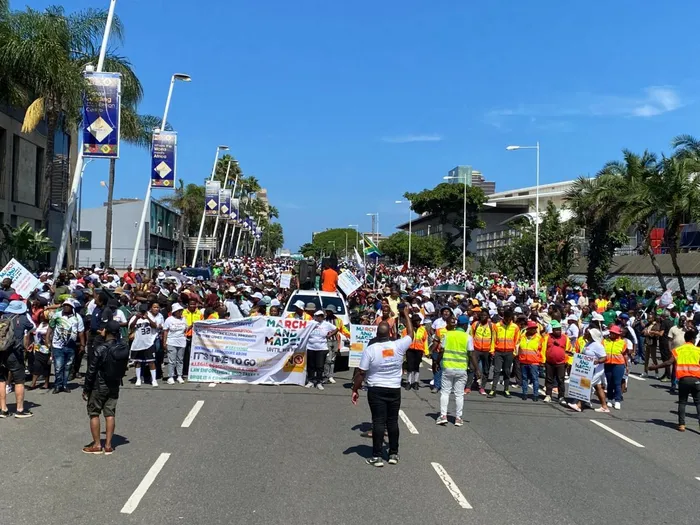
The largely peaceful demonstration faced police restrictions, sparking further debate on government accountability and the challenges faced by citizens.
Image: Sipho Jack