

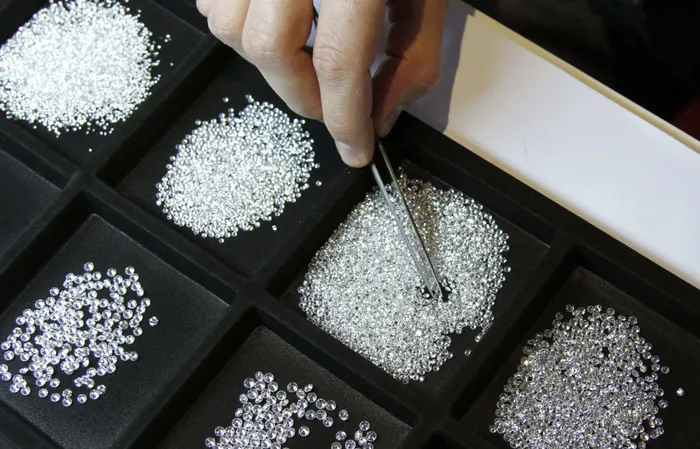
A vendor inspects 0.20 carat diamonds during the 3rd Antwerp Diamond Trade Fair in Antwerp January 31, 2012. Experts say a growing cadre of people, especially in North America, are thinking along the same lines. Rather than hanging on to memories of a failed relationship or departed relative, they are opting to "recycle" their diamonds. It's a trend that is sending ripples through the gem industry at a time when high-quality rough diamonds have become more difficult to find, and more expensive to mine. The growing influx of "used" gems means prices could stagnate over the long term despite the supply restraints, Even-Zohar said during a presentation at PDAC, the huge mining industry convention held last week in Toronto. To match Feature MINING-DIAMONDS/ REUTERS/Francois Lenoir (BELGIUM - Tags: BUSINESS SOCIETY COMMODITIES) A vendor inspects 0.20 carat diamonds during the 3rd Antwerp Diamond Trade Fair in Antwerp January 31, 2012. Experts say a growing cadre of people, especially in North America, are thinking along the same lines. Rather than hanging on to memories of a failed relationship or departed relative, they are opting to "recycle" their diamonds. It's a trend that is sending ripples through the gem industry at a time when high-quality rough diamonds have become more difficult to find, and more expensive to mine. The growing influx of "used" gems means prices could stagnate over the long term despite the supply restraints, Even-Zohar said during a presentation at PDAC, the huge mining industry convention held last week in Toronto. To match Feature MINING-DIAMONDS/ REUTERS/Francois Lenoir (BELGIUM - Tags: BUSINESS SOCIETY COMMODITIES)
Thomas Biesheuvel
Anglo American’s $5.1 billion (R39bn) plan to almost double its diamond interest and platinum mines that are missing targets risk killing its allure as a takeover target for a merged Glencore International-Xstrata.
Anglo has agreed to buy an additional 40 percent of De Beers, the biggest producer of diamonds, a gem shunned by most commodities companies because it only trades over the counter. Cynthia Carroll, the chief executive of Anglo, said last month she was reviewing its platinum operation, saying returns “are not acceptable”.
“De Beers almost becomes a poison pill,” Charles Wyndham, a former De Beers sales director and founder of WWW International Diamond Consultants, said. “In Anglo’s books, De Beers must be down for about $10bn. That’s quite a chunk of money to pay for something you might not want.”
Speculation about a bid for Anglo has been carried forward by analysts after people familiar with the companies said last month Anglo might draw interest from Glencore and Xstrata, who said on February 7 they planned to combine as the fourth-largest mining company.
A suitor for Anglo may be attracted by its copper, iron ore and coal. Neither Glencore, Xstrata nor competitor Vale mine diamonds.
While BHP Billiton has said it was studying selling its diamond business, the company could be interested in Anglo, according to Lutetia Capital and WallachBeth Capital.
Spokesmen for Glencore and Anglo, and a spokeswoman for Xstrata, declined to comment.
Anglo trades at about 8.5 times estimated annual profit, compared with an average of 13 times in the past decade.
The company planned to raise its holding in De Beers to as much as 85 percent by buying the Oppenheimer family’s 40 percent stake in the second half of this year, Anglo said in November last year.
Anglo operates its own platinum mines and owns 79 percent of Anglo American Platinum (Angloplat), the largest producer. The parent company said on February 17 that output from the platinum business was “a far cry from what it was”.
Selling all of Angloplat would make Anglo an “easier takeover target” for parties including a combined Glencore and Xstrata, Clinton Duncan at Avior Research said last month.
Glencore operates mines and smelters around the world and supplements that flow of commodities by trading with 8 000 other suppliers.
From its trading offices around the world Glencore gathers information on its markets and moves cargoes by ship and rail to arbitrage prices at different locations.
Diamonds may not fit that model, as pricing for the stones is not uniform, their worth being determined by colour, quality and size.
“Diamonds are not necessarily a natural fit” for Glencore and Xstrata, said Jeff Largey, a mining analyst at Macquarie Group in London. “Looking at Glencore and how they operate, whether it’s bulks or even base metals, these materials are easier for them to trade, to make premiums on and enhance margins.”
A merged Glencore/Xstrata “will play a decisive role in industry consolidation”, Mick Davis, the chief executive of Xstrata, said last month after the deal was announced.
In October 2009 Xstrata dropped a proposed £29.2bn offer to merge with Anglo.
Aside from opaque pricing, potential bidders for Anglo may be deterred by a clause in De Beers’ diamond sales agreement with Botswana, the source of two-thirds of the carats it mined in 2011.
The provision allows Botswana to renegotiate the agreement should the ownership of De Beers change, according to a person familiar with the contract.
De Beers signed the 10-year deal with Botswana in September last year to ensure its access to diamonds from the country, the leading producer by value.
As part of the agreement, which took almost a year of negotiations, De Beers agreed to shift its London operations to Botswana.
Botswana Minerals Ministry spokesman Potso Thari said the sales agreement with De Beers was confidential and it would not release details. Thari declined to comment on speculation regarding a bid for Anglo.
“If you have to keep De Beers, it might put people off,” said Des Kilalea, a London-based analyst at RBC Capital Markets. “If there is no impediment to listing De Beers, it may be attractive.” – Bloomberg