

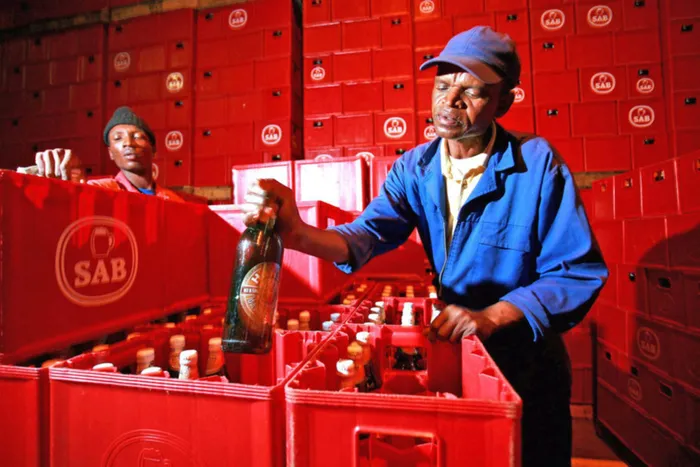
SABMiller: Photography of beer culture in the South Africa. Picture shows a distribution worker at work at Rossalyn Brewery. Rossalyn is one of seven breweries operated by The South African Breweries Ltd (SAB), a subsidiary of SABMiller plc. SAB enjoys a market share of c. 97% in South Africa. Mandatory credit: One Red Eye/Philip Meech SABMiller: Photography of beer culture in the South Africa. Picture shows a distribution worker at work at Rossalyn Brewery. Rossalyn is one of seven breweries operated by The South African Breweries Ltd (SAB), a subsidiary of SABMiller plc. SAB enjoys a market share of c. 97% in South Africa. Mandatory credit: One Red Eye/Philip Meech
Ann Crotty
SABMiller’s 11 939 employees in South Africa are among the most productive of the group’s 78 000 global employees. In terms of earnings before tax, interest and amortisation (Ebita) the 11 939 South African employees were pipped at the post by the 3 084 employees working at SABMiller’s Asia/Pacific operations.
South Africans are considerably more efficient than the comparative laggards in SABMiller’s European operations. Each of the South African employees was generating almost twice as much Ebita as each of the 14 095 European employees and about 50 percent more than each of the 26 933 South American employees.
The 8 812 North Americans were the third most productive and the 13 596 Africans (outside of South Africa) were the least productive.
The largest single determinant in the comparative productivity performance of the different regions appears to be the degree of market concentration enjoyed by SABMiller.
In South Africa, where the company’s SA Breweries (SAB) division has a market share of just under 90 percent, the group is benefiting from substantial economies of scale.
Details of the number and location of SABMiller’s employees are contained in the group’s 2012 annual report, which was released yesterday.
The report will be the last one to which chairman Meyer Kahn will contribute. Kahn is retiring at the group’s July annual general meeting after 43 years with the group.
In his chairman’s statement, Kahn discusses the strategy behind the group’s decision, taken in the late 1980s, to expand its operations beyond South Africa’s borders.
The group first moved into Africa where it acquired brewing assets “typically from governments wanting to privatise”, and applied “the rigorous operational disciplines learned in South Africa to drive down costs, achieve world-class standards in our breweries and distribute our products more efficiently”.
In the early 1990s, the group started to expand into “newly liberalised eastern Europe and the vast emerging market of China”. Motivated by a need to access the greater capital needed to support its growth strategy the group transferred its primary listing to London in 1999. In an unexpected move, that continues to be controversial, in 2002 SAB acquired the second largest beer group in the US and became SABMiller.
The next region of focus was South America, which is currently the largest contributor to group Ebita.
Most recently SABMiller moved into Australia with the acquisition of Foster’s.
Kahn points out that over this busy period the group has generated attractive returns for shareholders. “£100 (R1 315) invested in SABMiller in 1999 would have grown to £790 as at 31 March 2012, compared with just £200 if invested in our peer group median and just £144 if invested in the FTSE 100 index,” Kahn said.
“Over this period, our rolling annualised five-year total shareholder return has been a remarkable 19 percent compared with 1.9 percent for the FTSE 100 index.”
Presumably if the group had remained a South African business and maintained its virtual monopoly, it would have generated even greater returns for shareholders, but it would have become a target of the global consolidation that has characterised the industry’s past 15-years.