

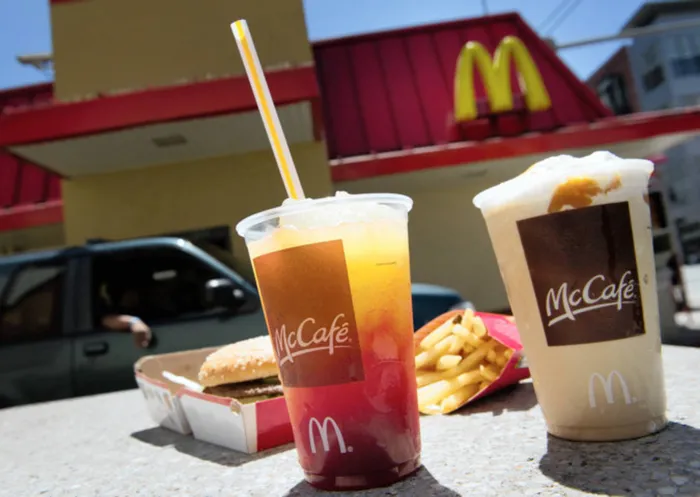
A frozen strawberry lemonade and an iced carmel mocha is seen in this photo illustration at a McDonald's Corp. restaurant in San Francisco, California, U.S., on Wednesday, July 20, 2011. McDonald's Corp. may report its eighth straight quarter of profit growth, the longest streak in 13 years, as beverages such as frozen strawberry lemonade combat rising costs that are making hamburgers less profitable. Photographer: David Paul Morris/Bloomberg A frozen strawberry lemonade and an iced carmel mocha is seen in this photo illustration at a McDonald's Corp. restaurant in San Francisco, California, U.S., on Wednesday, July 20, 2011. McDonald's Corp. may report its eighth straight quarter of profit growth, the longest streak in 13 years, as beverages such as frozen strawberry lemonade combat rising costs that are making hamburgers less profitable. Photographer: David Paul Morris/Bloomberg
Chicago - McDonald’s, already struggling to sell burgers in the US, now must contend with a brewing franchisee revolt.
Store operators say the company, looking to improve its bottom line, is increasingly charging them too much to operate their restaurants – including rent, remodelling and fees for training and software. The rising costs are making franchisees, who operate almost 90 percent of the chain’s more than 14 100 US locations, less likely to open new restaurants and refurbish them, potentially constraining sales.
McDonald’s was “doing everything they can to shift costs to operators”, said Kathryn Slater-Carter, who in June joined other franchisees in Stockton, California, to brainstorm ways of getting the chain to lessen the cost burden. “Putting too much focus on Wall Street is not a good thing in the long run.
‘‘It is not as profitable a business as it used to be,’’ said Slater-Carter, who owns two McDonald’s stores and backs California legislation that would require good faith and fair dealing between parties in a franchise contract. It would also allow franchisees to associate with fellow store owners.
Asked if McDonald’s was shifting costs to franchisees, Heather Oldani, a spokeswoman, said: ‘‘We are continuing to work together with McDonald’s owner/operators and our supplier partners to ensure that our restaurants are providing a great experience to our customers, which involves investments in training and technology.”
Lee Heriaud, who chairs the National Leadership Council, a group of franchisees that meets regularly with company executives to discuss ideas and concerns, attended the Stockton meeting and others. In a statement provided by Oldani, he said that “owner/operators’ feedback and perspectives have been shared with McDonald’s and owner/operator leadership in the spirit of open dialogue”.
The meetings were “productive”, he said.
Co-operation between McDonald’s and its store owners is deteriorating, according to an April 11 letter from a franchisee to other store owners.
“Many of you have said that you don’t feel that the top management understands the economic pressures that we face,” the letter said. “The tone has become much more controlling and less inclusive.”
This isn’t the first time the restaurant company has been at odds with the people who own and operate its stores. McDonald’s in the mid-1990s alienated US franchisees when it expanded too quickly and new stores began cannibalising other locations, said Dick Adams, a former McDonald’s store owner and restaurant consultant in San Diego.
Under pressure from franchisees, the company slowed the expansion. It opened 1 130 net new domestic restaurants in 1995; by 1998, it had cut that number to 92.
“There was a time at McDonald’s when the franchisee morale was extremely low and everyone was extremely upset,” Adams said. “We’re getting there again.”
Today’s tensions between McDonald’s and store operators coincide with the company’s struggles to grow after consumer confidence fell in July, after increasing for the past three months and with the unemployment rate stalled at 7.4 percent or higher. On July 22, the shares fell 2.7 percent, the most in nine months, when McDonald’s reported second-quarter profit and revenue that trailed analysts’ estimates.
Chief executive Don Thompson said economic weakness would hurt results for the rest of the year. Shares increased 13 percent this year to Tuesday, trailing the 20 percent gain for the Standard & Poor’s 500 restaurants index.
The Big Mac seller, which owns or leases most of its US stores, has been generating more income from franchisees. Revenue from franchised stores, which includes rent and royalties, increased 8 percent on average during the past five years, while total revenue rose 4 percent.
Some franchisees are paying as much as 12 percent of store sales in rent, according to the notes of an April 23 meeting attended by store operators. Instead, they want the company to return to a historic rate of about 8.5 percent, the document shows.
US McDonald’s restaurants average about $2.5 million (R24.7m) in annual sales, according to researcher Technomic. That means franchisees who have recently renewed leases are paying an average of $300 000 a year, up from $212 500 at the 8.5 percent rate.
“Across the country, the rent owner/operators pay for their McDonald’s restaurants is determined by local market real estate costs, as well as the cost of doing business in a particular market,” McDonald’s spokeswoman Ofelia Casillas said. “The range for rent has historically varied based on these and other… business variables.”
At the April meeting in Paramount, California, a group of franchisees spent five hours discussing ways to get the company to reduce rents and other costs. Another cadre of McDonald’s store owners met in Stockton in June to discuss similar issues.
The group in Paramount suggested reducing rents, royalty rates and creating a regional real estate team of store owners to help set lease rates.
Rent was “the firmest of fixed expenses”, said John Gordon, the principal at Pacific Management Consulting Group and a consultant to restaurant franchisees. “You pay that before you remodel… before you take owner salary out.”
As a result, some run-down stores weren’t getting fixed up, which in turn was alienating customers, he said.
Remodelling a McDonald’s store costs at least $800 000, according to Slater-Carter. That’s more than twice as much as at Burger King Worldwide, which cut the expense for its remodelling programme by half to about $300 000 on average. Wendy’s is also paring its upgrade costs and has said it will get to $375 000 for its least expensive model.
Oldani said it cost about $600 000, on average, to remodel a McDonald’s restaurant and $1m to build a store.
McDonald’s recently told franchisee Slater-Carter she must pay $80 a year to switch to the company’s e-mail system and she’s now forking over an extra $10 400 per store annually for new software, Wi-Fi and employee training costs – fees that McDonald’s has tacked on in the last five years. She won’t know until 2016, when her lease must be renewed, how much extra she may be paying.
“What I see going wrong is the corporation itself is forgetting that its fiscal strength rides on the fiscal strength and the creativity of the operators,” said Slater-Carter, whose family has owned McDonald’s franchises since 1971. – Bloomberg