

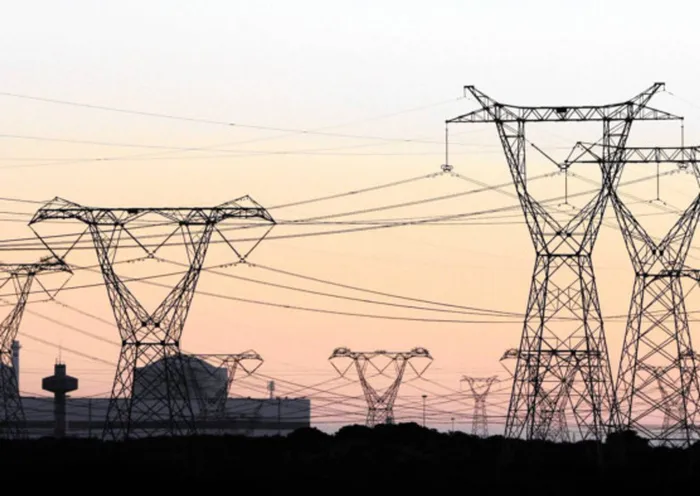
050910 Electricity pylons carry power from Cape Town's Koeberg nuclear power plant July 17, 2009. South Africa will need 20 gigawatts (GW) of new power generation capacity by 2020 and would require double that amount a decade later to meet rising demand, the country's power utility said September 7, 2009. Picture taken July 17, 2009. REUTERS/Mike Hutchings (SOUTH AFRICA ENERGY BUSINESS) 050910 Electricity pylons carry power from Cape Town's Koeberg nuclear power plant July 17, 2009. South Africa will need 20 gigawatts (GW) of new power generation capacity by 2020 and would require double that amount a decade later to meet rising demand, the country's power utility said September 7, 2009. Picture taken July 17, 2009. REUTERS/Mike Hutchings (SOUTH AFRICA ENERGY BUSINESS)
Durban - Small businesses in Pietermaritzburg were the biggest losers yesterday when the municipality finalised its monthly fixed electricity tariff increases for the 2013/14 financial year with the basic charge rocketing for commercial users.
The commercial tariffs have leapt from R46.66 to R661.35 for 80 amp users (a small shop) and from R81.65 to R861.80 for 100 amp users (a petrol station).
The electricity flow (amps) into a property attracts a fixed tariff depending on the strength of the flow.
Electricity use is charged over and above that tariff.
The chief executive of the city’s chamber of business, Melanie Veness, said last night that the increases were significant, especially for small businesses that were not expecting them.
She had been informed of the increases only when contacted by The Mercury and said she would need to look at the paperwork to get a better understanding of why the tariffs had been increased by such a big margin.
A special full council meeting was convened to finalise the tariffs.
This was after the National Energy Regulator (Nersa) decided that Msunduzi could increase its “usage” tariff (not its flow tariff) by only 7 percent.
However, the municipality had imposed a 10 percent hike from July, without Nersa’s approval.
The chamber objected and said in submissions to the regulator that businesses would suffer.
After Nersa announced its final decision, the municipality told electricity users they would be credited on their future monthly accounts for being overcharged.
This has not yet happened.
The latest decision by the municipality to increase the basic charges for domestic and commercial users, backdated to July, would probably cancel out the rebates.
Nersa had provided figures to the municipality two weeks ago for the different categories of energy users.
According to the ANC-led council, this could offset some of the losses the municipality would have incurred by imposing a lower electricity increase.
The ANC was of the view that these amounts were cast in stone and had to be implemented, while the DA said otherwise.
At yesterday’s meeting it was proposed that all the figures suggested by Nersa be implemented.
However, mayor Chris Ndlela said that the basic charge for domestic users should be kept fairly low.
Nersa said the charge for domestic users of 80 amps (a small house) should go up to R237.30 from R17.50 and for 100 amp users (a big house with a pool) to R245.80 from R29.16.
But Ndlela said the charges should go up to only R27 and R37.
Mergan Chetty, of the DA, vehemently opposed even these increases and a heated debate followed.
Chetty suggested increases of R18.72 and R31.20.
A vote was taken, with all the opposition parties banding together.
However, the ANC majority prevailed and Ndlela’s recommendation was confirmed.
Speaking afterwards, Chetty said that the municipal officials had been “creative”.
“This increase proposed by the ANC will now assist to offset the difference in the refunded amount due to residents (from the first incorrect increase). This is a rip-off of the residents. The council did not inform the public and stakeholders of this increase.”
Chetty said the tariffs and charges proposed by Nersa were the “upper limits guide”. Of the increase in the basic charge for businesses, he said the municipality appeared to be punishing the sector for complaining to Nersa. - The Mercury