

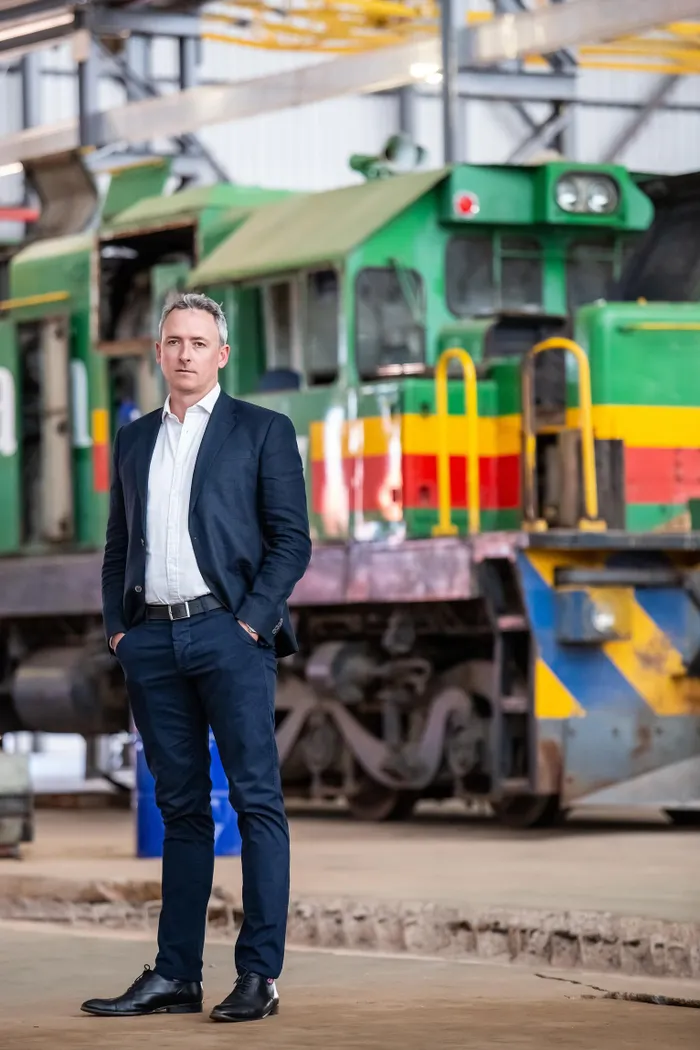
Traxtion CEO James Holley said the programme includes the acquisition of 46 Wabtec diesel-electric locomotives, 42 partly modernised U26C units and four fully modernised C30-8MMI models from KiwiRail in New Zealand.
Image: Supplied
Traxtion has confirmed it is finalising a R3.4 billion rolling stock investment programme, marking what the company describes as the largest private freight rail investment in South Africa’s history in both value and fleet size.
The move is intended to expand freight capacity and accelerate progress in South Africa’s rail reform agenda. It also forms part of a larger R5bn private-sector commitment signalled at the launch of the National Rail Policy in 2022.
The investment comprises R1.8bn for locomotives and R1.6bn for wagons, with a minimum 60% local content requirement and an estimated 662 direct jobs to be created during construction and deployment.
Traxtion on Tuesday said the additional rolling stock should help close roughly 5% of the national freight rail capacity shortfall.
Traxtion CEO James Holley said the programme includes the acquisition of 46 Wabtec diesel-electric locomotives, 42 partly modernised U26C units and four fully modernised C30-8MMI models from KiwiRail in New Zealand.
“Working with Wabtec, the 42 U26C fleet will be upgraded to C30MEI specification, featuring brand-new, fuel-efficient 7FDL-EFI engines and advanced Brightstar control systems, improving tractive performance and reliability,” he said.
“All locomotive upgrade work will take place at Traxtion’s Rail Services Hub in Rosslyn, anchoring local manufacturing and supplier participation.”
The locomotives will arrive in four tranches between April 2026 and August 2027, with each batch undergoing a four-month modernisation cycle that includes engine and control system upgrades, major services and full repainting.
The first refurbished locomotives are expected to enter South Africa’s mainline network in the third quarter of 2026.
Holley said the investment reflects confidence in government’s reform efforts.
“Each batch of 10 to 12 locomotives will undergo a four-month modernisation cycle, including engine and control system upgrades, major six yearly services and full repainting,” Holley said.
“Private capital flows when the government policies create confidence in the private sector to invest. This investment is our vote of confidence in South African rail and in the reform momentum we are seeing. Every additional locomotive we put to work lowers logistics costs, protects the road network, improves our environmental footprint, and creates jobs in the upstream economy.”
He added that the programme is structured to maximise local industrial value-add, from wagon manufacturing to supplier development and skills transfer. All wagons are expected to be manufactured domestically.
“The objective is to move more freight by rail, reliably, and at scale. We expect that all the wagons for this project will be domestically manufactured by our existing trusted wagon suppliers.”
Sipho Makhubela, CEO of Harith General Partners, said the investment marks a pivotal moment for private-sector participation in rail.
“As a long-term investor in Traxtion, Harith is confident in rail’s potential to unlock immense economic value. This programme sets a new benchmark for how private investment, aligned with policy certainty and local value creation, can deliver transformative outcomes for South Africa and the continent.”
Meanwhile, Holley said that they are preparing to unlock significantly more in further investment.
“To unlock that, the next iteration of the Rail Access Agreement under the Network Statement must be fully bankable with service-level guarantees for awarded slots, balanced legal protections, and clear recognition of lender rights,” he said.
Traxtion operates across 10 African countries and has an existing fleet of more than 50 locomotives on long-term contracts. Beyond immediate build-and-deploy activity, the company expects multiplier effects across mining, agriculture, manufacturing and export logistics as volumes shift from road to rail.
“Rail is a network industry. When trains move efficiently, the whole economy moves. This programme is about getting South Africa’s freight system working for growth and proving that private-sector investment, aligned with reform, can deliver fast, measurable gains for the country and the region,” Holley said.
BUSINESS REPORT