

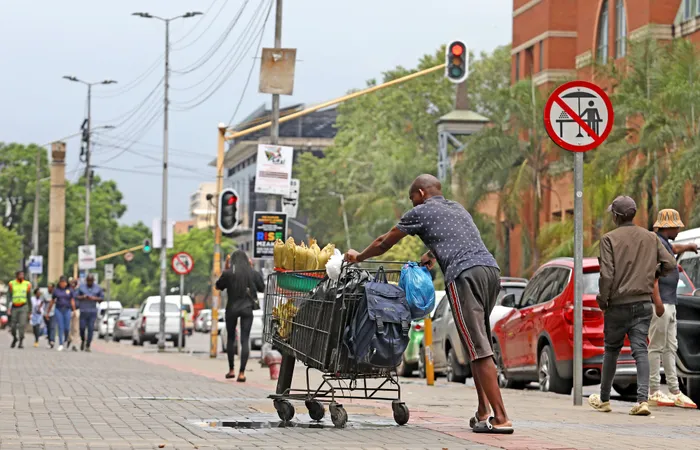
Total employment increased by 29 000 or 0.3% quarter-on-quarter, from 10 520 000 in June 2025 to 10 549 000 in September 2025; however, year-on-year employment indicated a decrease of -0.7%.
Image: Oupa Mokoena | Independent Newspapers
South Africa recorded a marginal uptick in jobs in the third quarter of 2025, with total employment rising by 29 000 jobs (0.3%) between June and September, Statistics South Africa (Stats SA) reported on Thursday.
However, employment was still 0.7% lower year-on-year, highlighting the economy’s ongoing labour market fragility.
According to Stats SA’s Quarterly Employment Statistics (QES), the quarterly gains were driven largely by increases in community services (+39 000 or 1.4%), trade (+6 000 or 0.3%), and mining (+5 000 or 1.1%). Employment levels in electricity and transport were unchanged.
Declines were reported in business services (-12 000 or -0.5%), manufacturing (-5 000 or -0.4%), and construction (-4 000 or -0.7%).
Overall, total employment fell by 79 000 jobs year-on-year between September 2024 and September 2025.
Full-time employment shrank by 21 000 jobs quarter-on-quarter to 9.4 million, mainly due to reductions in business services, manufacturing, community services and trade. Mining and construction were the only sectors to record small increases in full-time positions.
Year-on-year, full-time employment was down 72 000 jobs. Part-time employment, however, rose sharply by 50 000 jobs (4.6%) to 1.14 million, driven by strong gains in community services, trade and business services. Only construction and manufacturing shed part-time workers.
Despite the increase in part-time opportunities, part-time employment was still 0.6% lower compared with a year earlier.
Gross earnings paid to employees increased by R10.7 billion (1.1%), rising from R990bn in June 2025 to just more than R1 trillion in September 2025.
Matthew Parks, parliamentary coordinator for the Congress of South African Trade Unions (Cosatu), welcomed signs of improvement in the broader labour market, especially as reflected in last week’s Quarterly Labour Force Survey.
“The total increase in employment by 248 000 jobs bringing the total number of working South Africans to over 17.1 million is good news indeed. The fall in the number of unemployed persons by 360 000, bringing the total unemployed persons to 8 million, is equally positive,” he said.
Parks added it was crucial that this critical momentum is maintained into the festive season where there is normally a spike in employment as the retail and hospitality sectors cater for millions of workers and their families’ end-of-year festivities.
“South Africa is long overdue for some good news. Whilst welcoming nearly a quarter of a million new jobs over the past three months, we must not be complacent. A 42.4% unemployment rate remains a dangerous ticking time bomb that cannot be sustained,” Parks said.
“Much more needs to be done by the African National Congress-led government, in particular to further capacitate the frontline public and municipal services that the working class and businesses depend upon.”
Lara Hodes, Investec economist, said that formal sector employment (excluding agriculture) rose by 0.3% on a quarter-on-quarter basis (29 000 positions added) to 10.55 million in September 2025.
“However, a breakdown of the data indicates that part-time employees made up the majority of the hires during the quarter, while only a few full-time jobs were added. Indeed, the majority of sectors surveyed shed full-time positions,” Hodes said.
“Overall, 50 000 part-time employees were hired, while full-time positions decreased by -21 000.”
Hodes added that the Quarterly Employment Survey also provides details on wage developments across economic sectors.
“Specifically, gross earnings paid to employees across all industry groups rose by R10.7bn or 1.1% quarter-on-quarter in September. Increases were recorded by all segments surveyed, except for the transport and trade sectors,” she said.
“The economy is beginning to see some of its structural challenges worked down. These challenges have been impeding optimal economic activity.”
BUSINESS REPORT