

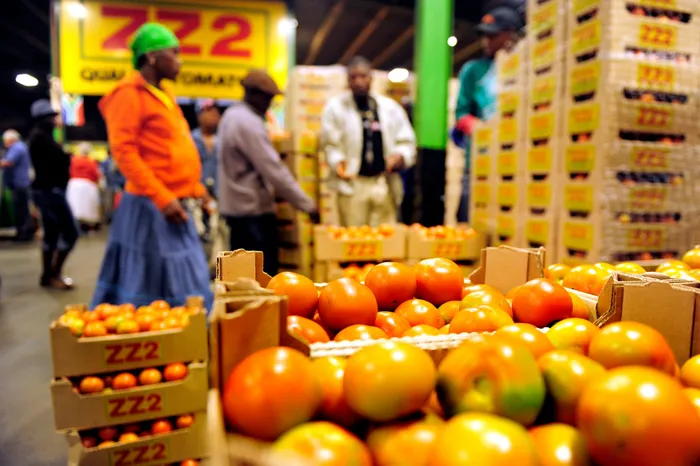
Concern has been raised by agricultural associations about Botswana imposing bans on vegetable imports earlier this week, with South Africa being one of the countries affected.
Image: Jennifer Bruce
Agricultural organisations have raised concerns following Botswana’s decision to impose a ban on vegetable imports earlier this week, a move that affects South Africa and other regional suppliers.
The ban, announced by Botswana’s Ministry of Lands and Agriculture, covers a wide range of produce, including tomatoes, potatoes, white and red cabbage, white and red onions, watermelon, green papaya, beetroot, carrots, lettuce, strawberries, ginger, red and yellow peppers, garlic and butternut.
Wandile Sihlobo, chief economist at the Agricultural Business Chamber of South Africa (Agbiz), said the decision reflects a worrying pattern among some Southern African Customs Union (SACU) member states.
He said countries such as Botswana and Namibia have repeatedly imposed short-notice restrictions on agricultural imports, often with limited consultation or communication.
“We continuously see countries restricting imports of agricultural products on short notice, with limited communication to other countries. Namibia and Botswana are the major culprits of this practice. They blocked South Africa’s vegetable imports in 2021 and at various points in subsequent years,” he said.
While he acknowledged Botswana’s intention to support its domestic farmers, Sihlobo expressed concern about the abrupt nature of the policy shift.
“I sympathise with supporting local farmers and reducing their dependence on South Africa. But I am uneasy with the drastic policy changes, with minimal consideration for regional ambitions.”
Sihlobo noted that the import ban is particularly troubling given that all affected countries are members of SACU, which is designed to promote free trade and economic integration.
Although the SACU agreement allows for certain trade restrictions under Article 18 — including for health, environmental or national security reasons — he said Botswana’s current measures do not appear to fall within those exceptions.
Sihlobo added that he does not see the current Botswana restrictions fitting the above description.
“Of course, this action has had a financial impact on South African farmers, who have for many years produced for the domestic market and the region at large. The question that remains is: how should we respond to these events? South Africa’s response will need to be sensitive but firm.”
Sihlobo cautioned that South Africa’s response should be measured but firm, given the country’s heavy reliance on regional trade. He noted that of South Africa’s record $13.7 billion (R219 billion) in agricultural exports in 2024, about 40% were destined for African markets.
“This figure has been the same for the past decade. Importantly, for every dollar of agricultural products South Africa exports to the African continent, 90 cents are traded within the Southern African region. Thus, an engagement with this region on the export ban must recognise that South Africa, as a country, depends heavily on the Southern African region.”
Francois Rossouw, CEO of Southern African Agri Initiative (Saai), said Botswana’s reinstated ban is disruptive but does not yet constitute a crisis.
He said South African farmers supply a significant share of Botswana’s fresh produce, making sudden market closures particularly damaging for producers who plan planting cycles around regional demand.
“These abrupt bans, issued with little to no warning, create uncertainty and undermine the regional cooperation that the Southern African Customs Union was built on,” Rossouw said.
He stressed that while Botswana’s goal of strengthening local production is legitimate, the unpredictability of the bans is a major concern.
“SACU is supposed to guarantee free trade, yet Article 18 loopholes are repeatedly used for blanket restrictions that don’t fit the intended criteria. When countries impose bans without clear justification, timelines, or coordination, it destabilises planning, cash flow, and investment confidence on the South African side.”
Rossouw said farmers could adapt to phased localisation strategies or seasonal protection measures, but not to sudden policy shifts.
“Farmers can adapt to seasonal access or phased localisation strategies, but they cannot operate in an environment of sudden policy swings. Predictability is essential,” he said.
He added that South Africa should pursue constructive but firm diplomatic engagement with Botswana to ensure clarity, prevent prolonged restrictions and protect regional value chains.
“Hostility won’t help any of us, our economies and food systems are tightly integrated. The priority now is diplomatic engagement to ensure clarity, avoid long-term bans, and protect regional value chains that benefit both countries.”
BUSINESS REPORT