

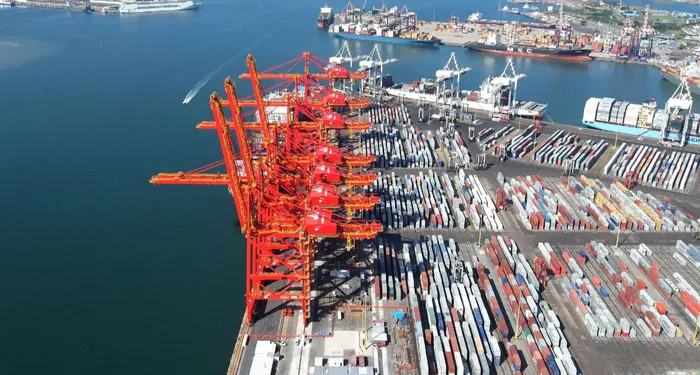
Transnet interim results for the six months to 30 September 2025 released on Friday indicated an increase in rail volume performance and tonnage throughput.
Image: File
Transnet saw a steady operational improvement in the six months to 30 September as higher rail volumes and increased tonnage throughput breached the 80 million tons, helping to narrow losses.
The State-owned logistics group last week reported that rail volume performance increased by 4.4% to 81.4 million tons, compared with 78.0 million tons in the same period last year.
Transnet said momentum strengthened towards the end of the reporting period, with September 2025 recording throughput of 14.8 million tons, the highest monthly performance since the 2022 financial year, despite maintenance-related disruptions to manganese volumes.
Group CEO, Advocate Michelle Phillips, said the improved operational performance translated into a 17.7% reduction in the reported net loss to R1.8 billion, from R2.2bn a year earlier.
“Transnet’s volume performance has been on an upward trajectory since the 2024 financial year. The company will leverage private sector participation (PSP) to improve efficiencies and fund capital investment requirements,” Phillips said.
“The acquisition of key port equipment has gained significant momentum, contributing to notable performance improvements within the port business.”
This is a development that industry experts have cautiously welcomed.
Dr Jacob van Rensburg, head of research and development at the Southern African Association of Freight Forwarders (SAAFF), described the results as “cautiously encouraging”.
“The improvement in volumes, particularly towards the end of the reporting period, suggests that some operational stabilisation is beginning to take hold across parts of the system,” he said.
“That said, these outcomes should be viewed in context: overall throughput remains below historical performance levels seen in earlier years, and the system is not yet on a path consistent with South Africa’s longer-term logistics and growth targets.”
He added that the increase in tonnage throughput was significant for both cyclical and structural reasons. The strong September performance pointed to a meaningful rebound in operational output, while higher volumes were critical for economic competitiveness.
“Even with this improvement, aggregate volumes remain well below the historical highs of around 226 million tonnes achieved in earlier periods. In other words, the system is recovering from a low base,” Van Rensburg said.
“The increase in rail volumes is clearly positive. Rail is the backbone of South Africa’s bulk and long-distance freight system, and improvements here have a disproportionate impact on economic competitiveness, logistics costs, and network resilience.”
Malcolm Hartwell, director at Norton Rose Fulbright and a master mariner, said the interim results reflected an ongoing improvement in both rail and port operations.
“It echoes other reports from Transnet in the last several months reflecting an improvement across the critical spheres of South Africa's economy that Transnet controls,” he said.
“As we have repeatedly said over the last several years, the performance of a country's logistics network is the single most significant factor in determining a country’s economic performance.”
Hartwell attributed the gains to a combination of increased public-private partnerships, the ongoing reform and partial privatisation of rail operations, greater investment in port handling equipment, the growth of private terminals and an enhanced focus on corporate governance.
“In a country heavily dependent on imports and exports, the growth in volumes across rail, container and petroleum products will be welcomed by everybody involved in the logistics sector and South Africa's import and export driven industries.”
Ulrich Joubert, an independent economist, also welcomed the improved performance, particularly the rise in freight volumes carried by rail and handled at ports.
“Good news that it comes from improved freight carried on the railway lines that could assist the total economy. This is welcome news. At the same time, we know that this is going to be a long and difficult road, especially if the debt is still increasing,” Joubert said,
“And we know that it is hard work just to keep up to date with servicing the debt. Overall, I'm happy to see these figures and we really hope that this is a start to a long-term improvement of the efficiency.”
BUSINESS REPORT