

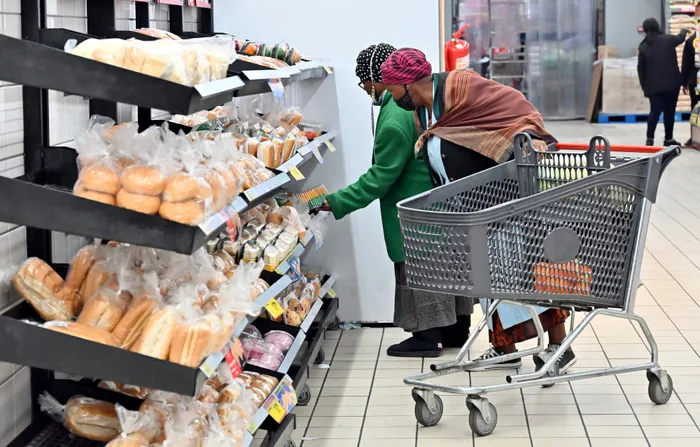
Despite a decline in the average cost of essential food items, South African families are still grappling with food insecurity. Discover the significant trends and implications for households across the nation in the December 2025 Household Affordability Index.
Image: Ayanda Ndamane/ Independent Newspapers.
As South Africans prepare to close the year, the December 2025 Household Affordability Index presented both a glimmer of hope and a stark reminder of ongoing economic challenges.
Tracking the prices of 44 essential food items across 47 supermarkets and 32 butcheries in urban areas— from Johannesburg's Soweto to Springbok in the Northern Cape— the latest report revealed a decrease in the average cost of the Household Food Basket to R5 333,45.
This represents a month-on-month reduction of R80,08, or 1.5%, from R5 413,53 in November.
Year-on-year, the figure has decreased by R49,93, down 0.9% from R5 383,38 in December 2024.
The data from the index, which offers invaluable insights into the monthly food expenditures for families in South Africa, highlights a complex landscape of food pricing.
In December, of the 44 tracked items, 18 saw price increases, while 26 items saw price declines.
Notably, prices for staple items such as rice (-5%), potatoes (-8%), and butternut (-28%) have decreased significantly.
Conversely, the prices of carrots (9%), bananas (6%), and oranges (9%) saw considerable increases, illustrating the volatility and unpredictable nature of food costs.
Geographically, the affordability trend showcases a variance in food basket prices across major urban centres.
Johannesburg experienced a month-on-month decline in its food basket of R66,08 (1.2%), bringing the total to R5 538,42.
Meanwhile, Cape Town reported the most significant decrease of R163,90 (3.1%) to R5 185,27.
In stark contrast, the Durban food basket remained largely stable, inflating marginally by R0,72, while still representing a year-on-year decline of R54,19 (1.0%).
In a broader economic context, Statistics South Africa's Consumer Price Index illustrates a landscape of cautious optimism.
With headline inflation pegged at 3.5%, food prices specifically saw inflation rates of 4.4% for food and non-alcoholic beverages.
Despite the slight decreases observed in the affordability index, the persistent price pressure underscores the need for continued vigilance among consumers.
However, beyond the monthly statistics lies the pressing concern of food security for many families.
The National Minimum Wage currently stands at R28,79 per hour, leaving workers with a staggering challenge as they support an average of 3.9 dependents.
The calculated amount for essentials— comprising transport and electricity— accounts for a staggering 60.4% of a worker’s wage, drawing attention to the dire circumstances facing low-income earners.
In this context, the average monthly cost of a basic nutritional food basket for a family of four is documented at R3 678,87.
This creates a worrying scenario where families, after covering basic expenses, may underspend on food by at least 50.4%.
Given that the rebased Food Poverty Line is marked at R777 per person, realities show that many are unable to secure adequate nutrition for their families.
The plight of children is particularly concerning, with the average cost of feeding a child a basic nutritious diet now at R937,61, showing a nominal year-on-year decrease.
The Child Support Grant of R560 per month starkly falls short, sitting 28% below the reestablished Food Poverty Line, thereby exacerbating the vulnerability faced by many households reliant upon this support.
As 2025 draws to a close, the Household Affordability Index serves as both a reflection of current economic conditions and a call to action.
The fluctuating food prices highlight the importance of continued advocacy for fair wage policies and enhanced support systems, ensuring that no family is forced to choose between basic necessities and nutrition in the new year.
BUSINESS REPORT