

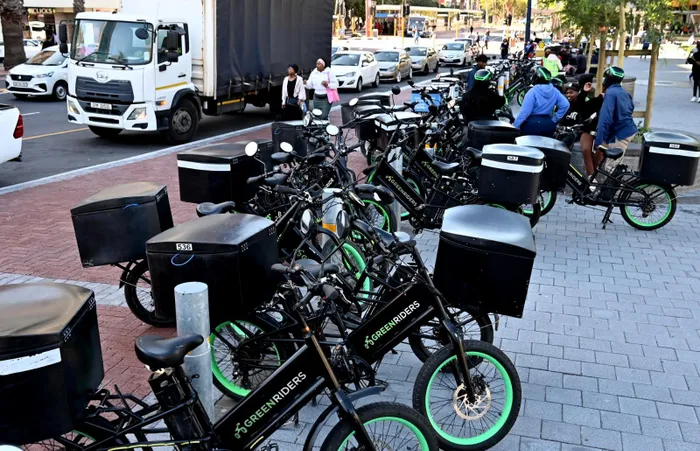
In a society where the bustle of daily life can draw our focus away from budgeting and savings, Standard Bank's findings serve as a necessary wake-up call. By examining and adjusting our spending habits, particularly in the realm of convenience, we can work towards establishing a robust emergency fund to navigate uncertain economic times.
Image: Ayanda Ndamane / Independent Media
As economic uncertainty looms over South Africa, a recent analysis by Standard Bank has revealed alarming insights into the financial behaviours of its customers.
Particularly concerning is the statistic that over 45% of clients lack accessible emergency savings, even among those earning stable incomes.
Among Private Banking clients who earn between R25,000 and R58,000 a month, more than a third have no emergency savings at all.
This troubling trend underscores the importance of developing a financial buffer in a fluctuating economic landscape.
Doret Jooste, Head of Money Management and Advisory at Standard Bank, articulated the challenges many face: "We know that growing one’s income isn't always easy because there are external factors we can't control." In response to this pressing issue, Standard Bank has initiated efforts to assist consumers by providing practical tips aimed at encouraging savings. A major focus has been on the often-overlooked area of takeaway spending.

Doret Jooste, Head of Money Management and Advisory at Standard Bank.
Image: Supplied.
In an age where food delivery is merely a tap away on our smartphones, the convenience of takeaways has become a staple for many urban households.
Balancing 9-5 jobs and navigating traffic often makes cooking at home feel like a luxury, leading to a rise in food delivery expenditures.
Recent data reveals that many customers spend an average of R775 a month solely on takeaways and food delivery— a staggering figure that excludes supermarket and grocery purchases.
This amount, calculated based on transactions with 14 major fast-food franchises, is likely understated, given that many customers use multiple banking services.
Interestingly, the data indicates that spending patterns vary with age and income.
Consumers in their late 20s to mid-30s are the heaviest spenders, particularly those earning over R60,000 a month, who average over R1,000, with expenses peaking at R1,300 during holiday seasons.
Jooste points out, "These are often family meals, and this group likely views it as a time-saving trade-off." Conversely, lower to middle-income earners confront a tighter squeeze; those earning below R20,000 spend approximately R472 a month, while those around R25,000 spend about R615. For many of these individuals, such expenditures can account for up to 2.5% of their disposable income and exacerbate financial stress due to the accumulation of low-value purchases over time.
Convenience spending, while seemingly innocuous, often goes unnoticed and unplanned, gradually chipping away at disposable income without adequate budgeting.
Jooste emphasises the necessity for households to scrutinise their monthly spending habits. "Identifying impulse triggers and setting spending caps are crucial," she advises.
Standard Bank's Mobile App includes a Money Movements tool that can assist clients in tracking these expenses effectively.
Jooste suggests that even modest adjustments, such as reducing takeout spending from R615 to R400 a month, could free up as much as R2,500 annually.
When invested wisely, this amount could grow to over R41,000 in ten years at a 10% annual interest rate.
Additionally, subscription costs represent another substantial expense that low to middle-income customers should review.
The average monthly outlay for subscriptions stands at R336 for low-income earners, R482 for middle earners, and spikes at R1,255 for Private Banking clients.
By halving expenditures on both food delivery and subscriptions, households could potentially redirect over R400 towards savings for lower-income earners and more than R1,100 for Private Banking clients, providing a critical opportunity to either build savings or decrease debt.
It’s not about eliminating these costs entirely, but rather about being intentional with spending.
Simple shifts, such as opting for a homemade burger night instead of a takeaway or packing lunch for work or school, can significantly ease cash flow challenges.
Jooste passionately advocates for these adjustments, stating, "Small changes set the foundation for stronger financial habits and a more secure financial future." In doing so, it becomes possible not only to improve one's financial situation but also to develop a more mindful approach towards consumption.
BUSINESS REPORT