

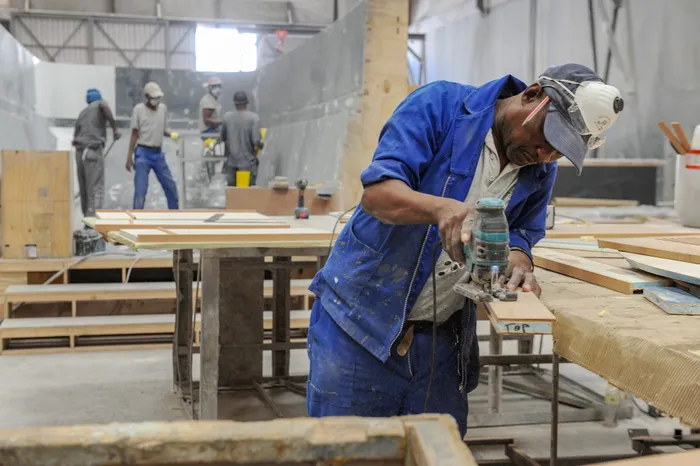
The index remains well below the 50-point threshold that separates expansion from contraction, underscoring the severity of the downturn in manufacturing activity as the year came to an end.
Image: David Ritchie/Independent Newspapers.
South Africa’s manufacturing sector closed out 2025 on an exceptionally weak footing, with business activity contracting sharply as demand dried up and firms cut back on inventories and employment, according to the latest Purchasing Managers’ Index (PMI) data released on Thursday.
The Absa PMI fell by a further 1.5 points to 40.5 in December 2025, moving even deeper into contractionary territory and marking its lowest reading since 2020.
The index remains well below the 50-point threshold that separates expansion from contraction, underscoring the severity of the downturn in manufacturing activity as the year came to an end.
The bleak Absa PMI reading followed the release of the S&P Global South Africa PMI earlier in the week, which also signalled a pronounced deterioration in business conditions.
S&P Global reported that December saw the strongest downturn in operating conditions in nearly a year, as customers reined in spending and manufacturers responded by scaling back activity.
Miyelani Maluleke, Absa Corporate and Investment Banking macro-economist, said the December PMI highlighted just how weak conditions were at the close of 2025.
“So we ended 2025 on a very weak note. The primary challenge at the moment, based on the survey data, appears to be weak new sales orders,” Maluleke said.
He added that weak demand was the primary drag on manufacturing performance, with survey respondents reporting subdued new sales orders across both domestic and export markets.
Maluleke said one encouraging aspect is the clear optimism in the sector regarding the outlook for this year. The index that measures expected business conditions in six months' time jumped nearly 20 points to its highest level in more than a year.
“Part of this optimism seems to be coming from the fact that operating costs for manufacturers have come down quite a bit over the last few months,” he said.
“Of course, partly supported by the fact that the rand is stronger, but also the fact that oil prices have come down, which, of course, has delivered fuel price cuts that are already coming into the new year.”
The PMI data showed that new sales orders were largely unchanged from November, dipping marginally to 35.4 in December, and remaining at deeply depressed levels. The decline in sales was driven mainly by the domestic economy, with modest improvements in export orders proving insufficient to lift overall demand.
While manufacturing activity remained under pressure, there were tentative signs of stabilisation. The business activity index rose sharply by 9.4 points to 46.1 in December, marking a notable month-on-month improvement, although it still remained below the neutral 50 mark.
Despite the rebound, the index has been in contractionary territory for 11 of the 12 months in 2025, highlighting the persistence of weak underlying conditions in the sector.
The Absa PMI noted that the weaker headline reading in December was driven largely by an unusually sharp decline in inventories, alongside a steep fall in the employment index.
These trends suggest that manufacturers continued to operate cautiously, trimming stock levels and limiting hiring in response to ongoing uncertainty and weak order books.
S&P Global’s PMI echoed this downbeat assessment. The S&P Global South Africa PMI fell to 47.7 in December from 49.0 in November, signalling a faster and more pronounced deterioration in private-sector operating conditions.
The index remained in contraction territory throughout the final quarter of the year, with December’s reading the weakest in 11 months.
S&P Global said reduced customer spending led to a sharp decline in business activity, prompting firms to curb purchases and run down input inventories.
While employment edged slightly higher, overall activity remained subdued, reinforcing the picture of a manufacturing sector struggling to gain traction.
Despite the slump in current conditions, sentiment about the outlook improved markedly.
Diyanna Slabbert, an econometrician at Investec, said that advance indications provided by the seasonally adjusted headline PMI show that the index worsened in December.
BUSINESS REPORT