

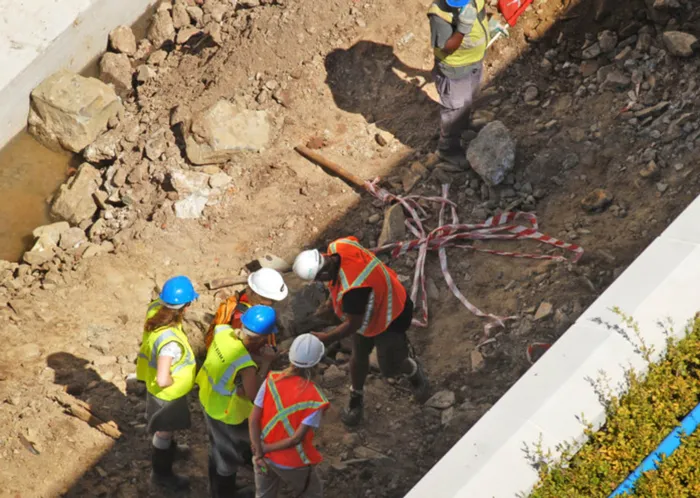
A new Bureau for Economic Research (BER) report indicates that infrastructure and investment are moving in the right direction
Image: Ross Jansen/Independent Newspapers
A new Bureau for Economic Research (BER) survey suggests South Africa’s infrastructure and investment environment is beginning to move in a more positive direction, with economists cautiously welcoming the improvement.
Craig Lemboe of the BER said the results of the fourth-quarter civil construction survey are the most optimistic seen in years. More than half of respondents reported satisfaction with prevailing business conditions, while views on the availability of work and profitability were notably upbeat.
“Even more encouraging is that respondents are significantly positive about the current availability of work and, consequently, their profitability. (A net balance of 14% reported higher growth compared to the same period in 2024 versus a long-term average of –28%).”
The latest First National Bank (FNB)/BER civil construction confidence index indicates that activity in parts of the infrastructure space is gaining momentum.
However, the survey primarily reflects contractors active in the private sector and large firms, known as Grade 9 civil engineering contractors.
Lemboe said the improvement is not broad-based, with most of the activity linked to renewable energy projects and, to a lesser extent, mining.
One encouraging sign for the energy sector is the growing pipeline of private renewable energy projects that have been registered but are yet to be built.
“Ever since the rule was lifted in 2022 that required private sector energy projects to acquire a license, economists have been waiting to see interest in renewable energy being matched by the number of projects that break ground," Lemboe said.
"There is now compelling evidence that this conversion of interest into actual bricks and mortar is happening at scale.”
Despite the improved sentiment, he cautioned that it is too early to conclude that South Africa has decisively turned a corner on infrastructure investment.
The broader fixed investment outlook remains heavily dependent on public sector spending on schools, roads and hospitals — areas that continue to underperform.
Beyond limited public sector projects, the civil construction sector still faces familiar constraints, including project delays, late payments to contractors and lengthy tender processes, all pointing to capacity challenges within the state.
Crime and corruption, including the activities of so-called “construction mafia” groups, also remain a persistent risk.
Lemboe added that to lift activity and confidence further we need to make more noticeable progress in improving the efficiency of the national logistics framework (among other things) in the same way that we’ve demonstrated is possible in reforming energy generation.
“In other words, to turn improved sentiment into actual investment we need to turn reform announcements into visible, daily improvements in how the country operates.”
Professor Waldo Krugell, an economist at North-West University, said the uptick in civil construction confidence is welcome news after a prolonged period of weak readings.
“Those civil construction confidence indicators have been very low for some time, and to have them improve is good news," Krugell said.
"The comment does mention the challenges with public sector infrastructure investment and one can only hope that reform momentum ahead of the local government elections translates into public sector investment in roads, clinics.”
Ulrich Joubert, an independent economist, also described the survey results as a notable improvement, highlighting stronger views on business conditions and the availability of work.
“So, more than half of the respondents were satisfied with the prevailing business conditions. So, it's an improvement in those conditions and what they also said in the report is that the respondents are significantly positive about the current availability of work,” Joubert said.
He noted some new mining-related projects but said the scale of activity remains surprising given strong commodity prices.
“That is very strange because, if we had a normal situation in the mining sector, then with these price increases that, we've seen on the gold, on the platinum prices, palladium, wherever, that you would actually have thought that you would see many new projects in the mining sector in South Africa.”
BUSINESS REPORT