

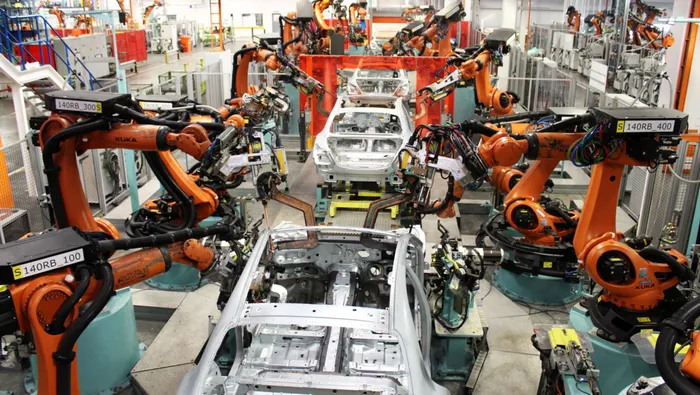
Manufacturing production decreased by 1.4% in December 2025 compared with December 2024 as released by Stats SA on Thursday.
Image: Supplied
Manufacturing production decreased by 1.4% in December 2025 compared with December 2024 as released by Stats SA on Thursday. Experts have given mixed reactions to the findings.
Stats SA said that the largest negative contributions to the decrease were made by the following divisions: food and beverages (-4.6% and contributing -1.4 percentage point); wood and wood products, paper, publishing and printing (-5.2% and contributing -0.6 of a percentage point); and basic iron and steel, non-ferrous metal products, metal products and machinery (-2.3% and contributing -0.4 of a percentage point).
Stats SA added that the petroleum, chemical products, rubber and plastic products division was the largest positive contributor (7.5% and contributing 1.6 percentage points).
Seasonally adjusted manufacturing production decreased by 1.2% in December 2025 compared with November 2025. This followed month-on-month changes of -2.1% in November 2025 and 1.1% in October 2025.
Stats SA said that in 2025, total manufacturing production decreased by 1.3% compared with 2024.
Lara Hodes, an Investec economist, said manufacturing production fell by -1.4% year on year (y/y) in December, largely in line with Investec’s forecast.
“This follows a -2.0% y/y contraction in November. Measured on a quarter-on-quarter seasonally adjusted basis, production declined by -0.5%. The result is in line with the movement of the seasonally adjusted headline Purchasing Managers’ index (PMI), which slid further into contractionary territory at the end of last year. It fell 1.5 points to 40.5, suggesting that conditions in the sector remained challenging at the end of the year, according to the BER,” she said.
Hodes added that the breakdown of December’s manufacturing data reveals that the decline was broad-based, with eight out of the ten manufacturing sub-sectors surveyed contracting when compared to the same period last year.
“The only positive contribution of 1.6% stemmed from the petroleum, chemical products, rubber and plastic products grouping. Food and beverage production, which makes up 22.2% of the manufacturing basket, declined by -4.6% y/y, detracting -1.4% from the headline reading,” she said.
Hodes said the wood and wood products, paper, publishing and printing segment detracted a further -0.6%, underpinned largely by a -10.0% y/y contraction in the output of paper and paper products. “Domestically, the industry continues to face a number of challenges, weighing on the cost of production and optimal activity. Sentiment amongst manufacturers picked up in the fourth quarter of 2025, according to the results of the BER’s manufacturing survey. Although still subdued at 39, it is the highest reading since Q1.22 and is “above the long-term average reading of 35 points according to BER.”
Thanda Sithole, a FNB senior economist, said in 2025, total manufacturing output contracted further, declining by -1.3% y/y, compared to -0.4% in 2024. “This reflected a broad-based downturn across most manufacturing divisions, except for textiles, clothing, leather and footwear, which recorded modest growth of 0.6% after declining by 2.9% in 2024.”
Sithole added that the electrical machinery division experienced the steepest decline (-3.3%) in 2025, followed by the wood and wood products division (-3.1%).
“The motor vehicles, parts and accessories, and other transport equipment division declined by 2.5%, an improvement relative to the sharp 13.5% contraction in 2024. Within the automotive division, the average annual decline was largely driven by weakness in parts and accessories, and other automotive-related products. We expect a modest rebound in manufacturing production in 2026, supported by continued improvement in domestic demand, easing infrastructure constraints, and a stable global growth environment,” Sithole said.
BUSINESS REPORT