
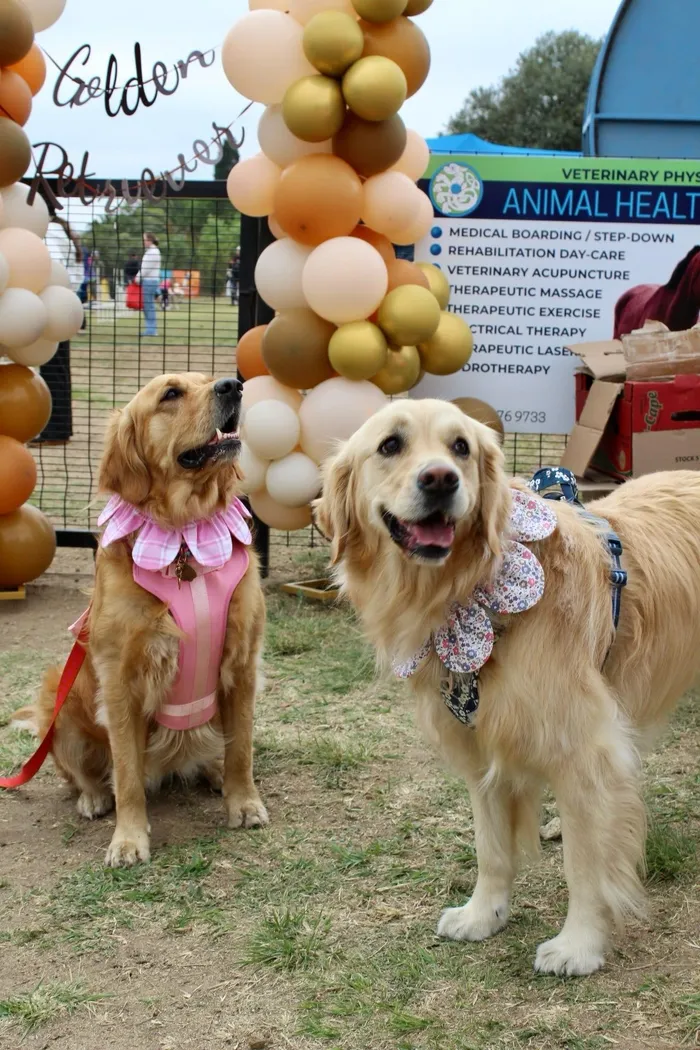
Instagram and TikTok stars, @Channathegolden and @Goldengirl.shiina in attendance at the first Gauteng Golden Retriever meet up that saw 149 golden retrievers gather in one spot. The South African pet care market, valued at $520 million (R8 billion) and projected to reach $800 million (R12.6 billion) by 2032, according to Vyansa Intelligence, has evolved into one of the country’s most resilient consumer segments.
Image: Supplied.
Towards the end of 2025, half of South African households cut discretionary spending.
Yet the country's pet care market continues to grow. This isn't an anomaly. It is evidence that the category has fundamentally changed.
The South African pet care market, valued at $520 million (R8 billion) and projected to reach $800 million (R12.6 billion) by 2032, according to Vyansa Intelligence, has evolved into one of the country’s most resilient consumer segments. For the 45% of adults who own pets - many spending R30,000 to R60,000 in the first year alone - this is no longer discretionary. It is household budget that's protected even when everything else gets cut.
The driver is pet humanisation. Ninety-seven percent of pet owners now consider their animals family members. When that shift happens, pet care migrates from “nice-to-have” to non-negotiable.
This pattern isn't unique to South Africa. During the 2008 financial crisis, the U.S. pet industry grew 5.1%. During Covid-19, pet product sales grew 16.2% compared to 4.3% for the broader economy.
Economists classify pet spending as "acyclical", with demand holding regardless of macroeconomic conditions.
When budgets tighten, surveys show consumers cut dining out, personal grooming, and fitness. Pet expenditure stays or increases.
For years, South Africa's pet care market was fragmented, with independent players operating on varying standards and with limited reach.
That era is ending.
The sector’s maturation is visible in Monic Group’s acquisition of Marltons Pet Care, uniting it with Montego Pet Nutrition within the group portfolio to leverage over a century of combined experience.
This integration is about building industrial capacity: by pooling resources and operational infrastructure, the group can unlock new growth opportunities and drive efficiencies in distribution and warehousing. It establishes a platform where deep category knowledge meets the logistical muscle required to serve a modern retail economy.
Manufacturing facilities are being upgraded to international certifications. Supply chains are becoming predictive. Some South African manufacturers are now exporting to developed markets - a signal of growing sophistication.
This maturation delivers tangible benefits. Specialised nutrition for renal support, joint care, and digestive health is now widely available.
A decade ago, options were limited to generic kibble. Today, the market offers segmentation into condition-specific formulations - premium ingredients, novel proteins, and grain-free options that were previously import-only rarities.
Scaled manufacturers are investing in certified facilities with rigorous quality protocols. In a market where only 1% of pets carry insurance and unexpected surgeries can cost R25,000, prevention through quality nutrition becomes critical.
Established brands with reputations to protect bring accountability that was diffuse in a fragmented market. What's on the label is actually in the bag. Products are safer, choices are broader, and standards are higher.
The economics are equally compelling for retailers.
Pet food accounts for 74% of total pet care market value, with supermarkets and hypermarkets commanding 61.45% of distribution. For retailers, the category offers a rare combination: higher margins than many FMCG staples, strong brand loyalty in an era of promiscuous switching, and basket-building potential as pet owners purchase food, toys, bedding, and grooming products in single trips.
Assortment depth now rivals infant formula, with specialised diets for life stages, health conditions, and breed sizes. Where traditional grocery margins face pressure, pet care defends profitability while driving foot traffic.
Ultimately, this industry is not built on spreadsheets or supply chains. It is built on the bond between people and their pets. As the market consolidates, the companies that will succeed are not the ones that simply grow the largest, but the ones that care the most.
Scale and values aren't opposites. Growth provides the capacity to support consumers when they need it most. It allows brands to absorb supply chain shocks without passing every cost to the shelf. It funds the innovation that prolongs pets' lives. And it enables meaningful support for animal welfare initiatives that smaller entities simply cannot sustain.
Consumers vote with their wallets for shared values. They support the brands that support them. The future of pet care belongs to those who prove that growing bigger means the ability to care better.
Johan van Jaarsveld, Managing Director of Montego Pet Nutrition.

Johan van Jaarsveld, Managing Director of Montego Pet Nutrition.
Image: Supplied.
BUSINESS REPORT