

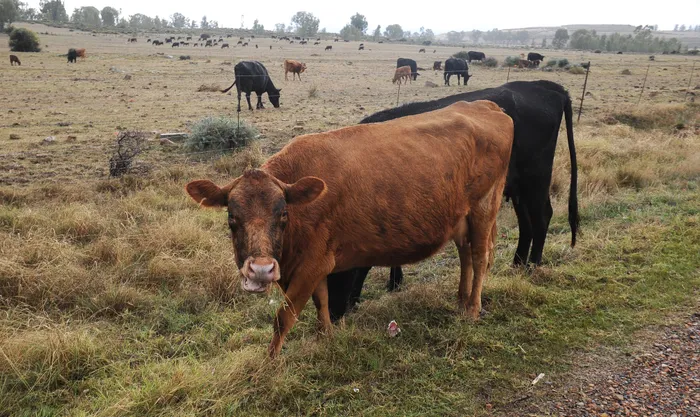
Zambia announcing a temporary import ban on South African livestock due to the Foot and Mouth disease (FMD) outbreak has received mixed responses from the agriculture industry and the Department of Agriculture
Image: Courtney Africa / independent Newspapers
Zambia announcing a temporary import ban on South African livestock due to the Foot and Mouth disease (FMD) outbreak has received mixed responses from the agriculture industry and the Department of Agriculture. This follows President Cyril Ramaphosa declaring FMD a national disaster last week in his State of the Nation Address.
Moses Rannditsheni, Director: Media and External Communication at the Department of Agriculture, said that Zambia imports an insignificant volume of agricultural products.
“Although every agricultural product exported out of SA grows the SA agricultural economy, suspension by Zambia would not really make any significant impact. We understood why Zambia arrived at its decision and hope they will review this suspension as soon as we start with the mass vaccination,” he said.
Wandile Sihlobo, the chief economist at the Agricultural Business Chamber of South Africa (Agbiz), said Zambia's decision to temporarily restrict imports of livestock from Namibia is understandable given the regional implications of the foot-and-mouth disease outbreak.
“These restrictions can remain in place until we resolve this disease, but with fair movement in some areas, subject to clear inspections. Once we get control of it, trade in the region must continue smoothly,” he said.
Dawie Maree, head of information and marketing at FNB Agriculture, said the banning of South Africa’s livestock exports to Zambia is not significant. “SA only exports genetic material to Zambia in the form of live animals, and that is not big enough to be a concern. It's not a huge concern, except for breeders of genetics, normally Boran breeders. But it can be expected given the FMD outbreak.”
Maree said that he does not feel the National Disaster declaration will have an impact on the ban issued by Zambia. “Declaration of the disaster just means that additional resources can be unlocked to contain the disaster. The only thing that will help is vaccinations and then to prove that animals are FMD-free before exporting. And then country-to-country negotiations, supported by scientific proof, to lift the ban.”
Francois Rossouw, the CEO of the Southern African Agri Initiative (Saai), said Zambia is an important but not dominant market for South African livestock exports. “The trade largely consists of breeding cattle, dairy genetics and some small stock. While it is not our largest export destination by volume, Zambia forms part of a broader Southern and East African trade network that supports stud breeders, dairy development programmes and long-term agricultural partnerships.”
Rossouw added that the value of this trade lies less in sheer numbers and more in strategic herd development and regional cooperation.
“However, the more significant impact of this suspension is not only direct exports into Zambia - it is transit through Zambia. Zambia is a critical road corridor into markets further north, including the Democratic Republic of Congo and parts of East Africa. When transit permits are suspended, it disrupts an entire regional supply chain. The effect is multiplied beyond one bilateral relationship,” he said.
Rossouw said regional livestock trade is built on confidence, veterinary credibility and rapid outbreak management. “When Foot-and-Mouth Disease is not contained swiftly and transparently, the consequences are immediate: border closures, cancelled permits, contractual uncertainty, increased logistics costs and reputational damage. Zambia’s decision is sovereign and precautionary. They are protecting their national herd. South Africa would do the same under similar circumstances. The real question is whether this scale of disruption could have been mitigated through faster reaction, improved vaccine availability, stricter movement control and a fully functional traceability system. Export markets require certainty and regulatory efficiency.”
Dewald Olivier, the CEO of Red Meat Industry Services, said Zambia’s decision to suspend livestock imports from South Africa should add further urgency to the implementation plans that will bring the outbreak under control, including vaccine acquisition and its coordinated nationwide rollout.
“The immediate impact of the suspension is one concern, but the cumulative effect over time is a risk that can’t yet be fully determined. Both the short- and long-term impacts of the suspension add additional pressure to an industry already under severe strain,” Olivier said.
BUSINESS REPORT