

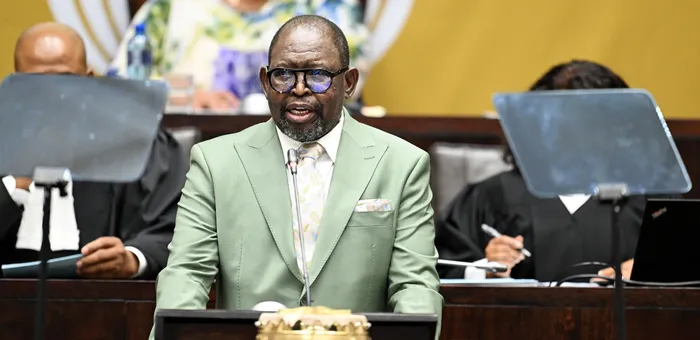
As South Africa braces for the 2026 Budget, Finance Minister Enoch Godongwana is poised to present a plan for cautious fiscal continuity, amid the backdrop of transformative challenges and upcoming local elections. Will the country overcome its economic stagnation, or will it surrender to the pressures of political ambivalence?
Image: Parliament RSA/Supplied
As the countdown to Finance Minister Enoch Godongwana’s 2026 Budget speech on 25 February intensifies, the prevailing sentiment is one of cautious stability rather than dramatic shifts.
With local government elections on the horizon, expectations for major tax shocks or sweeping reforms are low.
Analysts and economists suggest that the upcoming budget will prioritise a balanced approach to fiscal responsibility while navigating a challenging economic landscape.
According to Prof André Roux, an economist at Stellenbosch Business School, this year's budget represents a delicate balancing act where fiscal prudence contends with the demands of political expedience.
The government is expected to maintain a commitment to a primary budget surplus and to lower the country’s high debt-to-GDP ratio, thus leaving little room for an “expansionary budget stance.”
In 2025, the budget process faced considerable hiccups, but Roux predicts a more inclusive and transparent approach this year.
“The looming local elections make significant tax or expenditure changes unlikely,” he said, noting the impact of stagnant economic growth and high unemployment levels, which inhibit organic growth in tax revenue.
Despite these challenges, a silver lining exists, high gold prices are anticipated to yield a modest corporate tax windfall.
Interestingly, while the government aims to curb personal income tax rates visibly, a non-adjustment for bracket creep may surreptitiously raise the effective tax burden among middle-income taxpayers.
The anticipated boost from mining taxes will likely be insufficient to fill all fiscal gaps, prompting calls for increased efficiency from the South African Revenue Service (SARS).
Additionally, incremental increases in various “sin taxes” are expected as the government seeks to generate additional revenue.
On the expenditure side, Roux said that it would be politically unwise to cut transfer payments to vulnerable households, suggesting an extension of the social relief of distress grant (SRDG) for another year, possibly with a minor increase.
However, ambitions for a more universal income grant appear to have been shelved, given current fiscal constraints.
Politically, the government is unlikely to freeze civil servant salaries, although efforts to curtail wasteful spending will be highlighted.
Despite an overall stable budget process, the ongoing concern remains that nearly 70% of governmental spending is allocated toward current expenditures rather than vital infrastructure development.
The fact that less than 1.5% of GDP is directed toward projects like roads and bridges starkly contrasts with the 4.5% needed for developing nations to meet growth targets, as highlighted by the World Bank.
Yet, 2026 has started on a more positive note than previous years.
The high gold prices, a favourable rand-dollar exchange rate, and a reduction in inflation expectations have set a hopeful stage.
South Africa saw its long-term currency rating upgraded to a positive outlook by Standard & Poor’s in November 2025, the first such upgrade in over 15 years.
Coupled with the nation’s recent removal from the Financial Action Task Force (FATF) grey list, there lies a potential for restored investor confidence.
Johann Els, Chief Economist at PSG Financial Services, supports this sentiment, predicting a relatively uneventful budget ahead.
“This year should be much smoother than last, primarily due to a single coherent budget plan,” he said, forecasting improvements in tax revenue driven by strong mining performance, consistent VAT collection, and stabilised personal income tax.
As companies engage with the fiscal challenges, concerns about South Africa’s growth trajectory linger.
With GDP growth stagnating at around 1% and high unemployment rates persisting, the country needs sustainable growth rates of at least 4% to facilitate meaningful socio-economic progress.
Citing recent predictions from PwC South Africa, Lullu Krugel indicated that while the domestic economy is expected to expand gradually over the medium term, significant growth pressures could persist.
The firm projects real GDP growth rates at 1.2% for 2026, gradually rising to 1.5% by 2028.
Meanwhile, as Budget 2026 approaches, it is clear that this year's plan will be anything but revolutionary. Instead, it promises to stabilise South Africa’s fiscal state while addressing immediate socio-economic needs, a necessary step for securing long-term growth.
BUSINESS REPORT