

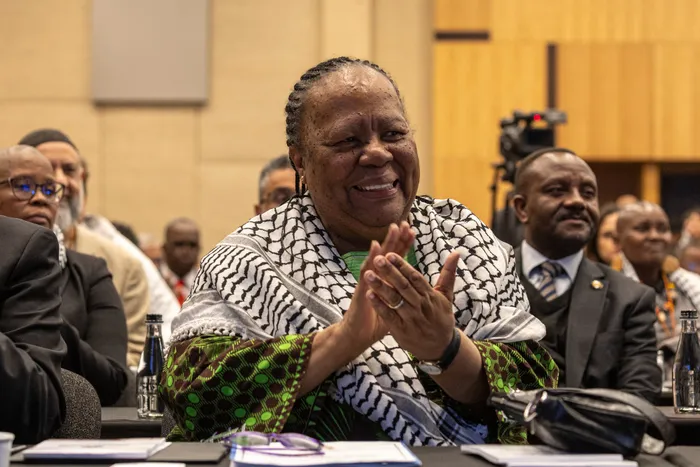
Former minister of International Relations and Cooperation, Dr Naledi Pandor.
Image: AFP/File
Former Minister of International Relations and Cooperation, Dr Naledi Pandor, has warned that 2026 could be a far more turbulent year for South Africa and the global economy, urging the corporate sector to step up as geopolitical risks intensify.
Wearing her hat as chair of the Nelson Mandela Foundation during the Top Employers 2026 gala dinner on Thursday night in Sandton, Pandor spoke about the economic sectors identified by President Cyril Ramaphosa, saying they “have significant value and the potential to increase GDP growth, in entrepreneurship and in employment.”
In his recent State of the Nation Address, Ramaphosa referred to several areas that hold significant broad-based opportunity for the country, including infrastructure, agriculture, mining, the development of technology and artificial intelligence, green energy resource access, tourism growth and a vibrant public sector.
However, Pandor cautioned that these opportunities are unfolding in “an increasingly complex and crisis-ridden geopolitical environment.”
“If we thought last year was bad,” she said, “I think 2026 is going to be even more scary.”
Pandor acknowledged that South Africa has built meaningful trade relationships over three decades of democracy, pointing to partners across China, the Middle East, Europe, Latin America and North America.
“In the 30 years of democracy, we’ve made positive trade gains with all of these regional partners,” she noted.
But she expressed concern about tensions with the United States, warning that “recent political developments in the United States of America pose a worrying disruption to our progress.”
Ongoing trade impasses, she suggested, threaten to destabilise established economic ties at a time when certainty is urgently needed.
While diplomacy remains the government's responsibility, Pandor argued that business leaders cannot remain passive observers.
“The corporate sector has great potential to use established business networks to encourage the presence of reason and logic in our trade relations,” she said.
She also criticised what she described as silence from influential sectors in the face of misinformation about South Africa.
“We’ve been almost subdued in voicing that it is a lie that there’s a white genocide in our country. Why are you silent about this lie? We need to speak up loudly that it is not true,” she said.
Beyond bilateral trade tensions, Pandor highlighted the opportunity presented by the African Continental Free Trade Area, saying expanded intra-African trade could “grow prosperity in Africa and boost overall African growth.”
Achieving this, she argued, would require “a very different interface between government and the corporate sector, an interface directed at business growth and broad-based people prosperity.”
In a world marked by conflict and declining multilateralism, Pandor called for a renewed focus on development.
Referencing the United Nations Sustainable Development Goals and Africa’s Agenda 2063, she urged businesses to integrate development priorities into their strategies.
“The world we live in today appears to have forgotten or abandoned people,” she said. “We in South Africa, the legacy of Mandela, we can play a role in restoring humanity to our prosperity goals.”