
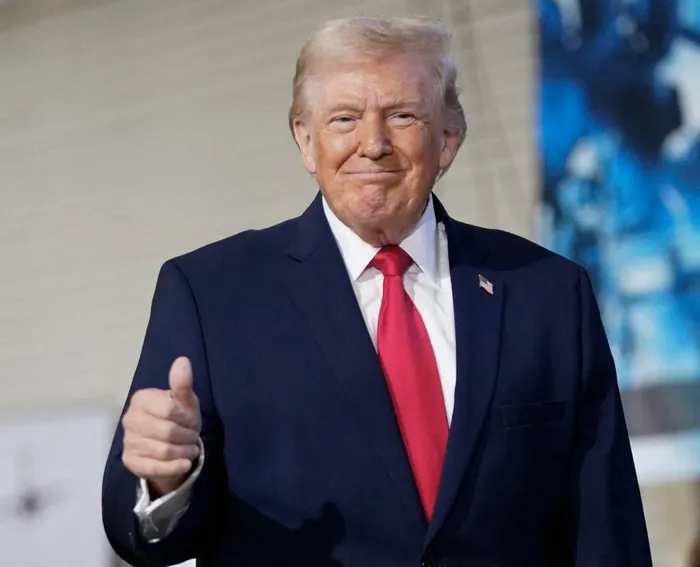
In a major development, the US Supreme Court has put a roadblock to US President Donald Trump’s global tariffs with the court ruling on Friday that the tariffs imposed by President Trump are illegal.
Image: AFP
Economists across the globe responded swiftly and sharply to the Supreme Court of the United States decision striking down US President Donald Trump’s sweeping tariff regime, describing it as a pivotal moment for constitutional governance and international trade stability.
In a major development, the US Supreme Court has put a roadblock to US President Donald Trump’s global tariffs with the court ruling on Friday that the tariffs imposed by Trump are illegal. Trump had imposed a 30% tariff on South Africa.
The US Court ruling said in its ruling that the government thus concedes, as it must, that the President enjoys no inherent authority to impose tariffs during peacetime. Tr. of Oral Arg. 70–71. And it does not defend the challenged tariffs as an exercise of the President’s warmaking powers.
The Court ruling added that the United States, after all, is not at war with every nation in the world. “The Government instead relies exclusively on IEEPA. It reads the words “regulate” and “importation” to effect a sweeping delegation of Congress’s power to set tariff policy—authorising the President to impose tariffs of unlimited amount and duration, on any product from any country.
Professor Andre Thomashausen, professor emeritus of international law at Unisa, said that the US Supreme Court judgement ruling the generic (not industry-specific), punitive imposition of tariffs by President Trump unconstitutional and null and void is a fundamental victory of the rule of law not just in the US but globally as well.
“It means that most tariffs collected could be claimed back, which may bring significant relief to South African exporters to the US market. We will see a normalisation of trade and the return of fair competition to global markets,” Thomashausen said.
Nigel Green, the founder and CEO of deVere Group, said that this ruling strikes at the core of the administration’s economic doctrine.
“Trade confrontation was positioned as the engine of renewed domestic strength. Instead, it now faces constitutional limits, market scrutiny, and diminishing economic returns,” he said.
Green added that tariffs were sold as a lever to rebalance trade and protect US industry. In practice, they have functioned as a tax on importers, many of whom passed costs directly to consumers.
Professor Waldo Krugell, an economist at North West University, said that it is an interesting development, which one would have to wait and see how it plays out.
“We will have to see President Trump tries to oppose it (the court ruling) in anyway as he is a creative politician. If they (tariffs) are struck down, at least that would return some normalcy to trade. But it's difficult to tell if it'll just go back to where it used to be. I think exporters across the world have tried to pivot. But it's a long time coming. And I think the political scientists would add to it to say that this is happening at the same time as his buildup of force right across the Hormuz Strait from Iran,” Krugell said.
Krugell added that if Trump now has this domestic setback, what would that mean for international trade?
“Trump never stops surprising us and shaking up the news cycle. In very simple terms, if we don't have to pay those tariffs anymore, our exports are much more competitive. But there are leads and lags in this sort of thing. It'll probably take some time before we can again land cars, for example, there at the more competitive price,” he said.
National Black Farmers Association President John Boyd, Jr. said that the Supreme Court’s 6-3 ruling striking down Trump administration tariffs is a life-saving victory for American agriculture and Black farmers.
“Today is a monumental day for the American farmer, and a long-overdue victory for the National Black Farmers Association. The Supreme Court has finally recognised what we have been screaming from the fields for over a year: these tariffs were an unconstitutional, man-made disaster that were destroying the livelihood of American farmers. The Supreme Court upheld the Constitution, ruling that the President cannot bypass Congress to destroy the livelihoods of the people who feed this country,” he said.
Chris Harmse, the consulting economist of Sequoia Capital Management and a senior lecturer at Stadio Higher Education, said the court ruling is good news for the South African economy.
"The two main industries in South Africa that will benefit is the motoring industry and the agricultural industry. The court ruling can save at least 50 000 jobs in the agriculture industry. The other good news is that it will be good for South African exports and trade to the United Sates," he said.
Harmse added that it has also been positive for South African markets. "The Rand has appreciated and the Gold price has also increased by over $50. It remains to be seen if the tarriffs will be declared illegal for all countries and if Trump will abolish the current tarriffs and then revise it buts the geopolitcial negativity surrounding it is good news for South Africa."
North West University's Business School economist, Professor Raymond Parsons, said the decision by the US Supreme Court that President’s Trump’s reciprocal tariffs are illegal is a welcome development for many countries, including South Africa, who have had to grapple with an aggressive US tariff policy in recent times.
"For South Africa it for now puts a legal question mark over the 30% import tariff that was recently imposed by President Trump on South Africa’s access to the US market. To that extent, the Supreme Court decision comes as good news to countries like South Africa, who want to normalise their economic relations with the US.
"However, it is essential to remain realistic. In the aftermath of the Supreme Court decision there remain a number of tariff uncertainties for countries like South Africa. The net tariff impact of the latest American judicial decision is not yet evident," added Parsons.
BUSINESS REPORT