

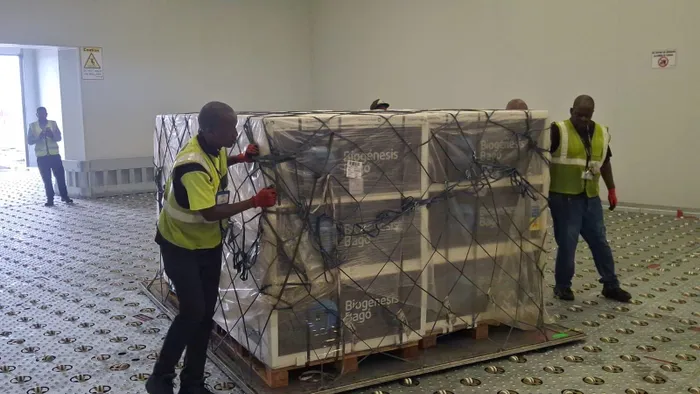
Minister of Agriculture John Steenhuisen provided an update on Foot and Mouth Disease vaccine distribution after receiving the first batch of one million high-potency vaccine doses from Biogénesis Bagó in Argentina at OR Tambo International on Saturday.
Image: Timothy Bernard / Independent Newspapers
Minister of Agriculture John Steenhuisen provided an update on Foot and Mouth Disease vaccine distribution after receiving the first batch of one million high-potency vaccine doses from Biogénesis Bagó in Argentina at OR Tambo International on Saturday.
The Department stated that vaccines, which strengthen South Africa’s expanding vaccination effort, are already being distributed in affected areas. “This shipment from Biogénesis Bagó in Argentina forms part of a sustained supply pipeline, with further consignments scheduled to arrive over the coming weeks, including vaccine sourced from BVI in Botswana and Dollvet in Turkey.”
The Department added that by the end of March, a total of over five million vaccines will have entered the country from the three international suppliers.
“Locally, the Agriculture Research Council (ARC) has committed to producing 20,000 vaccines per week and scaling up to 200,000 per week in 2027. The additional doses will allow authorities to scale up from targeted outbreak response to broader suppression of viral circulation in high-risk regions,” it said.
Minister Steenhuisen said that vaccination has already begun in affected areas, but supply has limited the speed and coverage.
“With this arrival, we can now accelerate protection across priority provinces and stabilise the livestock sector," he said.
The Department confirmed that outbreaks have now been reported across all provinces, with quarantine measures, movement restrictions, and surveillance continuing nationwide.
“A risk-based vaccination approach will prioritise outbreak epicentres in KwaZulu-Natal, parts of Gauteng, Free State, and North West, while high-risk and border regions will follow structured vaccination programmes. This strategy combines vaccination with strengthened diagnostics, traceability, and movement controls to progressively restore internationally recognised disease-free status,” it said.
The Department added that the million doses of vaccine will be distributed as follows: KwaZulu-Natal 200,000 doses; Mpumalanga 100,000 doses; North West 100,000 doses; Free State 200,000 doses; Eastern Cape 150,000 doses; Limpopo 100,000 doses; Gauteng 70,000 doses; Northern Cape 50,000 doses; and Western Cape 30,000 doses.
Steenhuisen said that vaccines alone will not defeat the disease.
“Quarantine rules, movement permits, and biosecurity measures exist to protect every farmer in the country. Those who deliberately move animals illegally, conceal infections, or ignore restrictions threaten the recovery of the entire sector. Where there is wilful non-compliance, we will work with law-enforcement authorities, and the full might of the law will be applied,” he said.
Steenhuisen noted that he will visit Mooi River in KwaZulu-Natal on 27 February to vaccinate dairy cattle alongside veterinarians and farmers, acknowledging the severe impact the outbreak has had on the dairy sector.
“The dairy industry has been among the hardest hit, with significant production losses, disrupted markets, and immense strain on farming families. That visit marks the practical beginning of recovery at farm level. Each vaccinated herd means stability returning to a business, wages returning to workers, and milk returning to shelves,” said Steenhuisen.
Steenhuisen concluded that they are moving step by step from crisis management to control. “Vaccines are arriving, the system is scaling up, and compliance will be enforced. Working together, we will stabilise the sector and rebuild confidence in South Africa’s animal health system.”
BUSINESS REPORT