

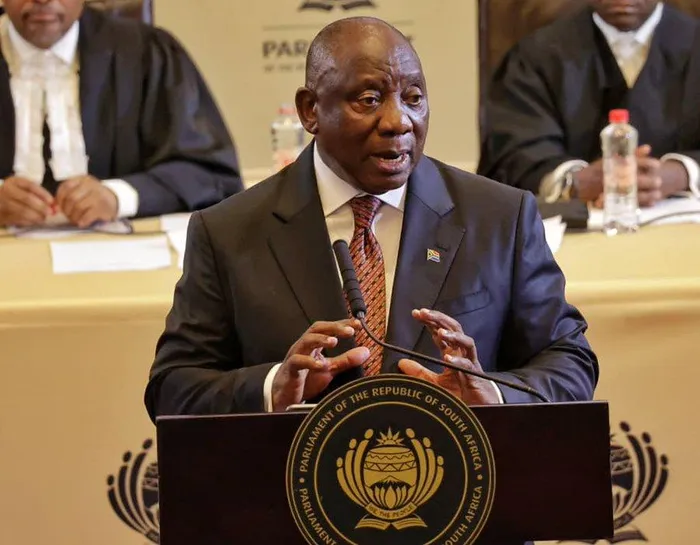
A new Bureau for Economic Research report by Natasha Marrian and Claire Bisseker indicated that South African President Cyril Ramaphosa's reform push is finally gaining momentum, enjoying a more stable macroeconomic backdrop than it has in years.
Image: GCIS
A new Bureau for Economic Research report by Natasha Marrian and Claire Bisseker indicated that South African President Cyril Ramaphosa's reform push is finally gaining momentum, enjoying a more stable macroeconomic backdrop than it has in years.
The report said that President Cyril Ramaphosa’s state of the nation address (Sona) suggests that as a leader he may be finally coming into his own.
“Certainly, it can be argued that it was eight years too late for him to finally show up for South Africa in the way he did last Thursday; that this was the address SA needed back in 2019. But what really matters is that he has now hit his stride,” it said.
The report added that his underlying theme was the deepening of institutional reform across the state – from reforming the criminal justice system to the country’s water boards. “He was honest about the absence of quick fixes for SA’s deep challenges and the multiple crises we face. But he was also refreshingly clear-eyed about what needs to be done - something he has not been since taking office.”
The report said that he has faced numerous catastrophes since then, including inheriting a state crippled by corruption; a debilitating energy crisis; the Covid-19 pandemic; the July 2021 riots; an onslaught from the white right.
“Abetted by irascible US president Donald Trump; the emergence of former president Jacob Zuma’s disruptive MK Party and having to steer the ANC through its first post-democratic electoral loss and then holding together a coalition government,” it said.
The report added that now his reform push is finally gaining momentum: the country’s macroeconomic credibility has strengthened thanks to sustained fiscal discipline, the shift to a lower inflation target, and the durability of the GNU.
“In fact, SA is currently enjoying a more stable macroeconomic backdrop than it has in years - something which might explain Ramaphosa’s new-found energy. But can his reform push last? Well, it depends on how much longer he will have the political capital, both within the ANC and across society, to continue driving it,” the report added.
The report said that it is critical for his administration to build on its current momentum, but Ramaphosa is in his final term as ANC president, with the party set to elect his successor next year. “Historically, as factions realign ahead of a second-term conference, the incumbent is largely sidelined, risks becoming a “lame duck”, or becomes reviled, resisted and sometimes, ultimately, removed.”
The report added that the ANC has another problem – who it selects to succeed Ramaphosa matters deeply. “In fact, it has become an existential question for the party and, perhaps, for the nation as a whole. Clearly, neither the ANC nor the country can afford another Zuma-esque leader who hops from one scandal to the next while the state buckles under the weight of neglect and corruption. At present, the front-runner is deputy president Paul Mashatile.”
The report concluded that the ANC is in limbo on the succession question, preoccupied by the looming local government election. “Given its dismal delivery record at municipal level, the green shoots of Ramaphosa’s reforms are all it is going to be armed with on the campaign trail.”
BUSINESS REPORT