

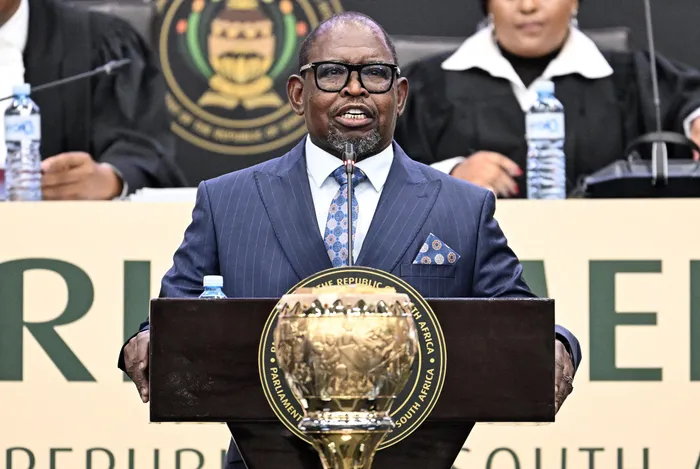
Agricultural associations have given mixed reactions following the Finance Minister Enoch Gondongwana’s tabling of the National Budget on Wednesday.
Image: Supplied
Agricultural associations have given mixed reactions following the Finance Minister Enoch Gondongwana’s tabling of the National Budget on Wednesday.
Francois Rossouw, the CEO of the Southern African Agri Initiative (SAAI), said that the Minister’s Budget carries a few welcome signals for agriculture, but it still avoids the one issue that is sitting on farmers’ balance sheets right now: animal disease control, especially foot and mouth disease.
“On the positive side, the budget treats logistics as an economic priority and admits that bottlenecks in rail and ports are choking growth. For agriculture, that matters more than for most sectors because export farming lives or dies by port performance, rail reliability and turnaround times. When logistics fail, farmers do not just lose profit. They lose market access, contracts and entire seasons,” he said.
National Budget 2026 Agricultural associations have given mixed reactions following the Finance Minister Enoch Gondongwana’s tabling of the National Budget on Wednesday.
Image: Supplied
Rossouw added that the infrastructure commitment is also substantial, with public sector infrastructure spending projected to exceed R1 trillion over the medium term.
“Water investment is specifically linked to bulk augmentation and refurbishment of ageing infrastructure, with a stated focus on supporting economic nodes, agriculture and household supply. If that is executed properly, it becomes the difference between irrigation certainty and production shrinkage, especially for family farms that cannot self-finance large water solutions,” he said.
Rossouw said that border and trade capacity is another area that could help agriculture if it is implemented properly.
“Work on public-private partnerships at key border posts and more capacity at the Border Management Authority can improve trade flow and, importantly, strengthen enforcement against illegal movement of animals and products that undermine biosecurity and formal markets. It is also a relief that the budget avoided a broad new tax shock. Inflation adjustments to brackets and rebates and the withdrawal of previously signalled tax increases give households and small businesses some breathing room. That supports food demand and helps stabilise rural economic activity,” he said.
Rossouw added that the problem is that the budget recognises foot and mouth disease as a risk to growth but does not match that recognition with a clear, funded, measurable recovery plan. “There is no direct, ring-fenced commitment to rebuild veterinary services, expand vaccine access and cold chain capacity, fund surveillance and laboratories, and strengthen movement control where it actually happens. That gap decides whether South Africa regains export credibility or remains trapped in rolling shutdowns and collapsing farmgate prices.”
Rossouw said that farming input costs remain under pressure and fuel is still a direct hit. Inflation-linked increases to fuel levies land on a sector that is diesel-heavy for planting, harvesting, irrigation pumping and getting product to market. “ Many family farmers are price takers and cannot simply pass those costs on. Saai will be watching and pushing for four practical outcomes in the months ahead. First, a properly funded animal health recovery plan with vaccines, labs, surveillance and enforcement, and a partnership model that uses private veterinarians and producer capacity where the state is thin.”
TLU SA said that a national budget is not merely a financial document; it is the clearest indicator of a government’s priorities, its understanding of the country’s reality, and its ability to unlock economic growth.
“In an economy struggling to achieve meaningful growth, with a projected 1.6% for 2026 and a medium-term outlook barely reaching 2%, the budget becomes a test of credibility. Against this backdrop, TLU SA assesses the 2026 budget tabled by Finance Minister Enoch Gondongwana on 25 February,” it said.
TLU SA added that according to the budget, total government expenditure will amount to R2.67 trillion in 2026/27, with more than R1 trillion earmarked for infrastructure over the medium term. “National debt is expected to stabilise at 78.9% of GDP, while the budget deficit is set to fall to 4.5%. These figures indicate fiscal stabilisation, but stability on paper does not necessarily translate into economic dynamism in practice.
TLU SA said that while the Minister emphasises fiscal discipline, debt stabilisation, and improved expenditure composition, the fundamental question remains whether the allocation and prioritisation of funds genuinely address the structural challenges in the South African economy. “A budget may be technically balanced, but if it does not lead to tangible improvements in growth, job creation, and investor confidence, its impact remains limited. The reality is that South Africa continues to face substantial unemployment, constrained growth, logistical bottlenecks, and a persistent security crisis.”
SA Canegrowers welcomes the decision to keep the Health Promotion Levy (HPL or sugar tax) unchanged in the 2026 Budget.
Higgins Mdluli, the chairman of SA Canegrowers, said the organisation welcomed the fact that no further increase has been introduced at this time. He said the levy continues to place significant strain on South Africa’s sugarcane growers, at a time when the industry requires coordinated efforts to save thousands of rural livelihoods supported by a sector in crisis.
Mdluli added that the South African sugar industry is currently facing a severe structural crisis driven by the potential liquidation of Tongaat Hulett and an unprecedented surge in imported sugar, caused by out-of-date tariff protections and unfair practices on the global sugar market.
“We call on all government, from the Treasury to the Department of Trade, Industry and Competition, to align in a moment when the industry is at a real risk of collapsing,” he said.
BUSINESS REPORT
https://businessreport.co.za/