

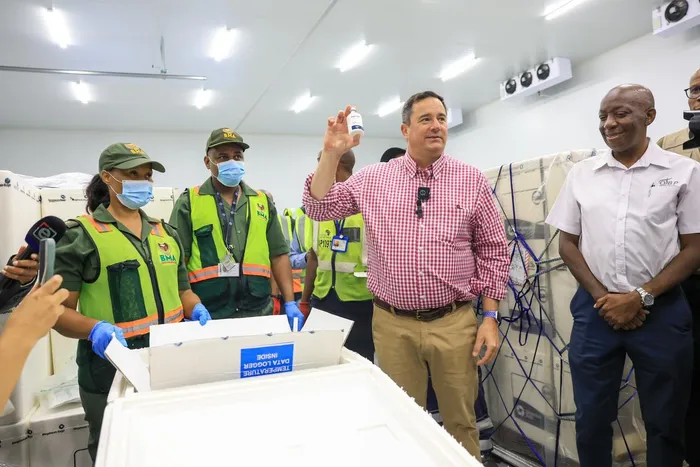
Minister of Agriculture John Steenhuisen said that a mass vaccination drive to vaccinate the entire national herd as part of the Government's comprehensive plan to eradicate Foot and Mouth Disease (FMD) has begun in earnest. Steenhuisen was visiting Colbourne Dairy Farm, near Mooi River in KwaZulu-Natal on Friday where FMD vaccination was taking place.
Image: File GCIS
Minister of Agriculture John Steenhuisen said that a mass vaccination drive to vaccinate the entire national herd as part of the Government's comprehensive plan to eradicate Foot and Mouth Disease (FMD) has begun in earnest. Steenhuisen was visiting Colbourne Dairy Farm, near Mooi River in KwaZulu-Natal on Friday where FMD vaccination was taking place.
The Department said that on Saturday, February 21, 2026, the first large consignment of FMD vaccines, one million doses from Biogénesis Bagó in Argentina, arrived in South Africa.
“The million doses of vaccines were distributed as follows: KwaZulu-Natal 200,000 doses; Mpumalanga 100,000 doses; North West 100,000 doses; Free State 200,000 doses; Eastern Cape 150,000 doses; Limpopo 100,000 doses; Gauteng 70,000 doses; Northern Cape 50,000 doses; and Western Cape 30,000 doses,” he said.
The Department added that the country has also secured Dollvet vaccine from Turkey, with the first consignment of 1.5 million doses arriving Saturday, 28 February 2026, in South Africa, with millions more to arrive from Argentina shortly after.
“Locally, the Agriculture Research Council (ARC) has committed to producing 20,000 vaccines per week and scaling this production up to 200,000 per week by 2027,” it said.
Steenhuisen said that he is pleased with the KwaZulu-Natal Department of Agriculture and Rural Development for its ‘zero-waste’ approach in starting vaccinations just 24 hours after receiving supplies.
“KwaZulu-Natal is identified as the FMD primary risk epicentre—housing over 1.6 million cattle herd in high-priority zones. We are committed to protecting the livelihoods of our farmers, from our communal lands to our commercial operations. This department has ensured that 45 teams will be deployed daily across 45 locations to vaccinate up to 90,000 animals per day to cover the 2.4 million cattle herd in the province,” he said.
Steenhuisen added that they are moving away from treating high-risk farms as guilty until proven innocent. “Only farms with confirmed or clinical signs of infection will be quarantined.”
“We will not stop until FMD is eradicated, and South Africa receives its ‘FMD free with vaccination’ status. This is our promise to our farmers: We are doing everything in our power to keep your milk moving and your herds safe,” said Steenhuisen.
Steenhuisen said that he also welcomes Cabinet’s approval of the national mass vaccination programme and National Treasury’s reallocation of approximately R400 million underspent agriculture funds toward the war on FMD.
The Department of Agriculture announced easing restrictions. It said, “To ease restrictions on affected farms as soon as possible, the Veterinary Working Group has also agreed on the following amended guidelines that can be implemented immediately, pending the formal amendment of the requirements for the control and management of FMD.
“The guidelines include Identification of infected and vaccinated animals: On farms/premises that are infected or suspected of being infected, all cloven-hoofed animals must be individually identified and recorded on a database that will ensure lifelong traceability; On farms/premises that are not infected or suspected of being infected, all vaccinated cloven-hoofed animals must be individually identified and recorded on a database that will ensure lifelong traceability; No F branding will be required for suspect/infected and/or vaccinated animals,” it said.
The Department announced further guidelines for controlled slaughter from FMD quarantined premises.
“For slaughter three months after day zero, controlled slaughter from quarantined premises can take place at any registered non-export abattoir. After three months post day zero, meat must be subject to maturation, however, there will be no further risk mitigation and no loss of parts of the carcass.No animals originating from properties under FMD restriction may be slaughtered for the export market unless expressly agreed to by the importing country,” it said.
Steenhuisen concluded that in the face of this unprecedented FMD outbreak, he wants to express his sincere gratitude to every farmer, farm worker, industry body and member of the broader community who has stood with us.
“The messages of support, the practical cooperation on movement controls and vaccination, and the willingness to work within difficult restrictions have reminded us that this is a national effort—one that the government cannot wage alone.It is this partnership between government, industry and community that will ultimately see us overcome FMD and restore confidence in our livestock sector,” he said.
BUSINESS REPORT