

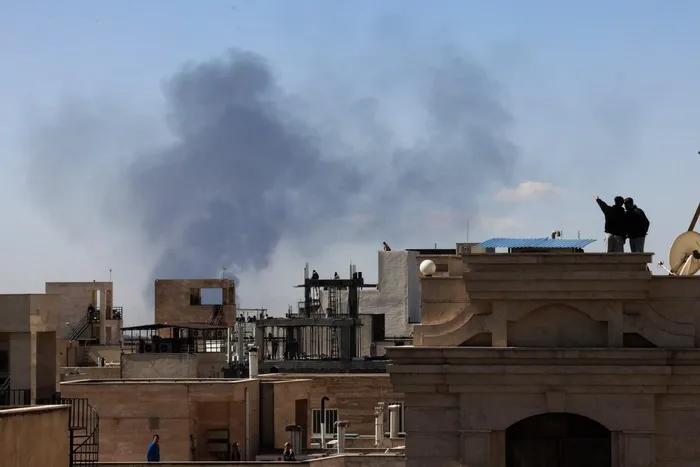
South Africa and other countries across the world cancelled international flights due to ongoing conflicts between Iran, the US, and Israel.
Image: ATTA KENARE / AFP
The escalating conflict involving the United States and Iran is already sending shockwaves through global markets, with economists warning of rising inflationary pressures and weaker growth prospects for countries like South Africa.
Frank Blackmore, Lead Economist at KPMG South Africa, said the impact of the war has two broad dimensions from an international perspective.
“The impact of the United States’ war in Iran has 2 basic arms to it and it seems from an international perspective, the first is the regime change aspects the replacement for overthrowing of the authoritative and the oppressive regime that has ruled for several decades now in Iran is generally seen as a good thing globally according to comments made by various leaders around the world,” Blackmore said.
However, he cautioned that the economic consequences stem from the uncertainty surrounding the conflict.
“The problem that comes in with the war is both an international legal issue as well as just the increase in global uncertainty and that is where I am going to comment on here. There is a lot of uncertainty regarding the future path of the war and what that may potentially and what consequences that may have,” he said.
Markets have already begun reacting. Blackmore pointed to immediate financial shifts that could have far reaching implications.
“The immediate consequence is that we have seen already an increase in the price of oil and gold as well as the depreciation of the Rand and the appreciation of the dollar,” he said.
“Given the significance of the geographical region in the Strait of Hormuz, we can expect an increase in transport costs for obvious reasons, because of this region being a major transport route for global exchange. All that would mean increases in inflation specifically through oil and the Rand leading to petrol prices increases,” Blackmore explained.
He noted that higher fuel costs ripple through the broader economy.
“We know you cannot move either people or goods throughout the economy without spending on that which means that this will be a broad based increase in prices and that could lead to interest rates remaining on hold for some time as well as obviously becoming a barrier to or oppressive factor on global growth prospects and South African growth prospects as well. Higher interest rates mean more expensive money and it means less borrowing out there,” he said.
Blackmore stressed that much will depend on how long the conflict lasts and how widely it spreads.
“Ultimately however the impact will depend on a number of factors which are yet to be clearer and may only do so over an extended period of months if not years if we compare to what has happened in the case of Russia’s invasion of the Ukraine. We are four years in that war now and the outcomes are still not 100% clear,” he said.
“The same would be true here. So the duration of the conflict the longer the conflict continues the more adverse the global impacts would be the size in terms of the involvement of the number of nations states or the regional impact of this war the larger that and the more states involved the more complex the problem would be.”
He added that the eventual political outcome in Iran will also determine the scale of economic damage.
“What government eventually takes power would have a lot of impact on the ultimate global impact of this war and the level of destruction. We know the region has a lot of oil and gas industry assets and the more that these and general infrastructure becomes destroyed the longer it will take to get production and the economy working again after the attack and etcetera. Therefore the greater the negative impact will be on both the global and local economy.”
Blackmore summarised the near term outlook cautiously.
“So to summarise we can expect an inflationary impact of this especially if it continues for some time and that will impact growth prospects both in South Africa as well as the rest of the world. It is too early to be able to say too much more. We will have to wait and see the progress of both the war as well as the international interventions to hold that war,” he said.
Echoing these concerns, North West University Business School economist Professor Raymond Parsons warned that South Africa should brace for potential economic fallout.
“South Africa must not underestimate the potential negative economic and business implications that could yet unfold for many economies resulting from the US Israel attack on Iran. Although it is still early days in the conflict it is already evident that travel and tourism in the Middle East has been disrupted with air flights having been cancelled on a large scale. The latest geopolitical developments have raised key questions about the future stability of the Middle East political economy,” Parsons said.
He highlighted oil price volatility as the most immediate risk.
“The biggest immediate impact for countries like South Africa will inevitably be the elevated uncertainty about global oil prices and hence the prospect of higher fuel costs in the months ahead. Oil prices are widely expected to spike in the short term and stay high for a period depending on the outcome of the war and in the absence of any new supply measures to offset higher oil prices,” he said.
Although the Organisation of Petroleum Exporters has signalled increased output, Parsons said a major unknown remains.
“Although the Organisation of Petroleum Exporters has undertaken to increase output soon the bigger unknown factor is whether the navigation and transport of Iranian oil through the Hormuz strait will be disrupted by prevailing war conditions. There are conflicting reports about the latest status of the straits. The global oil price outlook therefore basically remains very uncertain in the highly volatile geopolitical circumstances now existing in the Middle East,” he said.
Follow Business Report on Facebook, X and on LinkedIn for the latest Business and tech news.