

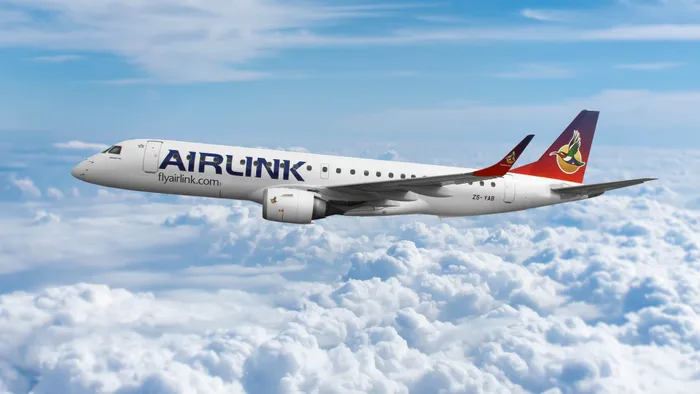
The South African Competition Tribunal is hearing closing arguments after the Competition Commission investigated Airlink for excessive and predatory pricing on the key route.
Image: Supplied
The Competition Commission on Monday said volatility and profitability fluctuations did not constitute a cycle warranting excessive pricing on the part of Airlink, which is facing allegations of predatory pricing on the Johannesburg-Mthatha route.
The South African Competition Tribunal is hearing closing arguments after the Competition Commission investigated Airlink for excessive and predatory pricing on the key route. The tribunal has previously heard oral evidence from factual witnesses as well as financial and economic experts in the matter.
On Monday, the Competition Commission argued that in internal documents Airlink had only referred “difficult trading conditions,” and not any identifiable business cycle of difficulty.
“It is a very odd thing,” said Advocate Jerome Wilson, counsel for the Competition Commission, “that if there were such a cycle, there is not a single document in the record substantiating it.”
The Competition Commission is prosecuting Airlink after receiving and investigating three complaints against the airline in relation to its pricing conduct on the Johannesburg-Mthatha-Johannesburg route. Airlink is accused of abusing its dominance by charging excessive prices for the provision of scheduled air passenger transport services on the route, for the period September 2012 to August 2016.
The Competition Commission also accuses Airlink of engaging in predatory pricing by pegging its fares below its average variable costs and/or average avoidable costs in respect of certain flights during August to December 2016, in response to the entry of a new competitor on the route, Fly Blue Crane. This, argues the competition commission, contributed to the exit of Fly Blue Crane from the market in question.
Airlink had also argued that fluctuations in profitability justified extending the analysis period for the charges. It argued that its pricing mechanisms were also influenced by dynamics such as volatility and low business cycles among others.
“Volatility is not a defense,” he said. “Excessive pricing is not assessed by averaging performance over decades.”
At the center of the issue is whether the benchmark for determining excessive pricing should be based strictly on a dominant firm’s own economic costs — or whether it may incorporate the hypothetical costs faced by a potential new entrants.
The Competition Commission argued, however, that current regulations require that an assessment of this be grounded in the incumbent firm’s actual costs, adjusted only where necessary to reflect true economic value under fairly competitive conditions.
Airlink had advanced a “potential entrant model” under which the price ceiling would reflect the higher cost base a new airline might incur when entering the market, including route development costs and other startup expenditures.
But the Competition Commission rejected this, saying: “The idea is not to model the costs of a firm that has not yet entered the market. It is to model the costs of the incumbent firm, adjusted for efficiency — not for entry barriers.”
The Commission identified a four-year complaint period, from FY2013 to FY2016, during which it alleges Airlink charged prices significantly above economic cost. Using that period, markups exceeded 33 percent, it charges. Nonetheless, expanding the analysis to 10 years, reduces the markup to roughly 15.7 percent.
Airlink argues that the longer horizon better reflects industry realities, including volatility and competitive fluctuations — particularly intense price competition in 2017 following market entry by Fly Blue Crane.
Counsel for the Commission countered that allowing firms to dilute a period of excessive pricing by averaging in later competitive “valleys” would effectively nullify enforcement.
“If you can always look on either side of a peak and average it out,” he said, “you could wish away excessive pricing entirely.”
Another issue disputed by the Competition Commission centered on Airlink’s argument that losses on a particular route reflect investments in building customer goodwill — an intangible asset that, it says, justifies certain pricing decisions.
Opposing this, counsel for the Competition Commission said the claim was “wholly underspecified,” arguing that the concept of goodwill being advanced “floats respectfully in the ether” and lacks any measurable foundation.
BUSINESS REPORT