

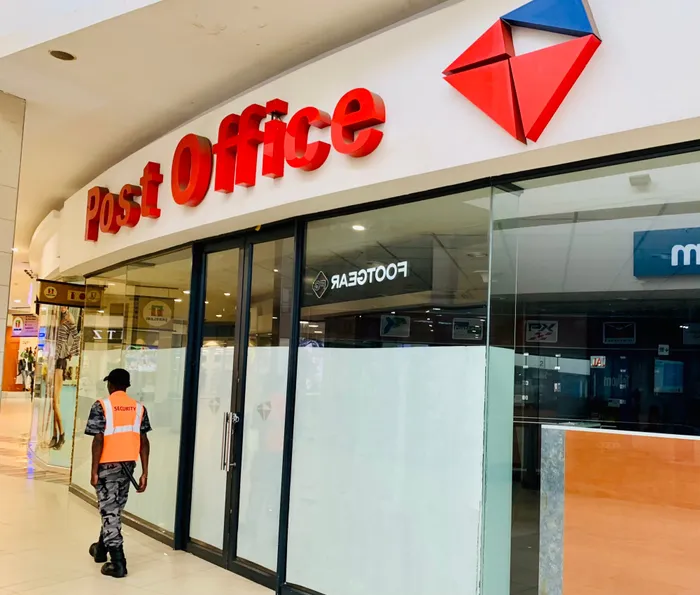
Business Rescue Practitioners (BRPs) of the South African Post Office (SAPO) are engaging with the government to terminate the process.
Image: Independent Newspapers Archives
Business Rescue Practitioners (BRPs) of the South African Post Office (SAPO) are engaging with the government to terminate the process because there are no reasonable prospects of implementing the rescue plan. This follows the lack of intervention in the 2026/27 budget allocations for the R3.8 billion funding commitment.
In an update responding to enquiries, Anoosh Rooplal confirmed that the law requires the BRPs to terminate SAPO's business rescue if there is no reasonable prospect of rescuing SAPO as envisaged in the plan.
“It is in this spirit that the BRPs continue to engage with the DCDT (Department of Communications and Digital Technologies) regarding SAPO funding,” he said, while pointing out that a notice had not yet been issued under the Companies Act.
The BRPs said the plan for SAPO was developed and published for approval after extensive consultations with all stakeholders, including the DCDT. The DCDT therefore supported and was aware of all components of the plan, including the allocation of R2.4 billion and R3.8bn in government funding and the purpose of that funding.
Rooplal said the adoption of the plan by creditors was premised on those funding assumptions. Without the second tranche of funding, the BRPs have been unable to fully implement the plan and achieve substantial implementation. Furthermore, a detailed and implementable turnaround plan has been shared with relevant oversight forums in appropriate settings.
“It is important to clarify that the R3.8 billion figure originates from funding commitments referenced in the then minister’s application for business rescue, as understood by the DCDT. SAPO's funding was discussed before the BRPs were appointed and dates back to when SAPO was in provisional liquidation, a process in which the BRPs played no part,” Rooplal said.
He told Business Report that the R3.8bn was allocated to complete various final aspects of the plan, including infrastructure upgrades, business digitisation, and payment of the conditional top-up dividend to statutory and payroll creditors. It was included in all presentations made by the BRPs to the DCDT and National Treasury after the adoption of the plan in December 2023.
“The failure to pay the second funding tranche, as anticipated in the plan, has made it impossible for the BRPs to fully implement the plan and file a notice of substantial implementation, which would effectively terminate the business rescue proceedings,” he said.
Rooplal said that over the last two years, members of the business rescue team and SAPO officials have provided ongoing detailed reports and feedback to various parliamentary committees. They also attended regular Monitoring Task Team meetings since the start of the business rescue process, which included representatives from the DCDT and National Treasury.
He said there were various opportunities for any of the parties to provide their firm opinions regarding the commitment and the binding or non-binding nature of the funding mentioned in: a) the minister’s court application, b) the process during which the business rescue plan was being formulated, c) when the business rescue plan was adopted, and d) when the plan was being implemented.
“This may have altered the very nature of the plan and even prevented its adoption by creditors at the outset. Due to the entity being a public interest entity and the widespread media coverage, it is reasonable to assume that all key stakeholders were aware of the undertakings made by the Cabinet and the government.
“A turnaround plan has been presented to relevant oversight committees in appropriate settings.
“A credible and implementable turnaround plan exists as a separate document from the plan. It was developed by the BRPs and the SAPO Executive Committee, with the support of external professionals experienced in delivering social mandates. This turnaround plan was not part of the BRPs’ remit, as they are not compelled by the Companies Act to present a strategy,” Rooplal said.
He said it was developed to support the entity’s planned turnaround, enabling it to fulfil its social mandate as envisioned by the National Planning Commission established in 2010 and supported by the recent South African Post Office SOC Ltd Amendment Act, 2024.
“Any turnaround strategy adopted for SAPO will require funding for implementation,” he said.
BUSINESS REPORT