

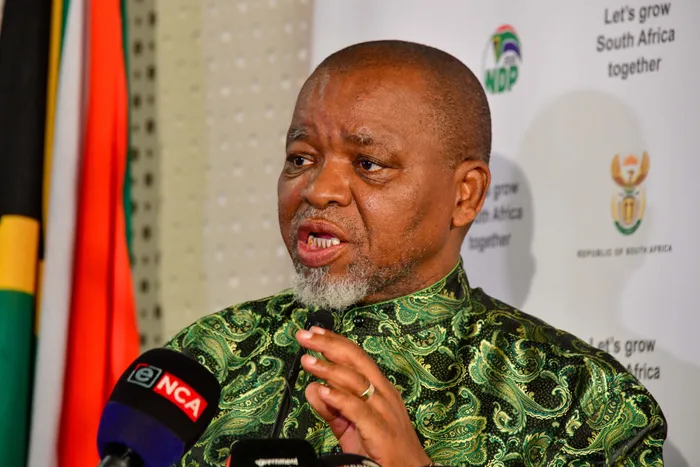
Minister of Mineral and Petroleum Resources, Gwede Mantashe.
Image: GCIS
Minister of Mineral and Petroleum Resources, Gwede Mantashe, said the government is urgently implementing a two-pronged strategy—immediate imports and accelerated domestic development, including fracking for shale gas—to improve gas supply security and avert the looming gas cliff.
Speaking at the Africa Gas Forum on Thursday, Mantashe said South Africa stands at a critical energy juncture. For decades, the country relied on piped gas from Mozambique’s Pande and Temane fields, which account for about 90% of domestic demand. This supply is now threatened because the fields are in decline.
Mantashe said the era of policy uncertainty is drawing to a close, assuring investors and partners that the regulatory framework is stabilising, infrastructure roll-out is underway, and demand fundamentals are policy-anchored.
He said that despite resistance from environmental lobby groups, offshore exploration activity remains resilient, led by specialised independent operators.
"The next frontier lies in strengthening midstream connectivity and downstream market certainty to convert gas molecules into industrial output, employment, and economic resilience. This is not merely an industry concern; it is a national economic risk. We cannot allow what happened in the electricity sector to be replicated in the gas sector," he said.
He mentioned Sasol’s proposed Methane-Rich Gas (MRG) bridging solution for the 2028 to 2030 period, which provides critical breathing space while the LNG import infrastructure is finalised.
He said that although strategic LNG hubs are progressing toward implementation, the sustainable long-term solution is domestic production.
Mantashe said the West Coast, particularly the Orange Basin, has emerged as a world-class frontier following significant discoveries in Namibia.
He said operators, including TotalEnergies and Shell, are advancing exploration programmes that could substantially expand the resource base and enhance long-term gross domestic product prospects.
In the Outeniqua Basin, Africa Energy Corp is accelerating development of the Brulpadda and Luiperd discoveries.
Onshore, the Virginia Gas Project in the Free State has reported a 60% increase in gas throughput since 2025 and maintains an 80% drilling success rate.
The Thungela Resources Lephalale coalbed methane project and Kinetiko’s gas project in Mpumalanga are progressing toward production following successful drilling campaigns. Thungela has submitted its application for a production right, while Kinetiko is also preparing to submit its production right application.
"On shale gas, we concluded a seismic survey in the Central Karoo last month, thus improving our geological understanding of the basin. Once the requisite regulations are promulgated, we stand ready to lift the moratorium to unlock the full potential of our basins," Mantashe said.
He said legislative reforms are planned to support the developments.
"The Upstream Petroleum Resources Development Act (UPRDA) strategically separates petroleum from mining legislation. By consolidating exploration and production into a single petroleum right, administrative transition periods are significantly shortened. The Act further provides for a 20% carried interest for the state, ensuring direct national participation in the returns from our natural endowment," Mantashe said.
He added that the South African National Petroleum Company (SANPC) Bill seeks to establish a unified state-owned champion to manage the government’s strategic interests across the petroleum value chain.
On a broader note, Mantashe said this year’s Africa Gas Forum presents a vital platform for African nations to examine gas potential and determine how it can catalyse industrial growth and economic transformation across the continent.
As the global energy landscape evolves, the discourse continues to pit energy sources against one another, creating a false dichotomy between fossil fuel development and climate action.
"We are told to choose between ecology and economy. Yet these two are not adversaries. They are mutually reinforcing. The fundamental truth is that Africa faces extreme energy poverty. Nearly 600 million Africans remain without access to electricity. This is not merely a social crisis; it is an industrial crisis. Without reliable energy, there can be no manufacturing base, no beneficiation, and no meaningful job creation," Mantashe said.
BUSINESS REPORT